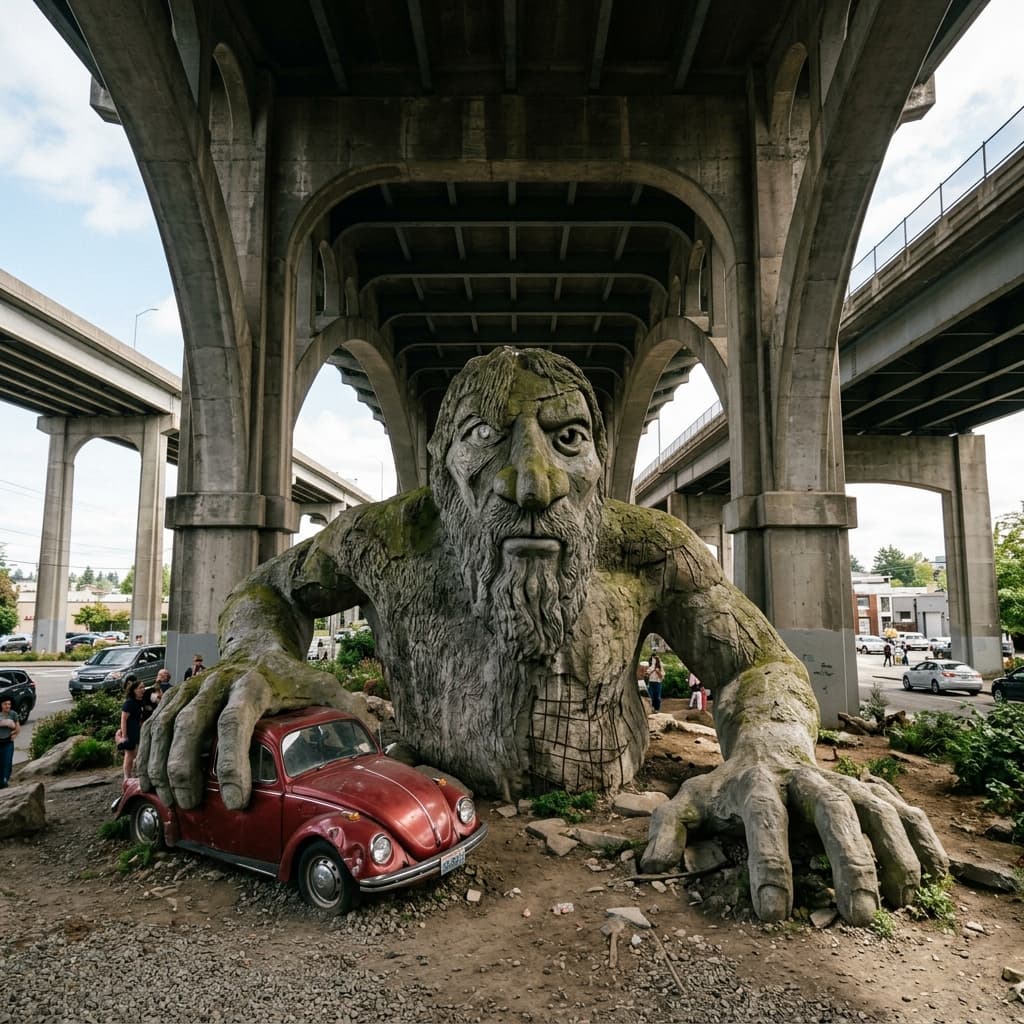
Imagine this: you’re walking down a street in a big city, you head beneath a huge bridge—and suddenly you see a giant. He’s sitting with his back against the wall, one hand gripping a real old car, while one eye stares straight at you. Don’t be afraid—he isn’t real! This is the Fremont Troll in Seattle, one of the most beloved sculptures in the world. But the most interesting thing about it isn’t its size—it’s how it came to be and what has changed since then.
The Place Everyone Tried to Avoid
To begin with, Seattle’s Fremont neighborhood has always been a little unusual: artists, musicians, and inventors live here. But the space beneath the Aurora Bridge was far from cheerful for a long time. It was dark, littered with trash, and people tried to hurry past it.
Imagine your own neighborhood: suppose there’s an empty corner where nobody plays because it’s dirty and unwelcoming. What would you do? Perhaps you would call your friends and think of a way to bring it to life. That is exactly what the people of Fremont did.
The Competition That Brought Neighbors Together
In 1990, a local group—the Fremont Arts Council—announced a competition: participants had to come up with a way to transform this forgotten place into something positive. The council was made up not of mayors and ministers, but ordinary people who cared about what their neighborhood looked like.
The winning project came from a team of four sculptors: Steve Badanes, Donna Walter, Will Martin, and Ross Whitehead. They came up with a giant troll. This was no coincidence: in Scandinavian fairy tales, trolls live under bridges! So the troll is not merely a beautiful figure, but a real fairy-tale resident who has “returned home.”
It was made from rebar—iron rods—wire, and concrete. It stands about 5.5 meters tall, or roughly as high as a two-story building. The artists worked on it together with local volunteers: neighbors came to help, passed around tools, painted, and shared ideas. Everyone felt that the troll was “a little bit theirs.”
The troll also grips a real old Volkswagen Beetle in its left hand. Legend has it that a time capsule was hidden inside the car so that future residents could learn about the people who created the sculpture.
How the Troll Changed the Neighborhood—and More
Today, the Fremont Troll is one of Seattle’s main attractions. Tourists take photographs sitting in its hand, children climb onto its shoulders—which is allowed!—and local residents come here for celebrations. Fun events are held nearby every year, and the troll has appeared in films and made appearances in various games and cartoons. People recognize it all over the world.
But the most important thing is the idea behind it. As early as 1990, local residents showed that you do not have to wait for someone in charge to solve everything. All it takes is coming together and imagining something bold.
We can see this happening everywhere today. In many cities around the world, residents paint huge murals on blank walls, create small parks on vacant lots, and install sculptures in abandoned spaces. This is called community art—art created not for people, but together with them. The Fremont Troll is one of the best-known examples of this approach.
What It Means for Us
It seems to me that the troll’s greatest secret is that it is not merely beautiful. It reminds us that any place can become beloved when caring people come together. The troll under the bridge is like a giant “thank you” that the neighbors gave to one another.
Now think about this: Is there a “forgotten corner” in your city, town, or even your own yard? What sculpture, painting, or game would you invent to make it everyone’s favorite place? Maybe your idea will be the next “troll.”
Conclusion
The story of the Fremont Troll shows that art can heal cities just as much as a kind word can lift someone’s spirits. A gloomy corner beneath a bridge became a place loved by millions of people. And it all began with a simple thought: “Let’s do this together.” Sometimes the greatest wonders are born exactly this way.