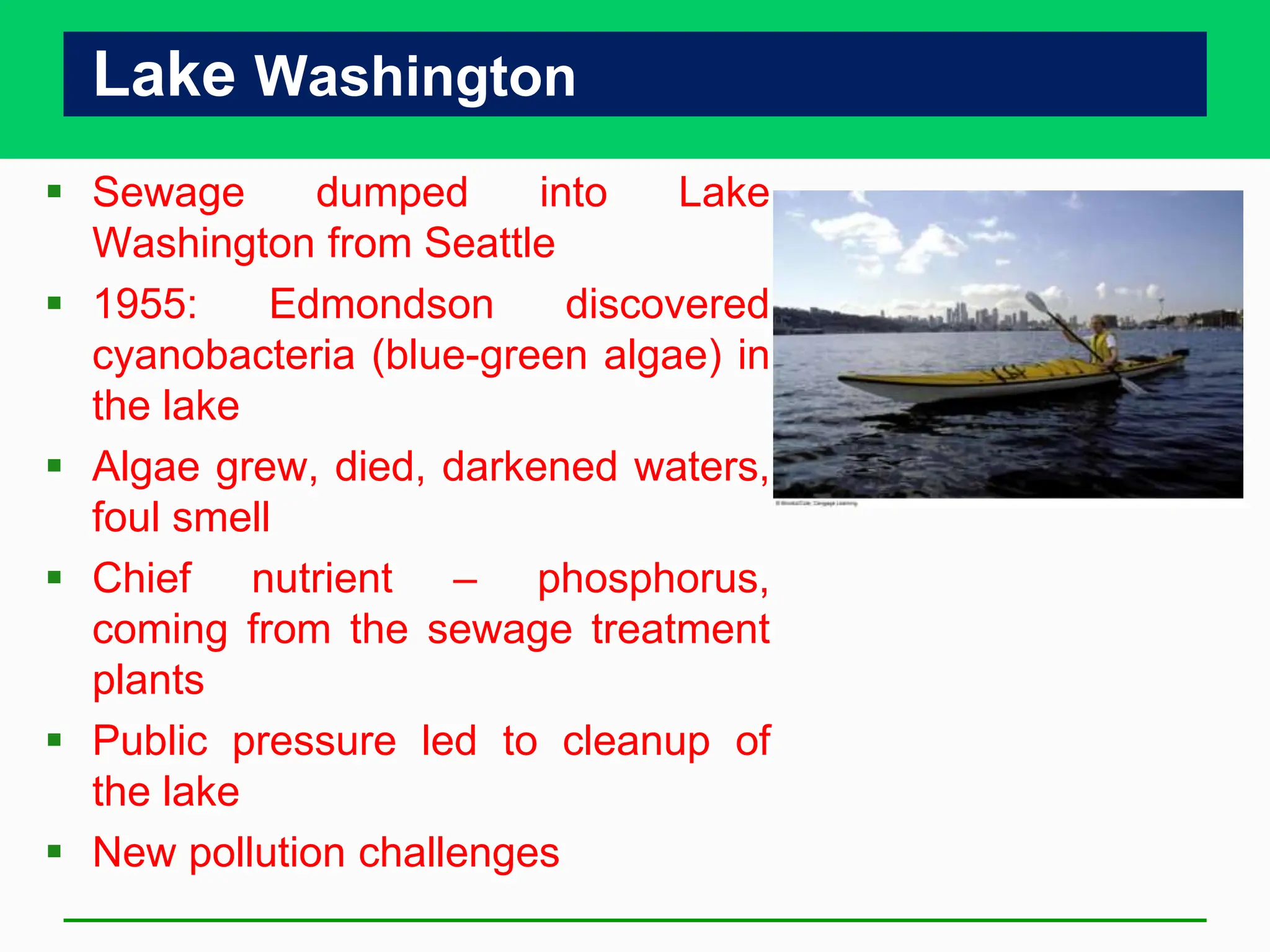
Imagine a large lake beside a city. In summer, people swim in it and boats travel across it. Then suddenly the water becomes cloudy, greenish, and foul-smelling. That is what happened in Seattle about seventy years ago. Lake Washington had “fallen ill,” and it was helped back to health by people who decided to listen to a scientist—and by tiny creatures that are almost invisible to the naked eye. This story is also connected to salmon and to concerns we still face today.
The Lake That “Fell Ill”
Lake Washington is enormous: it stretches along the whole of Seattle, and its water was once so clear that people could see the pebbles on the bottom. But the city grew, and more and more homes were built. In the mid-20th century, wastewater from several treatment plants flowed directly into the lake. The treatment was inadequate, and large amounts of phosphorus entered the lake with the water.
For algae, phosphorus is like a sweet pastry to a schoolchild: they love it and grow quickly. As a result, the lake filled with dense blue-green and brownish algae called Oscillatoria rubescens. It was even nicknamed “burgundy blood” because of its reddish tint. The water became cloudy, and in the 1960s swimming had to be banned at some beaches.
The Scientist Who Counted Water Fleas
The central figure in this story was biologist William Edmondson of the University of Washington. He was not a magician, nor did he invent a medicine. He simply observed and measured carefully: what was in the water, how its color changed, and what lived in it.
Edmondson’s favorite “heroes” were Daphnia, or water fleas. These tiny crustaceans, about the size of a dot on a screen, feed on algae and, in turn, serve as food for young fish. When the lake turned “green,” the Daphnia almost disappeared: it became difficult for them to live in such water.
Edmondson’s main idea was simple, although many people did not believe it at the time. The lake was not being damaged by mysterious forces, but by specific substances from wastewater. If the cause was removed, the lake could recover.
The City That Voted for Clean Water
Now comes the most interesting part. It was not enough for the scientist to understand the cause; he also had to convince people. Treating wastewater costs money, and all residents would have to help pay for it.
In 1958, voters in Seattle and the surrounding area agreed to create the Metro service, which would deal with wastewater. It was not an easy decision, because similar proposals had failed before. By 1968, all wastewater was being diverted to Puget Sound, a body of water with a far greater volume, and the lake was no longer being “fed” excess phosphorus.
The result was impressive. The algae began to disappear, the water grew clearer year by year, and the Daphnia returned. Edmondson described the changes in scientific papers, and Lake Washington became one of the world’s best-known examples of how people can correct their own mistake.
Where Does Salmon Fit In?
Sockeye salmon live in the ocean but return to the rivers where they were born. In Seattle, the Cedar River flows into Lake Washington. Young sockeye leave the river for the lake and spend about a year there, growing, feeding, and hiding from predators. The lake is something like a nursery for them, and it needs clean water and food—including, for example, those same Daphnia.
When the lake was sick, young fish faced cloudy water and a shortage of food. Once it recovered, the young salmon had a better chance. Of course, salmon are also affected by other factors: dams, locks, water temperature, and fishing. But without a clean lake, none of the other efforts would have been enough.
What the 1950s Have in Common with Today
This story bears a striking resemblance to today’s news. Recently, scientists discovered that rain washes an invisible substance from car tires into Seattle’s streams. It is called 6PPD-quinone, and it is extremely dangerous to coho salmon, another species of salmon. As in the 1950s, the culprit could not be seen with the naked eye, and only careful researchers were able to identify the cause.
Once again, everything depends on whether people will trust science before the problem becomes obvious. The city already knows how to take action: it once managed to heal a lake, and now it is trying “rain gardens” and new filters to make runoff from roads cleaner.
I like that this is not a story about a lone hero. A scientist noticed the problem, but the lake was saved by a vote of ordinary residents who agreed to pay for clean water. That is why stories like this are inspiring: to change an entire city, sometimes all it takes is to observe carefully, ask questions, and not be afraid to speak about what you have seen.
What We Can Learn
Lake Washington is beautiful and clear today. But it did not “recover” on its own. It recovered because people eventually understood that clean water is needed not only by fish, but by humans as well. If you ever find yourself standing beside a stream or lake, look closely: there may be a small mystery hiding in the water—and you may be the one who notices it.