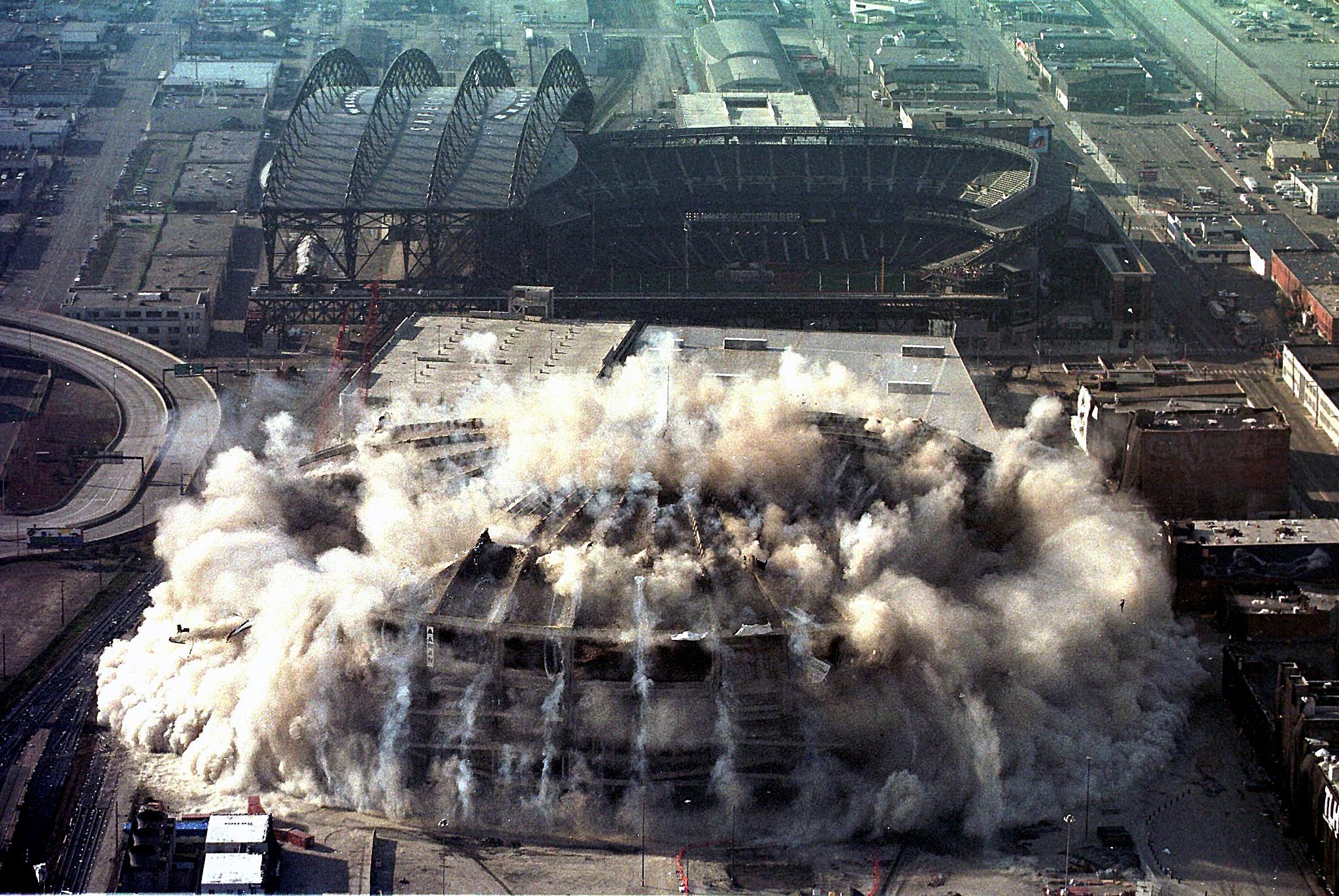
Imagine a huge upside-down concrete bowl, so large that people could play American football and baseball inside it. That was Seattle’s Kingdome. Then Washington state residents voted to keep their beloved team at home—and the old dome disappeared in a matter of seconds.
A Dome Not Named After a King
The word “Kingdome” sounds like “royal dome,” but the stadium was actually named after King County, where Seattle is located. It was built in 1976. Residents had approved funding for it back in 1968 through a program called Forward Thrust. At the time, they voted on many public projects at once: parks, swimming pools and the stadium. So the old dome and the city’s green spaces shared common roots.
The Kingdome stood on reclaimed land. The area had once been a shoreline, but people gradually filled it in to build a railroad and warehouses. The International District was nearby, and its residents had long complained about traffic, noise and the way major events changed their streets.
Over the years, the dome grew old. In 1994, ceiling tiles fell, making the building unsafe, and games were temporarily suspended. It became clear that a new home was needed.
The Day the Team Could Have Left
In 1996, Ken Behring, the Seahawks’ owner at the time, tried to move the team to California. For fans, it was as if their best friend had suddenly announced that she was moving to another city. The league blocked the move, but the anxiety remained.
Then Paul Allen, one of Microsoft’s co-founders, stepped in. He agreed to buy the team, but on one condition: it needed a new stadium. In June 1997, a statewide vote called Referendum 48 was held. Residents decided whether part of the public money—mostly from special taxes and lottery revenue, rather than school funds—could be used for a new stadium. Allen paid for the special election himself.
The result was extremely close: about 51 percent voted yes and 49 percent voted no. In other words, the team’s fate was decided by a very small margin. To put it another way, if there were 30 students in your class, the “yes” side might win by just one or two votes. Not everyone was happy. Many believed public money was needed more for schools, roads and parks. That debate has never fully gone away in Seattle.
| Year | What happened |
|---|---|
| 1976 | The Kingdome opens |
| 1994 | Ceiling tiles fall |
| 1996 | The owner tries to move the team to California |
| 1997 | Referendum 48 and Paul Allen’s purchase of the team |
| 2000 | The Kingdome is demolished |
| 2002 | The new stadium opens |
Sixteen Seconds and Care for the Environment
On March 26, 2000, thousands of people gathered to watch the Kingdome come down. The dome collapsed in about 16 seconds. It was one of the largest concrete buildings in the world ever demolished by implosion.
What happened to the mountain of concrete? That is where the “green” part of the story begins. Reports said that much of the rubble was crushed and reused, while the steel reinforcing bars were sent for recycling. Of course, demolition still creates plenty of dust and waste, and preparations had to be made in advance. Reusing the rubble instead of simply throwing it away was, at the time, a sensible way to show concern for the environment and nearby residents.
A Home Where Every Voice Can Be Heard
While the new stadium was being built, the team played at another venue. The new stadium opened on the old site in 2002. Builders covered most of the seating with a roof so the sound would not escape upward but remain among the spectators. This was designed for fans who had long been called the “12th Man”: a football team has 11 players on the field, and in Seattle, you become the 12th when you shout from the stands. The team even permanently retired number 12 for its fans back in 1984. In 2013, the crowd reached about 137 decibels, which was recorded as a Guinness World Record. For comparison, that is roughly as loud as a jet taking off.
What Remains Behind the Scenes
It seems to me that the main lesson of this story is not really about football. The question of whether to build something new involves money, the environment and the people who live nearby. While some people were shouting “hooray,” others were thinking about noise and traffic. It is good that Seattle discussed all of this openly and voted, rather than making the decision behind closed doors.