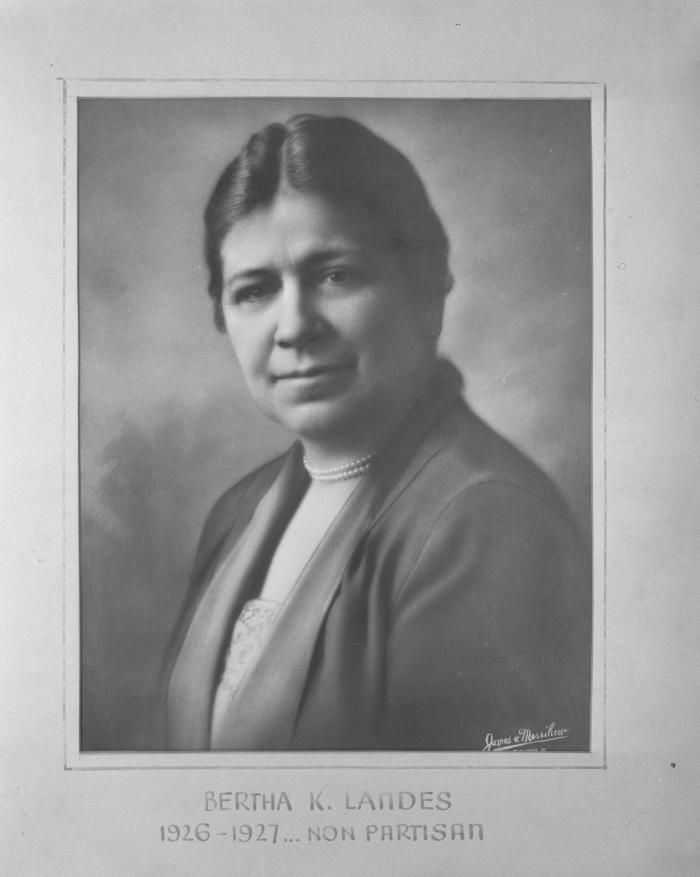
Imagine that your class is choosing a class monitor, and the winner is someone people once thought was “not suited” for the role. Then that monitor goes on to become the principal of the entire school. That is roughly what happened to Bertha Knight Landes, who became mayor of Seattle in 1926. She was the first woman to lead a major American city. But Bertha did not win on her own: behind her stood women’s clubs, voters, her family, and her own habit of seeing things through. Let’s look at the story through the eyes of those who made it possible.
A City Built by Many Hands
Bertha was born in 1868 in Massachusetts and grew up in a family where education was considered important. She later married Henry Landes, a scientist who studied rocks. In 1895, they moved to Seattle, a remote city in the Pacific Northwest that was growing rapidly at the time. Workers, sailors, and merchants came there, and along with them came new streets, schools, ports, and problems: how to maintain order and make the city safe and convenient for everyone.
At that time, American women still could not vote in national elections, but Washington State restored their voting rights in 1910. Even before that, back in the 1890s, Seattle women had already begun gathering in clubs. They discussed how to improve schools, make water and streets cleaner, and help children and poor families. They called this work “municipal housekeeping”: if women knew how to run a household, why shouldn’t they care for the “larger home”? Historians use a similar term—“municipal housekeeping.”
It was in these clubs and civic organizations that Bertha learned skills that would later serve her well: how to run meetings, negotiate with people, speak in public, and prove her case. She led the Seattle League of Women Voters and took part in the work of the state Federation of Women’s Clubs. It was like lengthy training before a major competition: no one had seen her on a huge stage, but she had already spent years practicing the “exercises” of public life.
The Team Behind Bertha
Here is the next important point. In 1922, Bertha was elected to the Seattle City Council—a group of people who decide how to spend the city’s money and what rules to establish. She was elected by residents, many of them women who were already familiar with her work. This was an important moment: to many voters, she was not an “unknown candidate,” but someone they had seen at meetings and knew by her actions.
She also had support at home. Her husband, Henry Landes, taught and later became dean at the University of Washington, which meant that the Landes household valued education and was comfortable with the wife taking part in public work. In those days, far from every family allowed a woman such freedom to choose her own path.
There were also newspapers that discussed Bertha, sometimes with interest and sometimes mockingly. I do not have details about which journalists supported her or exactly how they did so, so I will not invent names. But one thing is certain: in 1924, her fellow council members elected Bertha as its president, or leader. You cannot become chair if the others do not trust you. This means that even before the mayoral election, she already had a team within the council itself.
The Week That Changed Everything
Seattle Mayor Edwin Brown went on a trip, and during his absence Bertha was supposed to run the city as council president. This was when the most tense episode in her story began. Times were difficult: Prohibition was in effect in the United States, banning the sale of alcohol, and secret establishments, bribes, and arguments over how the police should deal with them were spreading through cities. According to historians, Bertha did not turn a blind eye to what was happening and decided to fire the police chief. The newspapers caused an uproar; many criticized her, while others supported her.
For a ten-year-old, the situation is easiest to imagine this way. Suppose you are entrusted with keeping order in your classroom for one day while the teacher steps out. You see that one of the students is breaking the rules and getting away with it. You can remain silent, or you can say, “That’s not allowed.” Bertha chose the second option. It cost her a quiet life, but earned the respect of many residents.
In 1926, she decided to run for mayor. Edwin Brown—the same man—ran against her, and Bertha won. That spring, Seattle’s name appeared in newspapers across the country: “A Woman Is Mayor of a Major City!” It seemed almost unbelievable. Judging from her speeches, Bertha herself did not believe she had been elected “because she was a woman”; she wanted to be judged by her work.
What Remained After City Hall
Being mayor, however, proved difficult. In 1928, Bertha ran again but lost to Frank Edwards. Historians usually explain this as follows: not everyone liked her hard line on bribes and “closed” establishments, and she also had influential opponents. So she did not remain in office for a second term.
But the story did not end there. After leaving the mayor’s office, Bertha continued her civic work: she gave speeches, wrote, and worked on issues connected with city life. She died in 1943, having lived for more than seventy years. I do not know the exact details of every project she undertook after 1928, so I will not invent what I do not know. But the main point is clear: she showed that a woman could lead a major city.
What seems important to me is that this story has no “magic hero.” There is Bertha, and there are many other people: women in clubs, voters, fellow council members, and family. Urban planning is usually imagined as maps, bridges, and roads, but in reality it begins earlier—with people who decide they need a better city and find someone willing to take responsibility for it.
Why This Story Matters
Today, there are many women mayors around the world, and no one finds it strange that a woman leads a city. But once, this seemed almost impossible, and the first step was taken not by armies but by people like Bertha: ordinary people who learned to run meetings, argue, persuade, and keep going.
If you ever find yourself in a situation where someone tells you, “That’s not for you,” remember Bertha. She did not become mayor in a single day. First, she worked for the common good in clubs, then on the city council, and each time there were people beside her who believed in her. She also reminds us that even if you lose once, what you have already changed remains.