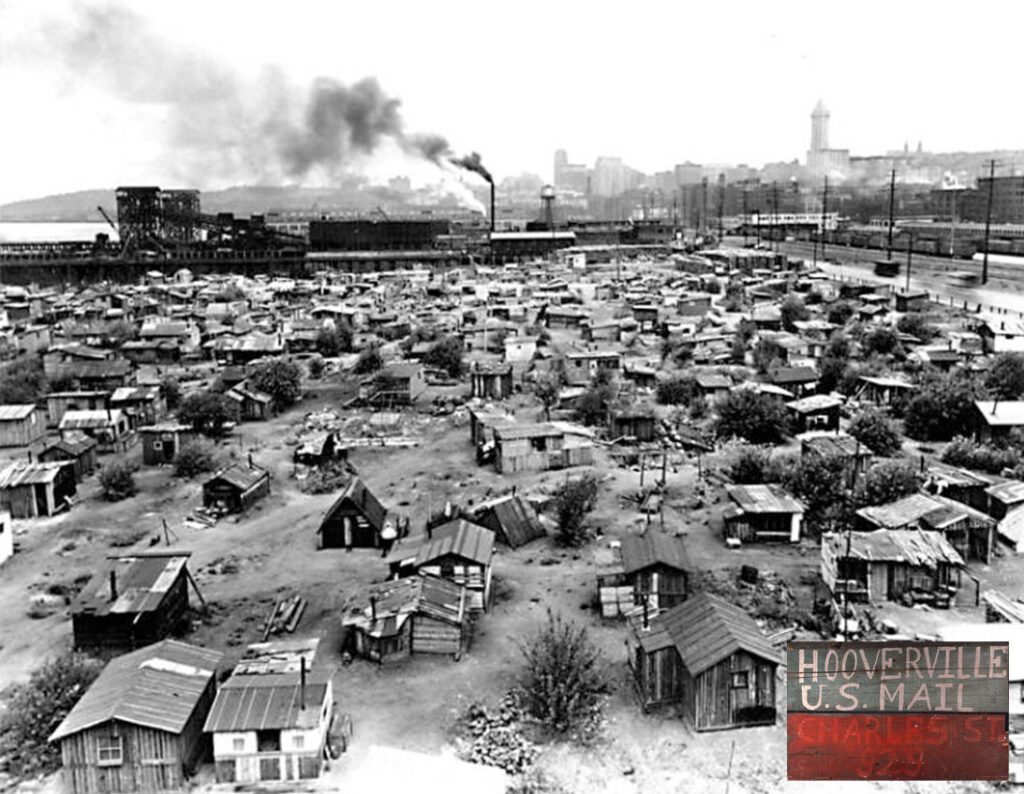
Imagine you had to build a home but had no money at all. All you had were boards found along the shore, rusty sheets of metal, and a couple of old barrels. Could you make anything out of that? More than ninety years ago, in the American city of Seattle, hundreds of people faced this challenge in real life, not in a game. That’s how Hooverville came to be—a remarkable settlement that was considered a real city, even without a mayor or brick walls.
When the Jobs Disappeared
In 1929, the Great Depression began in America. It was a time when many adults suddenly lost their jobs: factories closed, shops emptied, and banks couldn’t return people’s money. Families could no longer afford their homes, and some had to leave them.
In Seattle, many workers were employed at the port, sawmills, and construction sites. When there were fewer orders, thousands lost their jobs. With nowhere to go, they looked for somewhere they could live without paying rent.
They found a place by Elliott Bay—a vacant lot near the port, not far from downtown. The land belonged to the port, but no one needed the site. People began putting up tents there, then small houses. That’s how Hooverville appeared in 1931.
The settlement’s name was meant as a joke at the president’s expense. Herbert Hoover was president of the United States at the time, and many people thought he was doing too little to help those in need. Similar settlements across the country came to be called “Hoovervilles.”
Homes Made from Whatever Was at Hand
The most amazing thing about Hooverville was how people built there. There were no building-supply stores, of course. People gathered whatever they could use: scraps of lumber from sawmills, wooden crates, pieces of tin, old doors, and roofing felt.
Imagine building a shelter out of branches and blankets. Only this “shelter” had to stand up to rain and cold. In Seattle, it drizzles constantly in fall and winter, and nights can be bitterly damp. So residents found ways to make their homes warm.
They turned iron barrels into stoves. They cut up tin cans and flattened them to make sheets for roofs. They fitted in old window frames they managed to find. Some homes were so neat they had little porches and curtains, with small vegetable gardens beside the doors. Many residents fished in the bay to feed themselves, while kind people from the city brought some of them food.
Of course, life there was hard. There was no running water, and the houses were difficult to heat in winter. Still, these structures were real homes to the people who lived in them—a place to take shelter from the rain, with a door of their own that they could close.
A City with Rules of Its Own
Here’s what made Hooverville special: it wasn’t just a vacant lot full of trash and shacks. Residents quickly realized that a settlement this large needed order, so they set up their own system of government.
They elected a committee to settle disputes and enforce the rules. The rules were simple and clear, like the ones in a classroom where everyone has agreed on how to behave: don’t steal, don’t fight, don’t leave trash behind, and help one another. Those who refused to follow the rules could be asked to leave.
People from different backgrounds lived in Hooverville, which was unusual for the time. Most were workers—Americans as well as immigrants from various countries. They had come to Seattle looking for work and now found themselves in the same difficult situation. It helped to be among people who understood what you were going through.
The residents not only lived together but also shared food, cared for the sick, and looked after children. Some even had small homemade libraries, and in the evenings people gathered around a campfire to talk.
The Authorities Tried to Clear It Out, but Residents Returned
Not everyone in the city liked seeing the settlement grow on the vacant lot by the port. City authorities considered it unsafe and unsanitary and wanted to clear it out. In 1932, on the authorities’ orders, some of the shacks were even burned, and the residents were evicted.
But something unexpected happened. Many Seattle residents felt sympathy for those who had lost their homes. They saw that the unemployed weren’t drifters, but fellow citizens who had simply fallen on hard times. Priests, lawyers, and ordinary concerned citizens spoke up for Hooverville’s residents. Afterward, people returned to the same spot and rebuilt the settlement, making it a little better than before.
Hooverville lasted for about ten years, and at different times was home to anywhere from several hundred people to, by some estimates, more than a thousand. It was finally cleared in 1941, when the country began preparing for war and many new jobs opened up in factories. The settlement was simply no longer needed.
Why This Story Matters
I think the story of Hooverville is about people who refused to give up. When they had almost nothing left, they didn’t sit around waiting for help. They took what they could find and built themselves homes. Then they agreed on rules so they could live together, and defended their homes when someone tried to take them away.
It reminds us of something important: a home is more than just walls. It’s a place where people are waiting for you, and where you have others you can count on. Sometimes a few boards, rusty metal, and kind neighbors are enough to build something real.
Today, completely different buildings and roads stand on the site of Hooverville in Seattle. But when someone passes by, it’s worth remembering that there was once a city of scrap wood and tin here—and that it was home to people who knew how not to lose hope.