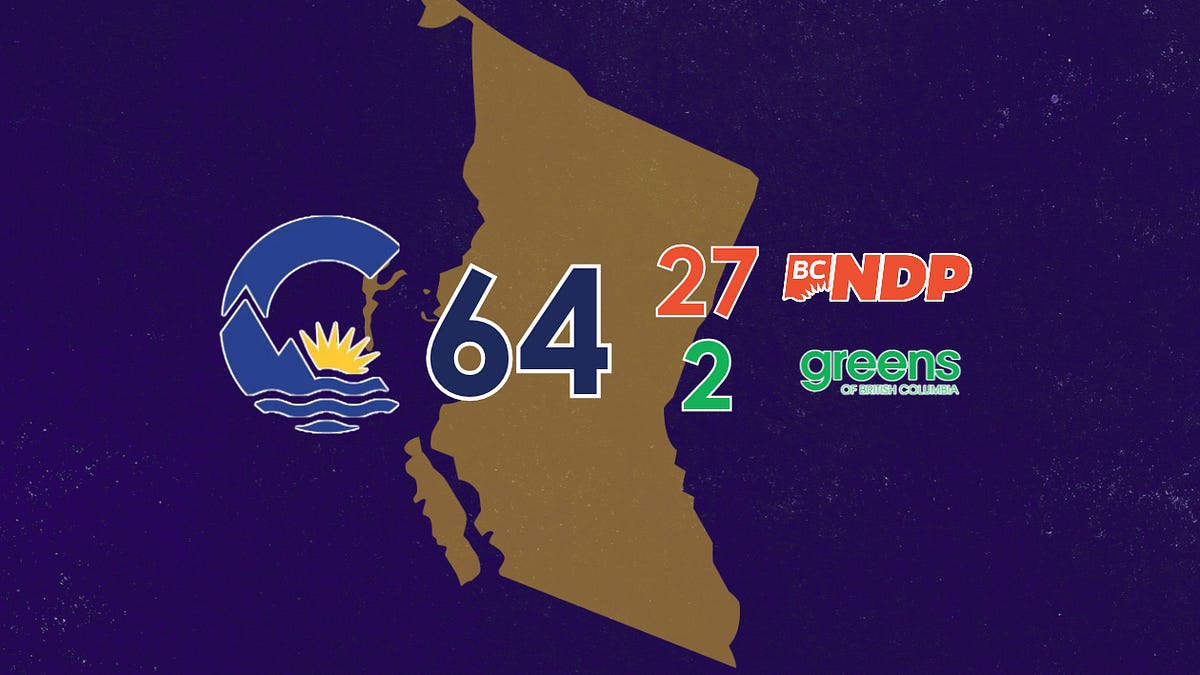
The British Columbia election ended in a crushing victory for Lorne Doerkson’s Conservative Party, which is forming a provincial government for the first time since 1928. The Conservatives won 48.1% of the vote and 64 seats, taking 15 Metro Vancouver ridings from the NDP. David Eby held on to Vancouver-Point Grey but resigned as NDP leader, accepting full responsibility for the failure of the snap election. Bowinn Ma was re-elected in North Vancouver, but her party is heading into opposition.
Conservative landslide in British Columbia: How the NDP lost an election it should not have lost
The British Columbia election ended in a crushing victory for the Conservative Party under Lorne Doerkson, which is forming a provincial government under the Conservative banner for the first time since 1928. Polls had predicted this outcome, but the scale of the victory exceeded expectations, largely thanks to the Conservatives’ advance into Metro Vancouver. According to Elections BC, with 99.57% of polls reported, the Conservatives won 48.1% of the vote and 64 seats—the biggest victory for any party in the province since Gordon Campbell’s Liberals took 77 of 79 seats in 2001. The New Democrats won just 37.4% and 27 seats, and David Eby announced his resignation. As The Writ notes, this was a completely unnecessary own goal: the NDP had a majority and two years left in its mandate, making the defeat one of the biggest strategic failures in Canadian political history. The Greens won 11% and elected two MLAs, improving their share of the vote compared with the last election, but still falling short of their 2017 and 2020 levels. CentreBC and OneBC received 1.6% and 1.5%, respectively. Only one OneBC candidate broke into double digits, with 11% in Kelowna-Lake Country-Coldstream, while party leader Dallas Brodie won just 4% in her riding of Vancouver-Kilchena. For CentreBC, only Elenore Sturko in Surrey South and Andrew Weaver in Oak Bay-Gordon Head reached 10%.
The Conservatives flipped ridings across the province, but especially in Metro Vancouver, where they took 15 seats from the NDP, including four in Surrey—sweeping the city—three in Vancouver, and two each in Burnaby and Coquitlam. Flips were less common elsewhere, with only one each in the Fraser Valley and the Interior. Four more seats on Vancouver Island shifted from the NDP to the Conservatives, though one went the other way: the NDP won Courtenay-Comox, its only victory of the night. The decisive shift came in Metro Vancouver, where the NDP lost 11.6 points. Most of that went to the Conservatives, who gained six points, but the Greens also made their biggest gains there, up four points. In the rest of the province, swings were more modest: the NDP lost 3.1 points in the Interior and North and 4.7 points on Vancouver Island; the Conservatives gained 4.3 and 2.8 points, respectively, while the Greens gained less than two points in both regions. Interestingly, the Greens made major gains in southern Vancouver Island, coming within 10 points of the NDP in two Victoria ridings. They also topped 20% where that had been expected—Victoria, Saanich and parts of Vancouver—but fell short of 20% in northern Island ridings and Kootenay Central. Their success was more concentrated than it might have been.
The final count depends on mail-in ballots, which will be counted over the next two weeks. In 2024, there were about 84,000 such ballots, and the NDP won them by 22 points. On average, however, that amounted to only 206 votes per riding in an election the party lost to the Conservatives by less than two points. With the NDP now trailing by nearly 11 points, a similar imbalance is unlikely, but Ladysmith-Oceanside, where the Conservatives lead by 89 votes; Kelowna Centre, where they lead by 132; Cowichan Valley, where they lead by 150; and Burnaby South-Metrotown, where the NDP leads by 66, are worth watching.
As for the pollsters, overall they underestimated the Conservatives and overestimated the NDP, though they correctly picked up the trend and predicted a Conservative majority. Their errors were slightly larger than usual. Pallas Data performed best, with a combined error of 5.8 points: it underestimated the Conservatives by about three points and overestimated the NDP by two, while its errors for the Greens and other parties were within one point. The Writ’s projection tied for second, helped in part by adjustments for the number of candidates, as were the forecasts from Pollara Strategic Insights and the final Forum poll. Léger, Ipsos and Research Co. did reasonably well, while Innovative Research Group, Angus Reid Institute and Mainstreet Research ranked near the bottom. Mainstreet’s six-point overestimate of the Greens was the largest error of the night.
Why the Conservatives outperformed the polls and the NDP fell so far short is an interesting question. Mail-in votes may narrow the gap slightly, but the result could signal a lack of enthusiasm among NDP voters, who may not have felt like turning out for an election their own party had botched. Turnout currently stands at just 48.1%, and many New Democrats likely stayed home. Paradoxically, that means the Conservatives are winning a large majority with roughly 50,000 fewer votes than they received in 2024. The author is pleased with the performance of the projection model: it assessed the Greens well and adjusted for their lack of candidates in 20 ridings, although it is clear that many Green voters in those ridings did not switch to the NDP, which consequently failed to outperform its polls as expected. The seat projection gave the Conservatives 59 seats—five fewer than they actually won—and the NDP 32, five more than it won. But the final result of 64 and 27 fell within the confidence intervals. The median projection, which expected the NDP to outperform the polls by even more, was off the mark. The riding-level forecast performed exceptionally well: just nine predictions were wrong, for an accuracy rate of 90.3%, and all nine were classified as toss-ups. If those are counted as correct, the forecast was 100% accurate: none of its Edge, Lean, Close, Likely or Safe predictions was wrong, which argues for simplifying the classifications. The author has already developed a new way to calculate each party’s probability of winning each riding. It will narrow the confidence intervals and make classifications more confident, and the author promises to implement the changes in the coming weeks.
For context: an “own goal” is a football term for scoring against one’s own team; here it is used metaphorically to mean self-sabotage. “Mail-in ballots” are votes cast by post and counted after election day. A “confidence interval” is a statistical range within which the true value is expected to fall with a given level of confidence. A “toss-up” is a riding too close to call with confidence. The key takeaway is that the NDP lost power after voluntarily calling an early election despite having a majority and time left in its mandate. Low turnout and disillusionment among its own voters completed the party’s collapse, while the Conservatives won by breaking through in densely populated Metro Vancouver.
David Eby’s bittersweet victory: BC NDP leader keeps his seat but loses power
British Columbia’s recent election reshaped the province’s political landscape. New Democratic Party (NDP) leader David Eby won his riding of Vancouver-Point Grey, but his party lost its majority to the province’s Conservative Party. According to the Canadian Press decision desk, Eby was re-elected in his riding, but the overall result went against his party. The Conservative Party, led by Lorne Doerkson, won a majority and will form the government. Eby reportedly resigned as NDP leader that same evening, accepting full responsibility for the campaign’s outcome. The decision capped five weeks that began when he opted to call an early election, two years before his term was due to end. Observers had described the move as the riskiest decision of his political career.
To understand Eby’s standing, it is worth looking at his political career. He has represented Vancouver-Point Grey since 2013, when he defeated the province’s then-premier, Christy Clark of the BC Liberal Party. The victory earned him a reputation as a “political giant-killer.” In 2022, he became premier after the late John Horgan stepped down as NDP leader. The current result is therefore more than an electoral setback: it is a major turn in the fortunes of a politician who, until recently, seemed one of the province’s most influential figures.
The key question in analysing the result is why an early election, intended as a strategic manoeuvre, ended in defeat. Political scientists often describe such decisions as a gamble: a leader with an advantage tries to consolidate power before public opinion shifts. In this case, however, the calculation did not pay off. The Conservatives apparently managed to mobilize voters amid mounting discontent or fatigue with the incumbent government. Eby retained support in his riding, suggesting he remains personally popular with voters in Vancouver-Point Grey, but that popularity did not translate into broader success for his party.
A few terms in the report are worth explaining. The NDP, or New Democratic Party, is a social democratic party that traditionally supports expanding social programs and protecting workers’ rights; in British Columbia, it has long been one of the two main political forces. The Conservative Party of British Columbia in this context is a provincial centre-right party that, judging by the results, managed to wrest the initiative from the NDP. A “decision desk” projection means the results are based on an analysis of data and exit polls rather than the final official count, though such projections are generally highly accurate. Finally, an “early election” is an election held before the legislature’s term expires, following its dissolution. Calling one is a government’s right, not an obligation.
The key insight is that a politician’s personal electoral resilience may not match the fortunes of their party. Eby won his riding but lost the province—a rare and painful scenario that highlights the gap between local support and broader regional sentiment. The fact that he resigned as NDP leader that same evening suggests he was willing to take responsibility without delay, a gesture often seen in political culture as an admission of strategic error. The quote “I take full responsibility for the result,” reported by CHEK News, illustrates the point.
The consequences extend beyond one province. First, a change of government in British Columbia could lead to a reassessment of priorities in social policy, environmental protection and economic regulation, as Conservatives traditionally take different approaches. Second, Eby’s departure as leader leaves a vacuum in the NDP and triggers a leadership contest, which could move the party further left or prompt it to seek a more centrist candidate. Third, the early-election episode will become a textbook example for political strategists: even a popular leader is not immune to a boomerang effect if public sentiment changes faster than expected. Finally, the publication date—October 24, 2026—is worth noting: it indicates that this political crisis is unfolding over the medium term, and its effects will be felt throughout the next electoral cycle.
Bowinn Ma keeps her North Vancouver seat, but her party moves into opposition
The 2024 British Columbia election brought not only a change of government but also a personal victory for one of the NDP’s best-known politicians. Bowinn Ma was re-elected in North Vancouver-Lonsdale, winning her fourth term. Her party, however, lost its majority and is moving into opposition. The result illustrates how regional politics can produce paradoxical combinations: a candidate’s strong personal standing alongside provincewide disillusionment with their party.
After all ballots were counted, Ma had 10,221 votes, or 46.92%. Her main opponent, Trevor Halford of the Conservative Party of British Columbia, received 9,044 votes (41.52%), while Green Party candidate Joshua A. Singer Johnson won 2,477 (11.37%). The race remained close until the end: Ma’s margin was just over five percentage points, whereas two years ago she won 64.88% in a two-party contest. The nearly 18-point drop is a warning sign, even though she formally retained her seat.
Ma watched the results come in at the NDP’s campaign headquarters at the Marriott Pinnacle Hotel in downtown Vancouver, alongside supporters and fellow party members, holding her son, Jack. In an interview with North Shore News, she said it had been an honour to serve the riding for the past 10 years and expressed gratitude for the opportunity to continue working for another four. Formally, this is her fourth term, though she was first elected in 2017—meaning she has represented the riding continuously for 10 years in the Legislative Assembly.
The broader context of her victory matters far more. The Conservatives, led by Lorne Doerkson, won a majority and will form the government, while incumbent Premier David Eby announced he was stepping down as NDP leader. In his speech, he called the decision difficult but necessary for renewing the party, acknowledged that voters had asked the NDP to become the official opposition, and accepted full responsibility for the result. It was a rare moment of candour in Canadian politics, where leaders usually avoid speaking so plainly about defeat.
Interestingly, Ma explained Eby’s decision to call an early election by pointing to the fragility of the NDP’s majority and the toll it had taken on legislators. Some, she said, had voted from hospital beds while undergoing cancer treatment or recovering from surgery. Her remark shifted the discussion of political tactics toward health and burnout—subjects rarely and reluctantly discussed in Canadian politics. She also stressed that the result was radically different from the one two years earlier, meaning it had been worth putting the question to voters.
Asked whether she might run for party leader, Ma answered directly: she had seen the toll that serving as an MLA and minister had taken on her own family, and did not want to ask her loved ones to make further sacrifices. The statement should be taken at face value. With the NDP now without a leader, her decision narrows the pool of potential successors to Eby and makes internal party discussions more complicated. At the same time, she paid tribute to outgoing colleague Susie Chant, who lost in North Vancouver-Seymour to Conservative Lynn Block, and thanked Eby and former premier John Horgan for their work together.
In the Legislative Assembly, Ma intends to continue advocating for the North Shore and the province as a whole on housing, the cost of living, transportation, early childhood education, health care and climate. She previously served as Minister of Emergency Management and Climate Readiness and, in the most recent legislature, as Minister of Infrastructure. That experience could make her an effective opposition voice pressing the Conservative government on infrastructure and climate issues, areas where the new government has yet to set out a clear agenda.
A few terms are worth clarifying. The official opposition is the party with the second-largest number of seats; it receives additional funding and question period time, and has the right to form a shadow cabinet. An early election means dissolving the legislature before its term expires. In British Columbia, the NDP called one despite holding a precarious majority—a risky move in any parliamentary system. A party’s shift from government to opposition in a single election cycle is rare but not unique: voters often vote against a government rather than for the opposition, allowing individual MLAs to retain their personal support even when their party’s fortunes collapse.
The key takeaway is that Bowinn Ma remains one of the NDP’s few reliable footholds in the province’s urban core, but her mandate has weakened considerably. A five-point margin, rather than the 20-plus points she had previously, is a warning. If the party cannot recover after Eby’s departure, MLAs like Ma will face the greatest pressure in the next election. Her decision not to pursue the leadership leaves her free, but somewhat isolated, as an opposition voice: she can speak about climate and housing without worrying about party discipline, but without a ministerial portfolio her influence is much more limited. Perhaps the most human moment in this story is that of a politician who has won an election, holding her child and saying that family matters more to her than career advancement. In an era when politicians are expected to sacrifice endlessly, that honesty is itself a political statement.