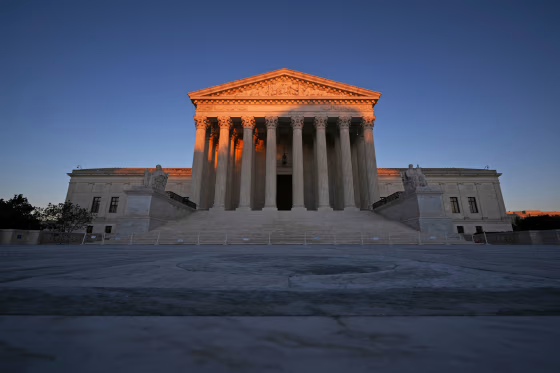
Three cases accepted or considered by the U.S. Supreme Court reveal a common trend: the Court is systematically reassessing the boundaries of federal power—presidential, legislative, and administrative—while also clarifying how far the government may intervene in institutional affairs, private life, and education policy. These are not merely separate disputes over the dismissal of an official, home distilling, or a school lottery. In each case, the Court must determine who actually has the authority to make decisions: the president, Congress, federal agencies, states, or local governments.
The most far-reaching development appears to be the Court’s refusal to hear the complaint brought by Gwynne Wilcox, a former member of the National Labor Relations Board. As CNBC reports, the decision left in place an appellate ruling that upheld President Donald Trump’s dismissal of Wilcox in January 2025. Wilcox, who had been appointed to a second five-year term by Joe Biden, argued that the president had no authority to fire her without cause: Congress had specifically created job protections for board members to ensure their independence.
In March 2025, District Judge Beryl Howell agreed with that position, holding that the law protecting National Labor Relations Board members from dismissal without cause did not violate the Constitution. In December 2025, however, the D.C. Circuit Court of Appeals overturned that decision, accepting the Trump administration’s argument that the president’s broad authority to manage the executive branch limits Congress’s ability to protect independent officials.
The Supreme Court’s refusal to hear the case is particularly significant in light of its June ruling in the case of Rebecca Slaughter, a former member of the Federal Trade Commission. At that time, the Court overturned the longstanding 1935 precedent in Humphrey’s Executor. That precedent allowed Congress to limit the president’s power to arbitrarily dismiss the heads of certain independent regulators. Its reversal was the result of a yearslong conservative campaign to strengthen presidential control over the federal bureaucracy.
Independent agencies are executive-branch bodies that formally belong to the federal system but have traditionally received a degree of protection from direct political pressure from the White House. They include, for example, the Federal Trade Commission and the National Labor Relations Board. Their independence is intended to ensure regulatory stability and reduce the risk that a president will fire officials solely for political disloyalty. Conservative legal theory, however, known as the “unitary executive” theory, holds that the president should have more complete control over all officials who enforce federal law.
This dispute lies at the heart of the Wilcox case. Her dismissal was part of the Trump administration’s broad campaign to shrink the federal bureaucracy, replace officials, and increase control over agencies. The material presented here refers to mass dismissals, the dismantling of certain structures, the appointment of leaders loyal to the president, and the removal of career employees. A decision in Wilcox’s case would therefore have mattered far beyond the National Labor Relations Board. It could have determined whether a president can effectively turn independent agencies into bodies directly subordinate to the White House.
Now, following the Slaughter decision and the refusal to hear Wilcox’s case, the balance has shifted noticeably in favor of the president. This does not mean that the head of state has gained unlimited authority to fire any official. But the barrier created by Humphrey’s Executor has been substantially weakened. In practical terms, independent regulators may become more dependent on the political agenda of the administration in power, while a change in president may more often lead to a complete turnover in agency leadership.
The two other cases accepted for review by the Court develop the same theme from a different angle: they concern not so much presidential control as the limits of congressional and local-government authority.
In the home-distilling case, the Court must decide whether Congress had the constitutional authority, as early as 1868, to ban the production of distilled spirits in private homes. According to AP News, federal law provides for up to five years in prison and a fine of up to $10,000 for home distilling.
Historically, the ban was introduced as part of tax reform during the Reconstruction era. The government argues that private producers could evade excise taxes and avoid federal inspections, so Congress had the authority to restrict where alcoholic beverages could be produced. According to the Justice Department, this is not arbitrary control over private life but a necessary means of ensuring tax collection.
The plaintiffs, by contrast, call the law an outdated relic of 19th-century policy. They argue that Congress’s taxing powers do not permit it to ban activity inside a private home merely because it could potentially be connected to tax evasion. Their attorney, Robert Alt, said that “the Founders of our country would turn over in their graves” if they learned that an activity practiced, among others, by George Washington had become a federal crime.
The dispute is made more significant by conflicting appellate rulings. The Sixth Circuit upheld the ban in the case of John Ream, an Ohio brewery owner who wanted to distill whiskey at home for personal use. The Fifth Circuit, by contrast, sided with members of the Texas Home Distillers Association and held that the ban exceeded Congress’s taxing authority.
The plaintiffs warn that if the government’s logic is accepted, Congress could use tax enforcement as a pretext to restrict a broad range of activities in private homes—from cooking and gardening to remote work. The government responds that such concerns are exaggerated because the production of distilled alcohol has a long history of widespread excise-tax evasion and avoidance of inspections.
Legally, the case involves several constitutional principles at once. The first is Congress’s taxing power. The second is federalism—the division of authority between the federal government and the states. The third is whether the federal government may regulate private activity if it is not directly connected to interstate commerce. The Supreme Court has so far agreed to review the Fifth Circuit’s ruling, but at the Justice Department’s request, it may limit its consideration to Congress’s taxing power and avoid the broader question of interstate-commerce regulation.
The third case concerns school policy and the racial composition of the student body. As NBC News reports, the Supreme Court agreed to hear a challenge to the admissions system for magnet schools in Montgomery County, Maryland. Magnet schools are public schools or specialized programs offering advanced instruction, for example in science, technology, and the humanities.
The plaintiffs from the Association for Education Fairness argue that the admissions rules unlawfully increase the chances of Black and Hispanic students and thereby violate the Fourteenth Amendment, which guarantees equal protection under the law. In 2023, the Supreme Court barred the consideration of race as a direct factor in university admissions. The current case, however, is narrower: the Court must determine what evidence plaintiffs must present to establish the discriminatory effect or purpose of an education policy.
Montgomery County uses a lottery for admission to four middle schools with specialized programs. Eligibility depends on a student’s test results compared with those of other students at the same school. The plaintiffs believe that this model may disadvantage Asian students, particularly if they attend schools with high average scores. The county had previously also used a program aimed at increasing the share of children from low-poverty areas. It included a special outreach campaign and a cognitive test.
The school district says that the policy does not use race as a direct criterion but is intended to address structural inequality and expand access to prestigious programs. The federal district court and the Fourth Circuit Court of Appeals sided with the district. The plaintiffs, however, argue that if the policy was created to increase the number of Black and Hispanic students, the absence of a formal “race” category does not make it constitutional.
Following the 2023 decision, conservative lawyers and some Supreme Court justices repeatedly warned that educational institutions might try to circumvent the ban by using facially neutral criteria with the same practical result. The Maryland case could therefore become an important test for distinguishing between the direct use of racial classifications and policies that formally rely on geography, school performance, socioeconomic conditions, or a random lottery while deliberately altering the racial composition of the student body.
The broader significance of the three cases is that the Supreme Court continues to reassess conventional understandings of the limits of government power. In Wilcox, the issue is how much control the president has over executive bodies. In the home-distilling case, it is how far Congress may go in regulating private activity by invoking taxation and the fight against evasion. In the Maryland case, it is whether local authorities may use facially neutral criteria to pursue goals related to racial diversity.
In all three cases, the formal text of a law or policy collides with questions about its actual consequences. The home-distilling law is formally a tax measure but effectively bans a specific activity in a private home. The school lottery formally does not ask about race but may produce disparities among ethnic groups. Protections for members of federal agencies formally limit the president but are also intended to shield professional administration from political changes in power.
The key trend is the Court’s heightened demand for constitutional justification of government action, combined with a more favorable attitude toward presidential power. The Supreme Court is not necessarily eliminating all existing restrictions, but it is requiring their foundations to be justified anew: do they derive from the Constitution, from Congress’s powers, or from the traditional understanding of the role of independent institutions?
For the Trump administration, the refusal to hear Wilcox’s case creates room for further personnel restructuring of the federal government. For Congress, the home-distilling case may serve as a warning that taxing powers do not necessarily authorize regulation of every activity associated with potential losses to the public treasury. For schools and universities, the Maryland case underscores the need to document admissions criteria particularly carefully and demonstrate that they pursue an educational rather than concealed racial objective.
More broadly, these cases show that American constitutional politics is increasingly shifting from questions about the substance of government decisions to questions about the mechanisms by which those decisions are made. Who appoints and dismisses officials? Who has the authority to ban activity in a private home? How can it be shown that a neutral rule actually conceals a racial classification? The Supreme Court’s answers will determine not only the fate of individual plaintiffs but also the balance among the president, Congress, federal agencies, states, and local authorities.