Three articles illustrate one broader process: NVIDIA and its partners are increasingly reshaping the computer market around artificial intelligence, professional workflows, and the CUDA software ecosystem. This affects not only server accelerators, but also expensive laptops, gaming graphics cards, and even Microsoft’s marketing strategy. As a result, buyers get more powerful devices, but face shortages, high prices, and a reallocation of resources from the mass gaming segment toward professional and enterprise workloads.
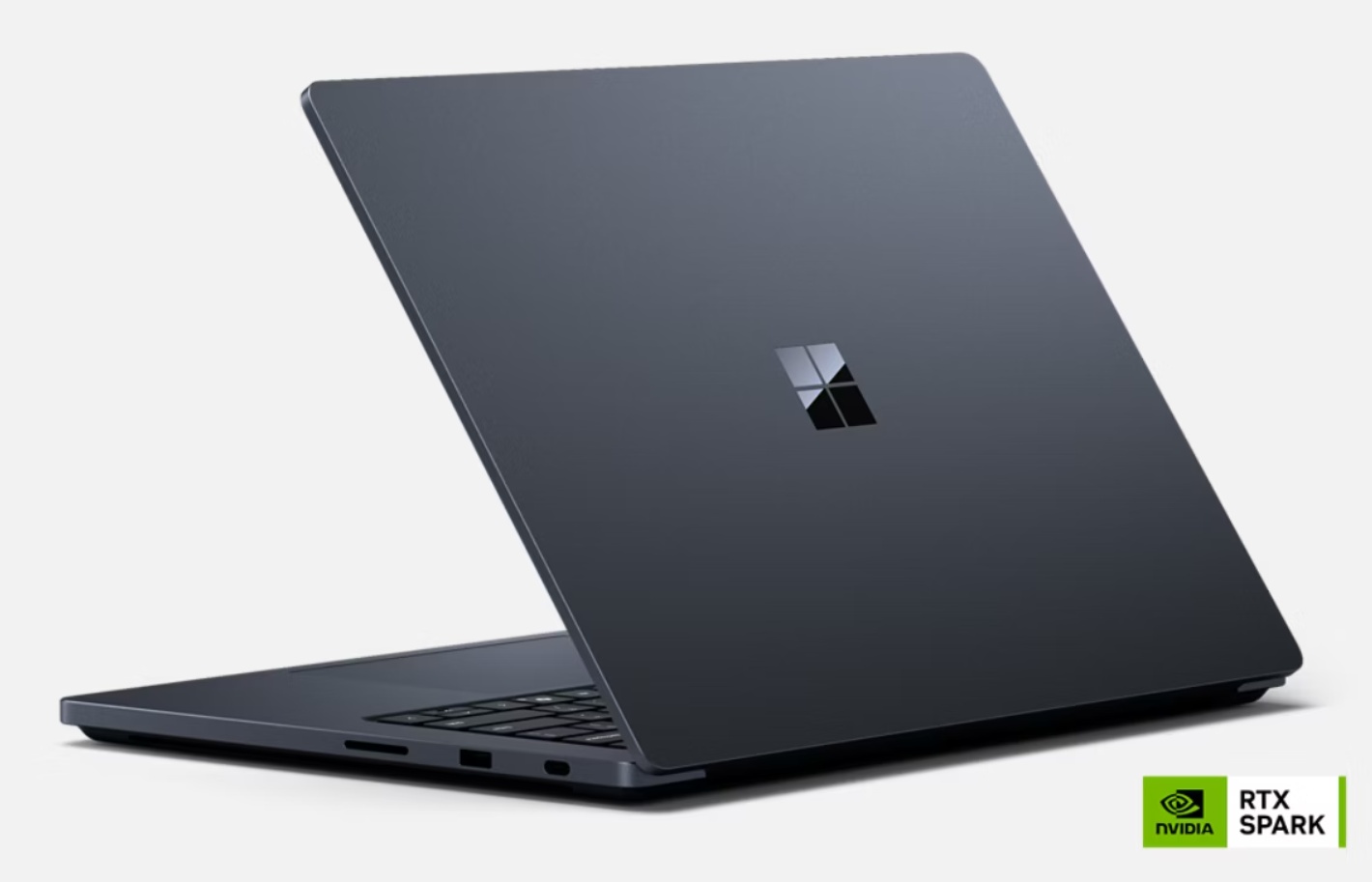
The clearest example of this trend is the RTX Spark-based Surface Laptop Ultra. As Wccftech reports, the configuration with 128 GB of unified memory and a 1 TB SSD, priced at $5,899.99, has already disappeared from Microsoft’s website. The fact that it sold out does not by itself prove exceptionally high demand: the reason could have been a small initial shipment. Microsoft has not disclosed sales figures. Nevertheless, the choice of the top-end version appears logical: it is intended primarily for AI developers, researchers, and content creators who need to run large models locally.
The key advantage of RTX Spark lies not only in its hardware specifications, but also in its compatibility with existing software. CUDA is an NVIDIA platform and toolkit that allows applications to use graphics-processor cores for general-purpose computing. Most popular machine-learning frameworks, inference systems, and professional creative applications are optimized for CUDA first. As a result, a specialist who has already built a workflow around NVIDIA’s ecosystem can simply transfer it to a new computer without spending time looking for alternative libraries, fixing compatibility issues, and performing manual optimization.
This is what is known as the “CUDA moat”—a durable competitive advantage that is difficult to replicate quickly. Competitors may offer more memory or a more attractive price-to-performance ratio, but compatibility with the software stack has value of its own. The article notes that the AMD Ryzen AI MAX 400 can support up to 192 GB of memory, but capacity alone is not enough if the required applications run worse or need to be adapted. For a professional, several days or weeks spent porting tools can cost more than the price difference between platforms.
RTX Spark is particularly interesting because of its unified memory. In this architecture, the CPU and GPU use a shared pool of memory rather than separate system RAM and video memory. This allows the graphics processor to access up to 128 GB of space—far more than standard consumer graphics cards, whose VRAM capacity is often limited to 16–32 GB. NVIDIA claims that this configuration can run models with 120 billion parameters and context windows of up to one million tokens. A context window is the amount of text or data that a model can take into account within a single request. The larger it is, the better suited the system is to analyzing large documents, software codebases, and extended conversations.
The practical significance extends beyond the technical specifications. Running large models locally can be important for companies that handle confidential data. It reduces dependence on cloud services, where businesses must pay for computing and send information to an external provider. For this reason, an expensive laptop may be viewed not as an ordinary consumer device, but as a compact workstation.
However, RTX Spark involves a significant compromise: relatively low memory bandwidth. The Surface Laptop Ultra offers around 273 GB/s, while the MacBook Pro with an M5 Max chip and the same 128 GB of unified memory can reach 614 GB/s. Memory bandwidth indicates how much data a processor can transfer between memory and computing units per unit of time. It is particularly important for workloads that constantly move large data sets, including image processing, simulations, and certain operations involving language models.
A comparison with the discrete mobile RTX 5090 demonstrates the difference between memory capacity and memory-access speed. The laptop RTX 5090 can significantly outperform the M5 Max in request processing and token generation—in the cited tests, its advantage reaches 133 percent—thanks to bandwidth of up to 896 GB/s. At the same time, its 24 GB of VRAM is insufficient for the largest models. RTX Spark, by contrast, is slower in some bandwidth-dependent scenarios but benefits from its available memory capacity. In other words, the RTX 5090 is better suited to fast computations on models that fit in VRAM, while RTX Spark is designed to run larger models at lower speed.
Microsoft is also trying to expand the platform’s audience by targeting Apple users. According to Notebookcheck, the company is offering MacBook Pro owners up to $1,000 in additional compensation when they trade in their device for a Surface Laptop Ultra. This amount is paid on top of the regular trade-in value—the program through which an old device is exchanged for a new one. To participate, customers must purchase an eligible configuration, submit an application, verify the purchase, and send their MacBook to a Microsoft partner within the specified period.
The offer shows that Microsoft views MacBook Pro users as one of its key target groups. These customers are already willing to pay for expensive laptops and value high-quality displays, long battery life, and performance, but they may also be interested in CUDA and local AI tools. The Surface Laptop Ultra starts at $2,599.99, and after factoring in the value of an expensive MacBook Pro and the maximum bonus, switching platforms could make financial sense for some buyers. Microsoft is effectively competing with Apple not only through specifications, but also by lowering the cost of changing platforms.
The configuration strategy itself is also important. The Surface Laptop Ultra is offered with an 18- or 20-core processor, graphics with up to 6,144 CUDA cores, 24–128 GB of unified memory, a mini-LED display, and a wide range of ports. This positioning differs from the traditional ultrabook approach: the device is designed not for maximum mobility or the lowest possible price, but to combine workstation capabilities with a laptop form factor.
The third article shows why such products are expensive and why their availability may remain limited. A Wccftech report claims that NVIDIA may discontinue GeForce RTX 5090 production and redirect GB202 chips to the professional RTX Pro lineup. This has not been officially confirmed, so the information should be treated as a market rumor. However, the economic logic behind such a move is clear.
GB202 is used in the 32 GB RTX 5090, as well as in the professional RTX Pro 5000, 5500, and 6000 accelerators, whose memory capacity reaches 96 GB. Professional cards are sold to enterprises, studios, and AI developers at significantly higher prices. Amid rising DRAM costs—including GDDR7 and system memory—it is more profitable for the manufacturer to direct a limited supply of large chips toward products with higher margins and steadier demand. The AI boom adds further pressure: enterprise customers are willing to purchase accelerators for training and running models, while gaming customers are more constrained by their budgets.
The situation is complicated by the fact that the RTX 5090 is already selling at prices approaching the professional segment. The article cites prices above $6,000 in some markets, although the recommended price and actual retail offers may differ significantly. If a gaming graphics card becomes comparable in price to a professional product, NVIDIA has fewer reasons to maintain its previous production volume—especially if professional versions offer more memory and certified support for specialized applications.
The presumed replacement is the 24 GB RTX 5080. According to preliminary information, it may use 3 GB GDDR7 memory chips instead of the 2 GB chips used in the current 16 GB RTX 5080. This would not make it a full equivalent of the RTX 5090: the flagship would remain substantially faster. However, the increase in memory capacity could make the new model more attractive for high-resolution gaming, professional applications, and local AI workloads. An estimated price of $1,999–2,999 would still be high, but lower than current RTX 5090 offerings.
Together, all three articles demonstrate how the criteria for value are changing in the market. In the past, the main parameters for a consumer device were clock speed, core count, gaming performance, and video-memory capacity. Now they also include the ability to run large AI models, CUDA support, unified-memory capacity, and the ability to perform computations without relying on the cloud. This expands the market for expensive devices, but also makes it less accessible.
The conflict between two types of demand is also important. Gamers need fast graphics cards, while AI developers place greater value on the combination of computing power and large memory capacity. Professional customers are willing to pay more and often purchase accelerators in bulk. As a result, the same chip competes across several markets at once: gaming, professional, and server computing. When production is constrained, the segment with the highest profitability receives priority.
For buyers, this has several consequences. First, hardware specifications cannot be considered separately from the software ecosystem: NVIDIA’s advantage is often determined by how easily a particular application runs and scales. Second, a large amount of memory does not guarantee maximum speed—the Surface Laptop Ultra can accommodate a larger model, but will be slower than solutions with higher bandwidth. Third, pricing and availability become part of the manufacturer’s strategy rather than merely reflections of production costs: shortages of professional accelerators can directly reduce the supply of gaming cards.
At the same time, CUDA should not be regarded as a universal or permanent advantage. Competitors are developing their own software platforms, open standards, and compatibility tools. If alternative ecosystems manage to offer comparable support, NVIDIA’s current “moat” may become less formidable. For now, however, switching from CUDA to another stack still involves technical costs, risks, and lost time, strengthening NVIDIA’s position among professional users.
The main conclusion is that the personal-computer market is gradually becoming an extension of the AI-accelerator market. The Surface Laptop Ultra is attempting to bring local AI computing to the laptop format, Microsoft is subsidizing the transition of MacBook users, and production of gaming flagships may give way to more profitable professional solutions. The sellout of the high-end Surface Laptop Ultra configuration and the possible reduction in RTX 5090 production are different events, but they reflect the same trend: memory capacity, CUDA compatibility, and AI suitability are becoming more important than the traditional division between “gaming” and “work” devices. For now, this gives NVIDIA strong market positions and high margins, while offering buyers new capabilities—but it also leads to higher prices, shortages, and a widening gap between the mass market and professional computing.