The latest escalation between Saudi Arabia and the Houthis shows that Yemen’s decade-long war has once again moved beyond the confines of a local conflict. Strikes on airports, oil infrastructure, and shipping are disrupting daily life in Saudi Arabia, threatening key trade routes, and forcing neighboring states to choose between direct intervention and limited support for Riyadh. The main conclusion, evident in all three reports, is that the balance of capabilities has shifted: despite their opponent’s superiority in aircraft and weaponry, the Houthis have managed to create a sustainable system of long-range strikes and pressure on critical infrastructure.
As Yahoo News, citing AFP reports, the Saudi-led coalition and the Houthis exchanged strikes on Sunday. Amid threats to Riyadh, the administration of the Kingdom Centre skyscraper—one of the capital’s landmarks—ordered office employees to work remotely “immediately and until further notice.” Merrill Lynch, McKinsey, and the International Monetary Fund are among the organizations operating in the building. The shopping mall at its base continued operating, underscoring the nature of the situation: this is not a complete shutdown of the city, but the gradual spread of military risks to business and civilian infrastructure.
Schools in Riyadh and surrounding areas also extended remote learning, while King Khalid International Airport remained closed after an attack that killed 13 people. According to Saudi civil defense authorities, a Houthi projectile struck a residential area in the city of Najran near the Yemeni border, injuring at least six people. Saudi authorities said they intercepted two ballistic missiles, but the very need for regular interceptions demonstrates the country’s vulnerability: even an unsuccessful strike forces airports to close, schools to change their operations, and major companies to restrict their activities.
The Houthis, for their part, claimed to have shot down a Saudi Apache attack helicopter near Najran. The coalition attributed the crash to a technical malfunction and reported that two pilots had been killed. The Houthi version is not independently confirmed in the report, but the episode is politically significant: these are the first confirmed Saudi military fatalities since intense fighting resumed in July.
PBS NewsHour takes a broader view of the situation, presenting it as the result of the Houthis’ gradual strengthening after years of air campaigns by Saudi Arabia, the United States, the United Kingdom, and Israel. Despite Riyadh’s possession of modern American aircraft and missile-defense systems, the Houthis continue to strike targets hundreds of kilometers from Yemen. Targets have reportedly included Riyadh’s international airport and the headquarters of oil company Saudi Aramco.
The Houthis’ military strategy is based on asymmetry. They use relatively inexpensive drones, ballistic and cruise missiles, as well as anti-ship weapons and naval drones. Saudi Arabia is forced to respond with costly interceptor missiles, whose supplies and availability are limited. Thus, even a missile that is shot down may benefit the Houthis: the cost of the attack is relatively low, while defending against it requires substantial expenditure and constant readiness.
The term “asymmetric warfare” refers to a confrontation between sides that differ significantly in resources and military power, in which the weaker side avoids direct clashes and attacks the stronger side’s vulnerabilities. In this case, the Houthis are not trying to destroy the Saudi army in open battle. Their goal is to disrupt airports, oil facilities, and maritime routes, thereby increasing the economic and political cost of the war.
According to PBS, the number of Houthi fighters grew from approximately 30,000 in 2015 to 350,000 by 2024. UN experts and other specialists link the group’s development to Iranian support, including training, technical expertise, and deliveries of components. Iran denies directly arming the Houthis, as such deliveries would violate the UN arms embargo. However, the seizure of numerous shipments of weapons and parts bound for Yemen, along with UN reports, points to enduring military ties between the Houthis, Iran, and other groups aligned with Tehran.
Of particular importance is the Houthis’ ability not only to receive finished weapons but also to produce a significant portion of them inside Yemen. This reduces their dependence on external supplies and allows them to adapt missiles and drones to local conditions. The reports also mention attempts to purchase components from Chinese suppliers for precision-guided ballistic missiles with a range of around 2,000 kilometers. Reports of possible use of artificial intelligence still appear to be speculation rather than an established fact, but they reflect a broader trend: non-state armed groups are gaining access to technologies that were previously available mainly to national armies.
The limited effectiveness of the Saudi campaign is linked not only to the quality of its weapons. Saudi Arabia is defending an enormous territory, roughly three times the size of Texas, while its border with Yemen stretches more than 1,300 kilometers through difficult desert and mountainous terrain. Oil facilities, airports, and pipelines are scattered across the country, making it virtually impossible to completely seal the airspace and protect every potential target.
Moreover, airstrikes are rarely capable of achieving final victory on their own. Defeating the Houthis would require ground forces capable of capturing and holding territory. But the anti-Houthi camp is divided: Yemen’s government, supported by Saudi Arabia, competes with southern separatists who were previously backed by the United Arab Emirates. These groups have clashed with one another, making a unified ground operation extremely difficult. Saudi Arabia is not confronting a single army, but a fragmented system of local forces, political interests, and external patrons.
The current wave of violence began after a lengthy, though fragile, truce. In 2023, the Houthis began attacking shipping in the Red Sea, claiming that they were thereby blockading Israel against the backdrop of the war in Gaza. US and British strikes on Houthi targets followed. Later, the group resumed attacks on Saudi Arabia and announced a blockade of Saudi shipping. According to Yahoo News, the Houthis seized territory near the Bab el-Mandeb Strait—a narrow maritime passage through which a significant share of global trade and energy exports passes.
Bab el-Mandeb is a strategic strait between the Red Sea and the Gulf of Aden. Its importance is comparable to that of the Strait of Hormuz at the entrance to the Persian Gulf: disruption of shipping here could increase transport costs, force vessels to reroute around Africa, and put pressure on global oil markets. Simultaneous threats to Bab el-Mandeb and the Strait of Hormuz turn the local Yemeni conflict into a factor in global energy security.
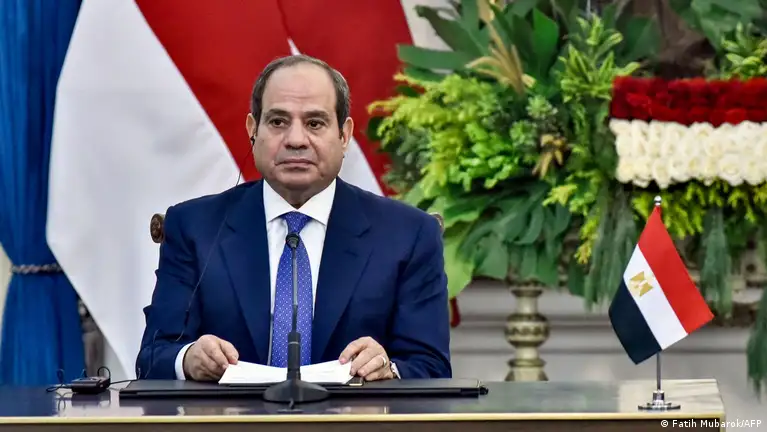
This is why the crisis affects more than Saudi Arabia alone. Egypt has a direct interest in ending the attacks, since reduced shipping in the Red Sea cuts revenue from the Suez Canal. In a DW report, Egyptian President Abdel Fattah el-Sisi said his country was ready to defend Saudi Arabia if Riyadh requested assistance. At the same time, he stressed: “We are talking only about defense,” not attacking anyone.
The Egyptian leader said Cairo was “not seeking a role” in regional conflicts, but could not allow harm to Saudi Arabia’s security and stability. For Cairo, this is a cautious formula. Egypt is demonstrating solidarity with a key ally while trying not to promise large-scale involvement in a war that could lead to further casualties, financial costs, and a direct confrontation with Iran or the Houthis. According to Yahoo News, the Egyptian parliament postponed a vote on Sisi’s request so that lawmakers could continue deliberations.
An important contradiction is evident here. Saudi Arabia needs support, but expanding the coalition could intensify the escalation. Egyptian involvement could strengthen air defenses and the protection of maritime routes, but it would also transform the conflict from a Saudi-Yemeni confrontation into a more overtly regional standoff. Iran could respond through the Houthis or other allied groups in Iraq, Syria, and Lebanon.
The political situation is further complicated by the fact that, according to PBS, the United States does not want to become more deeply involved in the conflict, as it is occupied with its confrontation with Iran. Saudi Arabia has signed mutual-defense agreements with nuclear-armed Pakistan and NATO member Turkey, but it remains unclear what practical assistance these agreements provide. France is publicly demonstrating support for Riyadh, while Russian and Saudi diplomats are discussing the escalation in Yemen and threats to shipping in the Strait of Hormuz and Bab el-Mandeb.
The main trend is that the Houthis are increasingly turning military weakness into political influence. They do not control a large modern economy and have no full-fledged air force, but they can force Saudi Arabia to close airports, send employees to work remotely, spend costly munitions, and seek help from its neighbors. This does not mean that the Houthis have won or are capable of inflicting a decisive defeat on Saudi Arabia. However, they have shown that superiority in aircraft and financial resources does not guarantee the security of critical infrastructure.
The second key conclusion is that a return to the previous strategy of airstrikes is unlikely to resolve the problem. The Saudi coalition has been striking Houthi-controlled territory for many years, yet the group has not only survived but also expanded its human and technological resources. A lasting settlement will require a combination of diplomacy, border-control mechanisms, security guarantees, and a political agreement within Yemen itself. At the same time, Saudi Arabia views the Houthi demand to lift the blockade as a potential admission of defeat, limiting the room for compromise.
Finally, the conflict is increasingly moving beyond Yemen’s borders. Its consequences are visible in airport operations, oil infrastructure, the activities of international companies, Suez Canal revenues, and the security of global shipping. Amid simultaneous tensions involving Iran, Israel, the Red Sea, and the Persian Gulf, even a limited attack could trigger a chain reaction—from higher insurance premiums and transportation costs to new military alliances and the direct involvement of neighboring states.
Thus, the current escalation is not simply another stage in the Saudi-Houthi war. It demonstrates how a non-state group with access to missile technology and external support can pressure one of the region’s wealthiest countries. Saudi Arabia retains a significant military advantage, but the Houthis are forcing it to defend an enormous territory while also taking threats at sea into account. Egypt’s readiness to help “only in defense” reflects the desire of regional powers to contain the crisis’s consequences without entering a full-scale war. However, as long as there is no political formula acceptable to both Riyadh and the Houthis, the risk of further expansion of the conflict remains high.