Three articles describe different crises: Houthi attacks on Saudi Arabia, Egypt’s possible involvement in defending the kingdom, and Donald Trump’s pressure on Ukraine to reach an agreement with Russia. Yet they share a common theme: U.S. allies are increasingly questioning Washington’s readiness to ensure their security, while regional powers and European states are being forced to fill the emerging vacuum themselves. As a result, the familiar model in which the United States served as the main guarantor of order is giving way to a more fragmented system of temporary coalitions, bilateral agreements, and independent military planning.
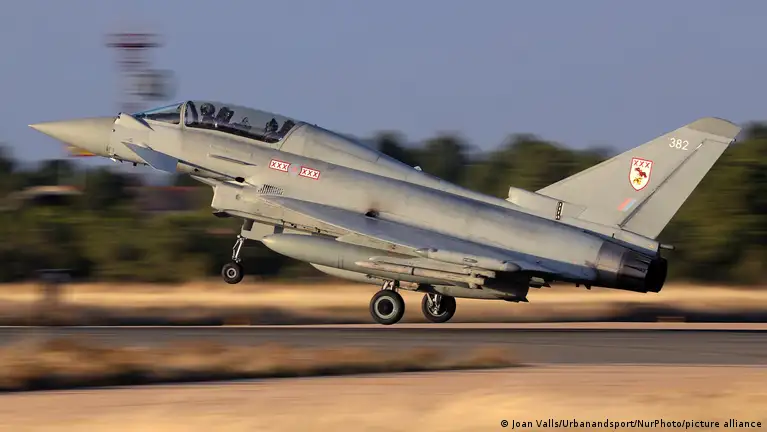
This shift is most clearly visible in the Middle East. The United Kingdom has decided to send Typhoon fighter jets, an Atlas A400M transport aircraft, and military advisers to Saudi Arabia. As DW reports, the British aircraft are to protect cities and critical infrastructure from drones and missiles, but will not strike Houthi targets in Yemen. London has also extended its offer to provide in-flight refueling for Saudi aircraft for 90 days.
This is an important limitation. The United Kingdom is prepared to help defend its ally but is avoiding a direct expansion of the war. This position reflects an effort to support Riyadh while avoiding becoming a full party to the conflict in Yemen. British Defense Secretary Wes Streeting called the Houthi attacks “absolutely appalling,” particularly the strikes on Riyadh International Airport, which, according to the data cited, had been attacked around 20 times since the beginning of October. Shelling of civilian infrastructure has killed at least 18 people and wounded hundreds.
The Houthis are a Yemeni movement associated with the political and religious group Ansar Allah. They control a significant part of northern Yemen and, since the outbreak of the civil war, have become one of the region’s main military actors. Saudi Arabia and the United States believe that Iran supports them, although Tehran denies this. In this context, the Houthi attacks are seen not only as a local Yemeni threat but also as part of the broader confrontation between Iran and the Arab monarchies of the Persian Gulf.
The escalation affects not only security but also the economy. The Houthis attack oil facilities, civilian infrastructure, and tankers, while also blocking maritime routes. This disrupts oil exports and contributes to rising energy prices. A symbolic consequence was the postponement until 2027 of Saudi Arabia’s Future Investment Initiative conference, known as the “Davos in the Desert.” The event was expected to attract bankers, investors, and private-capital representatives, but according to DW, major financial institutions expressed concern about security.
This is particularly sensitive for Saudi Arabia. The country is trying to implement its Vision 2030 economic diversification program, reducing its dependence on oil exports and attracting foreign investment in technology, tourism, industry, and infrastructure. Prolonged attacks undermine not only the physical security of facilities but also investor confidence. Military pressure is therefore becoming a factor capable of slowing the structural transformation of the Saudi economy.
Egypt is considering an even more serious form of support. President Abdel Fattah el-Sisi has asked parliament to authorize the deployment of Egyptian troops to defend Saudi Arabia. According to CBS News, the mission would be defensive and carried out only at Riyadh’s request. Egypt’s constitution requires consultations with the National Defense Council and approval by at least two-thirds of parliament before the army can be sent abroad to participate in combat operations.
Cairo faces a difficult choice. In recent years, Egypt has sought to avoid becoming entangled in regional wars and has advocated diplomatic settlements. Sending troops would represent a departure from this cautious policy. At the same time, the Egyptian leadership is bound to the Gulf monarchies by economic and political obligations. Saudi Arabia and other regional states have invested substantial sums in Egypt’s economy, creating a perception in Cairo that Egypt must now “return the favor” through practical support.
Retired Brigadier General Samir Ragheb, quoted by CBS News, expressed this position in particularly direct terms: “This is a time for war, not politics and statements.” In his view, if Egypt fails to fulfill its previous promises to support the security of the Gulf states, its statements will become “empty threats.” He also argues that the threat extends far beyond the Houthis themselves and includes Iran, Iraqi armed groups, and potential “sleeper cells” inside Saudi Arabia.
This assessment shows how a local conflict is interpreted by regional actors. For Egypt, the issue is not limited to protecting airports or oil terminals. It is connected to preserving the country’s status as a leading Arab power. Ragheb warns: “If you want to be a regional player, you have to play a role. Otherwise, you’ll lose your seat at the table.” In other words, military involvement is being viewed as an instrument of influence. A country unwilling to defend its allies risks losing the right to shape the regional agenda.
At the same time, Egypt is trying to assess how reliable U.S. support remains. Ragheb believes that Washington’s refusal to launch a direct strike on the Houthis has created a vacuum that other states must now fill. In this context, he cites the agreement signed by Saudi Arabia with Turkey and Pakistan—the so-called Mecca agreements—as evidence of a move away from the previous dependence on the United States. In his words, the agreement is “proof of the death of the idea of relying on America for defense.”
An article by Al Jazeera shows a similar problem in Europe. U.S. President Donald Trump is increasing pressure on Ukraine, demanding that it agree to a peace deal with Russia. He said that Volodymyr Zelensky “must want to end this war,” otherwise it would be “very bad” for him. Discussing a possible meeting between Zelensky and Vladimir Putin, Trump said: “I don’t care how it’s done.”
This wording matters less in itself than as a reflection of Washington’s new approach to its allies. The United States is talking less and less about long-term guarantees and increasingly about ending conflicts immediately, even if the terms of an agreement may be painful for a partner. Trump points to Russia’s superiority in manpower and claims that Ukrainian society will supposedly no longer support continuing the war. In effect, responsibility for prolonging the conflict is being placed on Kyiv.
Ukraine, by contrast, is seeking to retain influence over the content of the negotiations. After meeting with U.S. special envoy Steve Witkoff and European leaders in Oslo, Zelensky said that Kyiv had “clear ideas about how to achieve peace.” He called on the United States to convey these proposals to Russia and suggested moving toward a potential trilateral meeting of the leaders. This reflects Ukraine’s fundamental position: peace talks must take its own conditions into account rather than becoming an agreement imposed by external powers.
The dispute surrounding Starshield—the military version of the Starlink satellite system, which Ukraine uses for communications, intelligence, and coordinating operations against Russian attacks—is particularly revealing. Ukrainian officials reported that the system had slowed down, but it remained unclear who had ordered access to be restricted. Elon Musk said that Starshield is owned and controlled by the U.S. government, and that decisions about restrictions are made by the American military leadership and ultimately by the president. Trump and Defense Secretary Pete Hegseth, however, denied that the order had come from the government, shifting responsibility to SpaceX.
This episode demonstrates the vulnerability of allies dependent on foreign technologies. Even when a country receives weapons and communications systems, control over key infrastructure may remain with the supplier. During a political crisis, such dependence becomes an instrument of pressure. For Ukraine, this means that military resilience depends not only on the quantity of weapons but also on the United States’ political will to maintain access to satellite communications.
At the same time, Trump is seeking to normalize relations with Moscow. He invited Putin to meet in Alaska, expressed a willingness to negotiate with the Russian and Chinese leaders on nuclear disarmament, and supported an agreement to purchase Russian diesel fuel. In addition, his administration postponed the introduction of new sanctions against Russia and Iran, citing the need to take their possible consequences for the global economy into account. Secretary of State Marco Rubio called this “balancing,” since pressure on one country can negatively affect others.
Taken together, these steps create an image of a foreign policy focused on deals, flexibility, and the short-term reduction of tensions. This approach may help initiate negotiations, but it also creates uncertainty for allies. If support depends on current political calculations, partners begin seeking additional guarantees: the United Kingdom strengthens specific bilateral commitments, Egypt discusses an independent military role, and Saudi Arabia builds ties with Turkey and Pakistan.
The main conclusion from all three articles is that international security is becoming less centralized. Previously, many states relied on American protection as a basic guarantee, even while developing their own armed forces in parallel. That confidence is now weakening. The United States is not necessarily abandoning its allies entirely, but it is showing a willingness to limit its support, use it as leverage in negotiations, or demand a greater contribution from partners.
For Europe, this means developing its own defense capabilities and political agency. For the countries of the Persian Gulf, it means moving away from reliance on a single patron and creating a cross-cutting network of agreements with the United Kingdom, Turkey, Pakistan, and Egypt. For Egypt, it means choosing between cautious nonintervention and preserving its status as a regional leader. For Ukraine, it means facing the risk that its military and diplomatic strategy will be determined not only by Russia’s actions but also by changes in U.S. policy.
At the same time, any strengthening of regional alliances cannot automatically be considered a stabilizing factor. New coalitions may increase states’ ability to defend themselves, but they may also raise the likelihood of a chain reaction of escalation. Deploying Egyptian troops to Saudi Arabia could deter attacks, but it would also expand the conflict’s geographic scope. British Typhoons could strengthen missile defense but would not eliminate the political causes of the war in Yemen. Pressuring Ukraine into a ceasefire could reduce the intensity of the fighting, but an agreement perceived as unjust could merely postpone a new round of confrontation.
Thus, all three articles reflect a transition from the “American umbrella” model to a system of distributed but less predictable security. States can no longer limit themselves to political statements and waiting for assistance from a single external center. They must determine the limits of risk themselves, form new alliances, and take the economic consequences of conflicts into account. The key question is now not only who possesses military power, but also how reliable allies’ promises are in a moment of crisis.