In the days before the U.S. midterm elections, two trends intensified at once: early voting reached record levels by the standards of recent midterm campaigns, and tensions grew over who controls the election process and how. National polls show Democrats holding a significant lead over Republicans in preferences for the House of Representatives, while the outcome of the Senate race remains less clear. Against this backdrop, the Justice Department sent all states warnings about criminal penalties for failing to follow rules on retaining election records—a move that drew questions because of its timing and stern tone.
According to Politico, on Thursday the Justice Department sent letters to election officials in all 50 states. The letters, signed by Acting Deputy Attorney General Trent McCotter, reminded officials of their duty to preserve election records and warned that violations could carry “up to a year in prison and a $1,000 fine.” McCotter said the requirement was necessary to “protect the right to vote and maintain public confidence in the democratic process.”
The requirement to retain records is not new: it concerns compliance with laws governing the preservation of election materials. What was unusual, Politico noted, was the form the intervention took—a mass mailing threatening possible criminal prosecution just before voting. More than a dozen states confirmed receiving the letters. The Justice Department said it had sent them to every state, filing a notice to that effect in a lawsuit in which Democratic organizations accuse the department, the Department of Homeland Security, and President Donald Trump of interfering in states’ administration of elections. The dispute is therefore not only about how long records must be kept, but also about the limits of federal authority in an area where much of the day-to-day administration has traditionally remained with the states.
The political backdrop to this move is a tense election campaign marked by high turnout and uncertainty over the balance of power in Congress. Three days before the election, Democrats led by an average of 8.2 percentage points in a national poll on congressional preferences: 51.4% to 43.2%. As Al Jazeera reports, analyst Kyle Kondik believes that lead points to a strong likelihood that Democrats will take control of the House of Representatives. But national vote results cannot automatically predict the outcome of the Senate race: seats are allocated by state, and competitive campaigns are concentrated in particular districts and regions. As Kondik put it, a Democratic advantage in the House “does not mean the Senate will also go to Democrats”; that contest remains wide open.
An Economist/YouGov poll reflects a similar difference in voters’ expectations: 44% of respondents thought Democrats would win the House, while 31% expected Republicans to retain control. The gap was much narrower for the Senate: 39% expected a Democratic majority and 36% a Republican one. These figures reflect respondents’ expectations, not a forecast of the outcome, and should therefore be distinguished from their stated voting intentions.
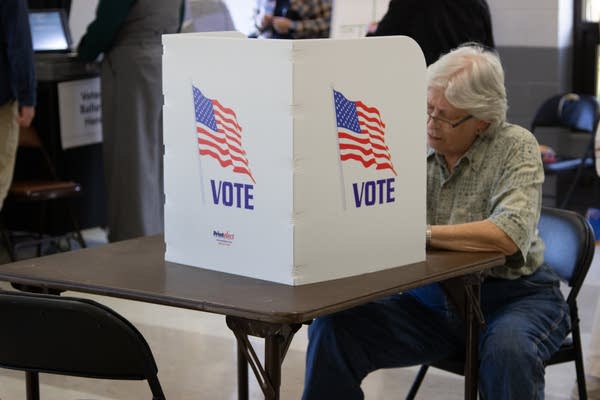
A key backdrop to the campaign is the scale of early voting. According to an Associated Press analysis cited by Al Jazeera, more than 43 million Americans had voted early in person or mailed in their ballots. That is about 10 million more than at a comparable point before the 2022 midterms. The increase is especially striking in states with competitive Senate races: in Texas, more than 6.3 million people had voted by Wednesday, compared with 4.2 million at the same point in 2022; in Georgia, more than 2.5 million ballots had been cast by Friday—more than during the entire early-voting period in 2022. Reports from Atlanta described long lines and increased participation among young voters. One said they were voting to ensure “a better future for everyone, especially the next generation”; another said social media had brought voting “to the forefront.”
Minnesota has also seen a surge. According to MPR News, nearly 729,000 people had voted there by Friday morning, in person, by mail, or using absentee ballots. That is well above the figures for any other non-presidential election year in the state. With ballots already requested and polling places open over the weekend and on Monday, Minnesota could approach the one-million-vote mark before Election Day.
High early turnout, however, does not show how people voted and does not guarantee any particular result. Above all, it reflects the scale of mobilization and changes the practical dynamics of the final days: campaigns must not only persuade undecided voters, but also get their supporters to show up or mail in their ballots. Democratic strategist Celinda Lake described the mood among some voters as an attempt to “take one last chance for change,” while also expecting elected officials to take concrete action.
Both parties have been working toward that goal. Trump added rallies in Iowa and Kansas back to his schedule after previously planning to replace them with phone events, and appeared in Florida. His team is counting on in-person appearances to energize Republican voters, especially in states with competitive Senate races. In Kansas, Republican incumbent Senator Roger Marshall faced a serious challenge from Democrat Adam Hamilton: one Emerson College poll put Hamilton at 49% and Marshall at 45%. In Texas, Republican Ken Paxton focused the final stretch of his campaign on Harris County, the state’s most populous county, as early voting there was drawing to a close. Democrats, meanwhile, held events in states and districts where they hoped to boost turnout. Former President Bill Clinton urged people to vote, recalling that candidates had lost in Mississippi because their supporters stayed home.
Local disputes over election administration take on particular significance amid such a close contest. Al Jazeera reports on a dispute in Alaska, where Trump accused Democrats of allegedly recruiting an independent candidate named Dan Sullivan to confuse voters and siphon votes from the Republican incumbent senator. Democrat Mary Peltola denied involvement in such a scheme, and the Justice Department took legal action related to the dispute. This episode, like the letters to state officials, shows that the battle for trust in the process is unfolding alongside the fight for votes—and may itself become part of the political contest.
The central tension in these reports is that exceptionally high voter participation is coinciding with the growing politicization of the rules under which elections are administered and verified. On the one hand, a federal agency cites legal record-keeping duties and the public importance of transparency. On the other, mass warnings of criminal penalties on the eve of an election may be perceived as pressure on election administrators, particularly when they come amid a court dispute over federal intervention. The information published so far does not establish that the letters changed the course of voting or were sent for a particular political purpose. But their arrival increases the risk that technical questions—record-keeping, retention periods, and the powers of federal agencies—will be viewed through a partisan lens.
The term “early voting” covers several ways to cast a ballot before Election Day: in person at a designated polling place, by mail, or through a state-specific process for requesting and submitting a ballot. The figures cited therefore cannot be directly compared without accounting for differences among states and their counting rules. A “congressional preference poll” typically asks which party’s candidate a voter would prefer to support. It helps gauge the national political mood, but does not replace forecasts for individual districts and states. Finally, preserving election records is a legal duty to ensure that materials are accounted for and available for reviews required by law; it is not an assertion that irregularities have occurred.
Taken together, the sources describe an election in which high turnout does not eliminate uncertainty but makes the contest for every state and every vote even more visible. Polls suggesting Democrats are likely to win the House do not guarantee them the Senate; early-voting records do not reveal the party affiliation of those who voted; and federal warnings about legal compliance may both strengthen formal accountability and intensify disputes over the independence of election administration. After Election Day, the key measure will therefore be not only the distribution of seats in Congress, but also whether government agencies, campaigns, and voters can accept the results as credible.