
Nearly five years after the collapse of Zillow Offers, its ambitious home-buying service, Seattle-based Zillow Group has agreed to pay $212.5 million to settle a class-action lawsuit brought by investors. Shareholders alleged that the company and several executives painted an overly rosy picture of the division’s performance, even as its home valuation models and purchasing system were already leading to costly mistakes. Zillow admitted no wrongdoing; the settlement still requires approval by a federal court.
In the summer of 2021, Zillow looked like one of the companies poised to enter a new era on the back of the pandemic-era housing boom. Its Zillow Offers service promised homeowners a quick cash sale: the company would buy the property, arrange repairs and then resell it. On August 5, 2021, co-founder and CEO Rich Barton told investors that the iBuying business was gaining momentum and offered sellers a convenient alternative to a traditional real estate transaction.
But behind that convenience was a risky bet on algorithms’ ability to predict the price of an individual home in a severely overheated and unstable market. The plaintiff in the case was investor Jeremy Jaeger, who represented purchasers of Zillow Class A and Class C shares between August 5 and November 2, 2021. The lawsuit named the company, Barton, Chief Financial Officer Allen Parker and executive Jeremy Wacksman. The plaintiffs alleged that management failed to disclose the scale of problems with pricing and purchasing, as well as with so-called manual adjustments to offers that, they claimed, concealed weaknesses in the automated models.
Warning signs became apparent in October 2021, when Zillow paused new home purchase agreements through the end of the year, citing operational constraints. On November 2, the board of directors decided to shut down Zillow Offers entirely. The company acknowledged that unpredictable home prices, limited renovation capacity, and difficulties with repairs and supply chains had made the business too risky. Zillow wrote down $304.4 million in value on homes it had acquired at prices above the expected future revenue from their resale after expenses, and announced plans to cut about a quarter of its workforce.
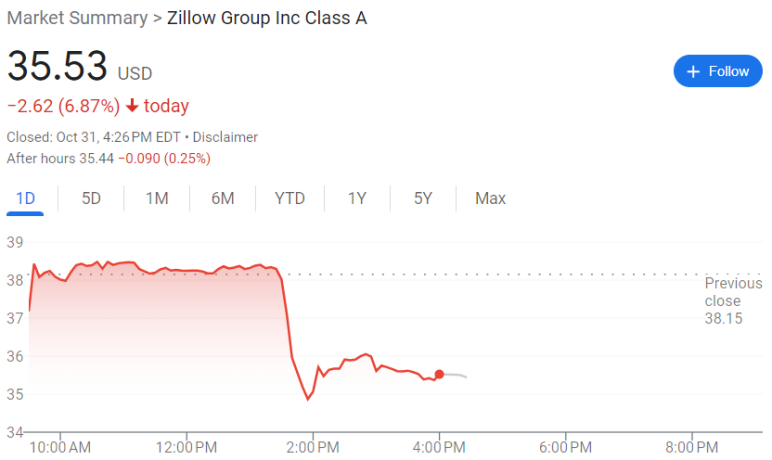
The move was a painful reversal for the market: Zillow shares fell about 32 percent in the two days after the news broke. The company had to sell off thousands of homes already in its inventory or under contract, while investors got a stark lesson in the limits of a “technology-driven” approach to real estate. An algorithm can instantly value millions of listings, but buying a particular home requires accurately predicting not only its price, but also future renovation costs, neighborhood demand, the cost of capital and how quickly it can be resold.
The lawsuit, filed in November 2021 in the U.S. District Court for the Western District of Washington, endured several years of procedural wrangling. In August 2024, Judge Thomas Zilly certified the investor class, and in September 2025, the Ninth Circuit Court of Appeals upheld that decision. Zillow sought to challenge the certification in the U.S. Supreme Court, but on October 5, 2026, the court declined to hear the appeal. The parties signed a settlement on October 27.
According to Zillow’s filing with the U.S. Securities and Exchange Commission, $212.5 million will be placed in a dedicated account once the court preliminarily approves the deal; about $48 million is expected to come from insurance policies. The fund will first cover notice to class members, case administration and attorneys’ fees, which the court will determine separately. Only then will the remaining funds be distributed among eligible investors, so the amount each shareholder will receive is not yet known.
The settlement does not resolve all the legal fallout from Zillow Offers. The company said explicitly that related shareholder derivative lawsuits remain pending. But for the main class-action case, it likely marks the end of a drawn-out dispute: after preliminary approval, investors will be able to object to the deal or opt out of the class, and the court will then hold a hearing on final approval. For Zillow, which has long since returned to its role as a digital platform for home searches and service advertising, the cost of its brief experiment in becoming the owner of thousands of homes has been not only financial, but reputational as well.
Based on: Zillow to pay shareholders $212.5 million in legal settlement