A roundup of Kenneth Walker III’s unsuccessful return to Seattle, the Kansas City Chiefs’ structural problems without Simmons and Rice, and betting expectations ahead of the Seahawks’ game against the Bears.
Kenneth Walker III returned to Seattle but couldn’t outrun the past: How the Seahawks shut down the Chiefs’ star
Returning to his hometown is always more than just another regular-season game for a professional athlete. It brings emotion, heightened media attention and a desire to prove that letting you go was a mistake. Kenneth Walker III found himself in exactly that situation after moving from the Seattle Seahawks to the Kansas City Chiefs in the offseason. On Sunday, he took the field at Lumen Field for the first time as an opponent. The intrigue was about more than personal drama: Walker had opened the season on an incredible pace, rushing for 665 yards in his first five games—the best mark in history for a player who had changed teams. It seemed the Seahawks’ defense, which had not allowed a 100-yard rusher in 35 straight games, and the Chiefs’ ambitious newcomer were headed for an epic duel. But, as often happens in sports, reality proved brutal and one-sided.
Instead of the anticipated battle of titans, we watched the Seahawks methodically and ruthlessly neutralize their former player—and the entire Kansas City offense—on their way to a 20–3 victory. Walker had perhaps his worst game of the season, gaining just 36 yards on 14 carries. After the final whistle, he did not join his former teammates as they celebrated at midfield; he headed straight to the locker room. “Damn, we lost. I was upset. That’s it. I saw them out there celebrating, that’s all,” he told reporters after the game, his words conveying not only the bitterness of defeat but also wounded pride.
The chief architect of Walker’s failure was Seattle’s defensive scheme. The Seahawks played two-deep safety coverage for almost the entire game and used nickel or dime personnel—packages with five or more defensive backs—on all 50 of the Chiefs’ snaps. It was a direct challenge: Seattle was effectively telling Kansas City, “Try to beat us through the air. We still won’t let you run.” The strategy worked brilliantly. Before this game, Kansas City led the league in yards per attempt (7.3) against teams using five or more defensive backs. On Sunday, however, the Chiefs could not capitalize. According to Next Gen Stats, Walker gained just 19 yards on eight carries against a seven-man box. Before the game, he had seven runs of 20 or more yards; that night, he failed to gain even 10 yards on a single carry.
After the game, Seahawks safety Nick Emmanwori admitted that stopping Walker had become a matter of principle for the whole team. “I’m not gonna lie, I wanted to keep him under 100 yards. I don’t listen to all the media noise, but that was my motivation. I know a lot of guys on defense wanted that too—to stop him and play a perfect game,” he told ESPN. His words confirm that the Seahawks saw Walker’s return not as an ordinary game, but as a personal challenge.
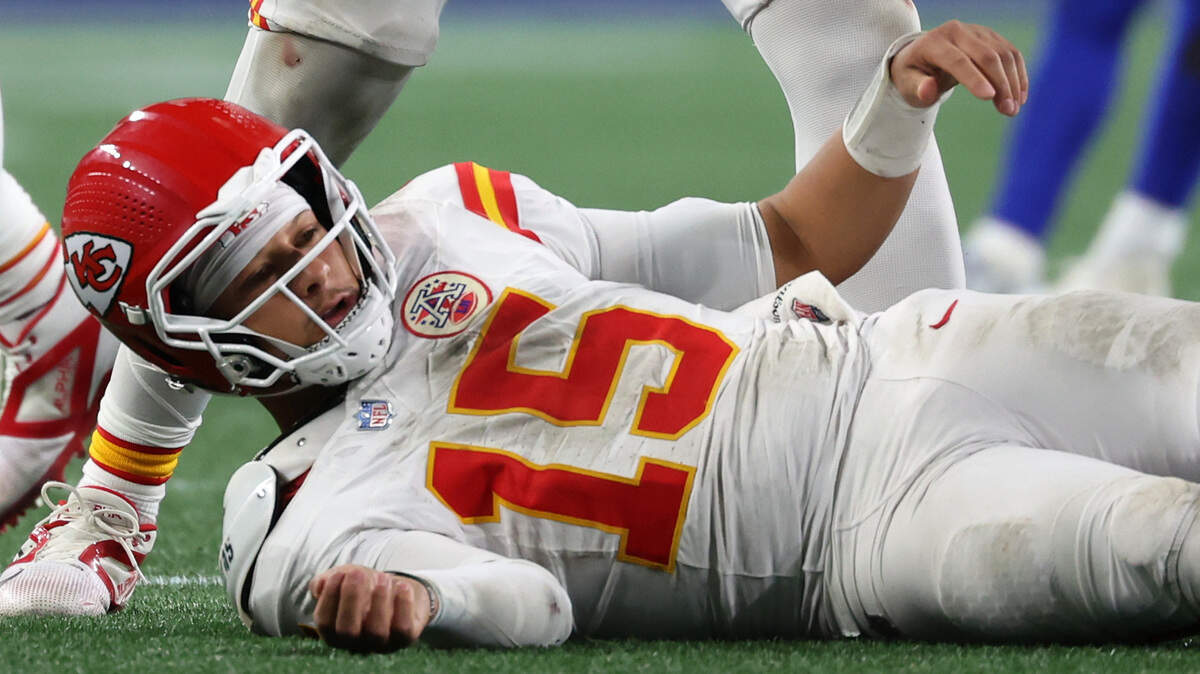
The Chiefs’ problems, however, went beyond Seattle’s defense. Kansas City took the field shorthanded. Key offensive linemen—tackles Josh Simmons and Jaylon Moore—as well as receivers Rashee Rice and Tyquan Thornton were out with injuries. Patrick Mahomes was left without reliable protection or proven targets. The Chiefs’ receivers—Xavier Worthy, rookie Cyrus Allen, Justin Watson, Andrew Armstrong and Jalen Royals—combined for just six catches and 39 yards. Mahomes, who usually finds ways to win even in the toughest situations, was helpless this time. Kansas City’s three points were the fewest the team had scored in any of Mahomes’ 153 career starts, including the playoffs. What’s more, the Chiefs failed to reach the red zone for the first time in the quarterback’s career.
Mahomes took responsibility after the game but also pointed to a systemic problem: “We have to help him [Walker]. That’s the main thing. When they’re focusing so much on stopping the run, we have to use the passing game and motion to be able to throw the ball. If we don’t, they’re going to keep putting guys up at the line of scrimmage. That’s tough on the run game.” In effect, Mahomes acknowledged that Seattle’s defense had forced the Chiefs into predictable play, and without a passing threat, Walker was trapped in the box.
For Walker, the evening was a bitter lesson. His return to Seattle, which was supposed to be a triumph, turned into his worst game of the season and a conspicuous exit without handshakes. “They played hard, and they beat us. We just have to get better,” he said—a remark that conveyed both disappointment and an understanding that nostalgia does not work in the NFL. Results do. The Seahawks proved their defense remains elite, while the Chiefs received a stark lesson: even the brightest newcomer cannot save a team when the entire offensive structure around him is falling apart. Kansas City now faces the difficult task of restoring balance to its offense before injuries turn a promising season into a failed one.
A guide to key terms: The article uses several specialized football terms. “Nickel” and “dime” refer to defensive packages in which extra defensive backs replace defensive linemen or linebackers. The “box” is the area near the line of scrimmage where defenders line up to stop the run. When a team puts seven defenders in the box, it is heavily focused on stopping the ground game, leaving itself more vulnerable to the pass. The “red zone” is the part of the field between the opponent’s 20-yard line and the goal line, where the offense has its best chance to score. A “snap” is the act of putting the ball in play to begin a down.
Patrick Mahomes was left without support in Seattle: The Chiefs lost where everyone expected them to
Perhaps the main takeaway from Sunday’s Kansas City Chiefs–Seattle Seahawks game is not the 20–3 score in the hosts’ favor, but how clearly it exposed the team’s dependence on two players who were not on the field. Kansas City Star columnist Sam McDowell puts it bluntly in his analysis of the game: Patrick Mahomes needed help in Seattle, and that help was back home. He means left tackle Josh Simmons and receiver Rashee Rice—two key offensive players whose absence turned an already difficult road trip to the reigning Super Bowl champions into a test of endurance.
The game itself was a picture of helplessness. The Chiefs scored just three points in the first three quarters—a first for Mahomes, and only the second time in his career the team had been held to three points that late in a game—and did not run a single snap in the red zone. The game began to slip away in the first half, as the quarterback came under constant pressure. According to PFF, he was pressured on seven of his 15 dropbacks, and those seven plays yielded 37 yards, an interception and a 32.1 passer rating. The pressure came mostly off the edges, where backup tackles Joshua Ezeudu and Kahlil Benson struggled. Together, they allowed nine pressures, including five by Ezeudu—the most on the team. Mahomes lost confidence in the line early and started leaving even clean pockets. One play became especially emblematic: the quarterback threw a spectacular sidearm pass right into a receiver’s hands, only for him to drop it. Mahomes’ reaction—hands on his helmet, head tilted back—said more than any statistic.
But the most interesting point in McDowell’s column is not his account of the failure; it is the question he poses directly: the Chiefs were not unlucky. They had deliberately chosen to rely on two players whose histories made clear that their availability was uncertain. Over the past 24 months, Simmons has missed games in college and the NFL for four different reasons: a torn patellar tendon at Ohio State, an unexplained monthlong absence for personal reasons during his rookie season, a wrist injury that ended that season, and now a back injury that began as minor, became a “week-to-week” issue and is now guaranteed to sideline him for at least half the season. It is telling that Simmons was only placed on injured reserve now, and that Andy Reid had to insist at a press conference that it was solely because of the injury. Before the game, NFL Network reported that Reid and Mahomes had asked Simmons to leave a team meeting earlier in the week. Rice, meanwhile, is missing his second straight game with a hamstring injury suffered nearly a month ago. Over the past two years, he has missed games for four reasons: a torn ACL, a league suspension over street racing in Dallas, a concussion and now a hamstring injury. Before this season, he had appeared in only 12 of 37 available games, including the playoffs.
The receiver group is in no better shape: Rice’s absence has exposed the lack of depth. Xavier Worthy led the team in snaps but turned six targets into 11 yards and dropped that pass. Second-year player Jalen Royals, who had seven career catches, ran the second-most routes—and in two consecutive plays, a teammate had to tell him at the line that he was lined up incorrectly. At one point, he was on the completely wrong side of the field. Andrew Armstrong dropped a pass with no defender anywhere near him, while Justin Watson, signed just a week earlier, caught one ball. Meanwhile, Cyrus Allen, who has at least shown flashes of talent, has inexplicably seen little playing time.
The broader context makes the situation even more worrying. The Chiefs are entering a stretch of six road games in eight weeks. Over ten weeks, they will face both Super Bowl teams, all four conference finalists, a team that started 6–0, and the team that just beat that 6–0 team. This stretch, not the first five weeks, will determine both Kansas City’s place in the playoffs and its ability to make a run once there. There is hope Rice could return next week. Simmons, however, has been told to rest—after it emerged that the previous plan, which ironically also involved resting him, had stalled his progress. McDowell advises keeping expectations in check.
Ultimately, the column makes a point that is easy to miss behind the 20–3 score: the Chiefs’ crisis is structural, not so much a coaching or on-field problem. The team built its plans around two talented players whose reliability had never been established, and that bet fell apart in its first serious test against a top-ten opponent in quarterback pressure. Andy Reid says the team must focus on the players who are available, but Sunday’s main story was about those who were not—and how predictable their absence was. Mahomes can win games on his own, but not when he has no left tackle, no top receiver and no confidence in his line. The Chiefs will have to play at their best or hope that something less will be enough. So far, “less” has meant three points through three quarters.
Seahawks at home against the Bears: Bookmakers back Seattle, but Macdonald’s season is off plan
Betting lines are a strange thing. They almost never reflect the whole story of a season, but they do capture very precisely what people with money think about the coming Sunday. And here there is an interesting disconnect. The Seattle Seahawks opened as home favorites against the Chicago Bears, even though Mike Macdonald’s team has had a season that looks nothing like what was expected over the summer. That’s according to Yahoo Sports, in a report on the opening line for the matchup.
A reminder of the context, because without it the numbers mean nothing. The Seahawks entered the season as the reigning Super Bowl champions and opened with a win over the New England Patriots. Expectations naturally followed: Macdonald hoped his team would again set the pace in the NFC West and secure home-field advantage in the conference playoffs. In practice, things went differently. The article, however, ends almost immediately after those words. What follows is an editorial note about a report on the Seahawks’ injury situation ahead of the Chiefs game and about how Zach Charbonnet’s absence affects fantasy football—so the original simply provides no details about the current form of Seattle or Chicago. This, in itself, is telling: the NFL news cycle is so packed that a preview of one game can easily turn into a fragment of another story.
Still, the main fact is clear: Seattle opened as a home favorite against Chicago. For readers who do not follow betting lines every day, a couple of terms may need explaining. “Opening the line” means that bookmakers have posted their initial odds, from which the betting market will move; the line has not yet settled and is almost certain to shift as people place bets. A “home favorite” is a team considered more likely to win at its own stadium. In the NFL, home-field advantage is traditionally valued at roughly three points, although that edge has gradually diminished in the modern league. In other words, the line tells us less that Seattle is absolutely better than Chicago than that, all else being equal, Seattle is considered a slightly safer bet at home.
The key insight here is the gap between expectations and reality. A team considered a contender for the top spot in the conference over the summer now has to prove itself in games like this, against an opponent bookmakers see as an underdog. Macdonald arrived with a reputation as a defensive specialist capable of building a tough scheme, and the opening win over the Patriots seemed to confirm that the team was on the right track. Judging by the tone of the original article, disappointment followed. The mention of the injury report ahead of the Chiefs game is another warning sign: missing players like Zach Charbonnet affects not only fantasy managers but also the team’s depth and flexibility in its game plan. In the NFL, where the schedule is unforgiving, one or two injuries to key players can often outweigh a coach’s tactical plans.
For Chicago, the line is also informative. Being a road underdog against a team that is itself going through a rough patch means bookmakers do not yet believe in the Bears enough to make the matchup even. But games like these—against a struggling favorite—are a litmus test for young teams. If Chicago can put up a fight in Seattle, that will say more about the Bears than a win over a bottom-feeder.
So what’s the takeaway? The line opened in Seattle’s favor, and that makes sense: home field, the roster and the coach’s reputation. But the Seahawks’ season has already taught us not to trust summer predictions. The game against the Bears is less a test of ability than one of character: can Macdonald’s team maintain control of its own story before it becomes a tale of missed opportunities? And keep an eye on line movement closer to kickoff—injuries and player-status updates can shift the opening odds faster than any analyst can write a preview.