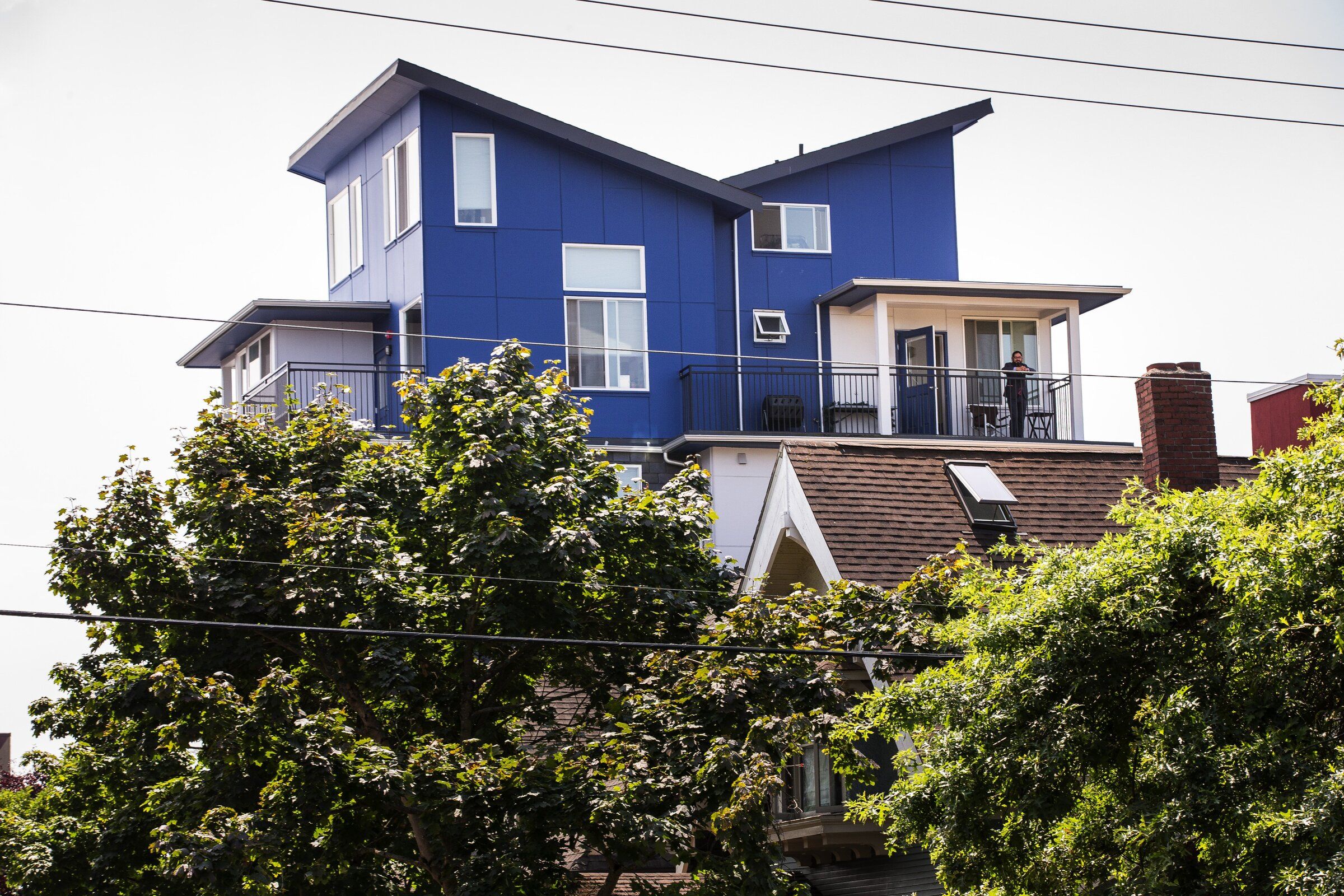
Three stories look at Seattle from different angles: a journalist swapped her San Francisco apartment for a house in Ballard for a month to test the idea of moving—and ultimately realized the city wasn’t for her; the undefeated Kansas City Chiefs, at 5-0, visit the reigning Super Bowl champion Seattle Seahawks at Lumen Field; and census figures show Seattle ranks third among the largest U.S. cities for the share of rental households without a complete kitchen: 2.7%, or about 5,900 households, nearly twice the national average.
How a home swap helped a San Francisco resident decide whether Seattle was right for her
Sometimes it’s better to test a major life decision in practice rather than make it blindly. That’s exactly what journalist Heather Snow did after seriously considering a move, having lived in San Francisco for 18 years. She loved the life she had built in the Bay Area, but her next step—buying a home of her own with a yard—seemed out of reach because of housing prices. And the thought of leaving a place she had called home for so many years made her worry she would regret it. Looking for an alternative, she turned her attention to Seattle: the city seemed to offer similar energy and career opportunities, while its proximity to spectacular nature was an added draw. She had visited many times and had a close friend there, so it seemed like a logical choice. But instead of jumping in headfirst, she decided to put the idea to the test and spend a month in Seattle before making a final decision.
To do that, she used HomeExchange, a platform that lets people swap homes around the world, and traded her apartment in Noe Valley for a house with a yard in Seattle’s Ballard neighborhood for the month of July. The greatest value of the experience was that she could feel like a local rather than a tourist. She worked remotely, went grocery shopping, visited Ballard’s Sunday farmers market, walked her dog, Pepper, in various parks in the mornings, and stopped by local breweries in the evenings. She paid particular attention to Ballard because she was considering it as a possible future home. She was impressed by the mix of residential streets lined with trees and single-family homes, and by the neighborhood’s historic center—with its shops, restaurants and bars—being within walking distance. It seemed like the perfect compromise: a home with a yard in a quiet neighborhood, while still enjoying city life and the walkability she valued in San Francisco.
A month of living there also let her experience problems she would have faced as a local. Although Ballard was very walkable, Seattle as a whole felt far more spread out and suburban than San Francisco. She had to drive more and spend more time in traffic than she was used to. One evening, a friend invited her to dinner. What she expected to be a 30-minute trip turned into a 55-minute rush-hour ordeal. That was when she realized getting around the city would take far more planning than she had expected. Having a dog also opened her eyes to local rules she might not have noticed on vacation. Although Seattle is considered a very dog-friendly city, she found more restrictions on access to the water and off-leash areas than she had known as a tourist. In San Francisco, she was used to letting Pepper run off-leash on the sand at Fort Funston. In Seattle, she discovered, most sandy beaches are closed to dogs.
In an unexpected way, the home swap also helped her understand what she wanted from a permanent home. Having someone else stay in her apartment gave her a chance to see her own home through another person’s eyes. The woman she swapped with remarked that many neighbors greeted her and that people she met on daily dog walks in Noe Valley were friendly. Heather wasn’t surprised: the sense of community in her neighborhood was one of the main reasons she loved San Francisco. Time away gave her a clearer idea of what she valued in the home she already had, and a new perspective on what she wanted next. A month in Seattle made it clear that the city wasn’t for her, but it also confirmed that she wanted something San Francisco prices had put out of reach: a home with a yard. Ideally, she would find a place combining the best of both cities—affordability, a walkable neighborhood with a sense of community, and natural beauty. She also realized that avoiding heavy traffic and crowds might mean looking beyond major metropolitan areas.
Perhaps the main lesson of her experiment is a universal one: a home swap proved to be a relatively inexpensive, low-risk way to test a major decision like moving. Before spending a lot of money on a move, she was able to refine her list of what she did and didn’t want in her next home. She is still looking for her next city, but she has a much clearer idea of what the next chapter of her life should look like. A few terms may need explaining for readers unfamiliar with them: HomeExchange is a service based on reciprocal home swaps, in which members stay in one another’s homes temporarily without paying rent, making it much cheaper than a typical rental or purchase. “Walkability” describes how easy it is to reach shops, cafes and other everyday destinations on foot. “Off-leash areas” are designated places where dogs are allowed without a leash, and their availability—or lack thereof—can have a significant effect on the quality of life for dog owners. The story’s key insight is that a short-term “test drive” of a new city can offer a more honest picture than tourist visits and help prevent a costly mistake. As the journalist put it simply, the home swap let her “refine her list of wants and deal-breakers” before spending money on a move.
Kansas City Chiefs vs. Seattle Seahawks: Where and when to watch the NFL Week 7 game
The Week 7 regular-season matchup between the Kansas City Chiefs and the Seattle Seahawks promises to be one of the weekend’s marquee games. The Chiefs come into the game undefeated at 5-0, having beaten the Denver Broncos, Indianapolis Colts, Miami Dolphins, Las Vegas Raiders and Los Angeles Chargers. They sit alone atop the AFC West. Their opponents are the reigning Super Bowl champions, the Seattle Seahawks, and the game will be played at Seattle’s home stadium, Lumen Field. That adds intrigue: the home team traditionally plays well in front of its fans, while Kansas City will try to extend its unbeaten run on the road. The Chiefs hold the edge in the teams’ head-to-head history, with 34 wins and 19 losses in 53 meetings. Both teams are seen as contenders with high ambitions this season, so the game is more than just another regular-season matchup; it’s an early test of those ambitions. Seattle will want to confirm its status as champion and defend its home fortress, while Kansas City will look to prove its perfect start is no fluke. Details on how, when and where to watch the game are available in the team’s official article at Chiefs.com. A few points may help readers who don’t follow American football closely: the NFL is divided into two conferences, the AFC and NFC, and each conference is split into divisions. So leading the AFC West means the Chiefs are currently the best team in their four-team division and have an advantage in the race for the playoffs. A 5-0 record means five wins and no losses. Lumen Field is the Seahawks’ home stadium in Seattle, known for one of the loudest crowds in the league, which has historically made it a tough venue for visiting teams. The Super Bowl is the final game of the season, played to determine the NFL champion; Seattle won it last season, hence the term “reigning champion.” The story’s key points are Kansas City’s perfect start and division lead, Seattle’s status as defending champion, the home-field advantage and the Chiefs’ historical edge in the head-to-head series (34-19). The main takeaway is simple: this is an early but revealing test for both teams, one that could affect their confidence and the playoff picture as the season progresses.
No kitchen included: Why Seattle ranks high for rentals without a stove
If you take having your own stove for granted rather than seeing it as a luxury, the statistics on Seattle may surprise you. According to the latest U.S. Census Bureau figures, about 5,900 rental households in the city lack a complete kitchen. That’s roughly one in every 40 rental households, or 2.7%. The figure may seem modest at first, but nationwide it puts Seattle third among the 50 largest U.S. cities, behind only San Francisco and Los Angeles. In other words, for thousands of city residents, making dinner means heating something in a microwave, taking food out of a mini-fridge or walking down the hall to a shared kitchen.
It’s important to understand what the Census Bureau counts as a complete kitchen. It must have three features inside the unit: a sink with a faucet, a stove or cooktop, and a refrigerator. If even one of these is missing, the home is classified as lacking a complete kitchen. That includes apartments with only a microwave or a portable hot plate, as well as units where residents share a kitchen with other people in the building. So the figure covers not just unusual cases, but also fairly common types of shared housing.
The national breakdown is telling. San Francisco leads, with 3.6% of rental households lacking a complete kitchen, followed by Los Angeles at 3%. Seattle, at 2.7%, narrowly outranks Indianapolis, Long Beach, Portland and Oakland, where the figure is around 2.5%. The pattern is striking: six of the top seven cities are on the West Coast. For a typical large American city, the share of such households is just 1.2%—less than half Seattle’s rate. At the bottom of the list are Orlando, Las Vegas and Washington, where well under 1% of renters make do without a complete kitchen. Even New York, known for its cramped apartments, comes in at just 1%.
The situation in Seattle is getting worse. In 2010, about 3,200 rental households, or 2.2%, lacked a complete kitchen, and the city ranked just 12th among today’s 50 largest cities. Since then, the number of such apartments has nearly doubled, and their share has risen. Most large cities have moved in the opposite direction: the national average fell from 1.6% in 2010 to 1.2%. Even San Francisco and Portland, which topped the list in 2010, have improved considerably.
The census data do not explain the reasons, but the common thread is clear: high housing costs. As rents rise, the cheapest options are usually the smallest. A kitchen without a stove is not a new invention. Old Seattle single-room occupancy hotels, many of them downtown, in Pioneer Square and in Chinatown, have housed workers and low-income residents for decades in small rooms with shared bathrooms and no way to cook. Some of these buildings are still in use, often as subsidized housing. The statistics also include other types of accommodation: the census counts a hotel or motel room as a home if someone lives there permanently and has no other home, and some basement apartments and converted spaces have a sink and refrigerator but no stove.
A newer phenomenon is microhousing. Starting around 2009, developers built a wave of tiny units with shared kitchens in neighborhoods such as Capitol Hill and the University District, until zoning changes and opposition from neighbors brought the trend to a halt. For some residents, a small apartment without a stove is a deliberate compromise that means lower rent in a neighborhood where everything is within walking distance. And for those whose top priority is living alone, such units remain one of the few ways to do so on a limited budget. Renting a standard one-bedroom apartment often requires several thousand dollars upfront: the first and last months’ rent, plus a substantial deposit. Many micro-units and older single-room occupancy buildings have a much lower barrier to entry, making them the only realistic option for renters with little cash on hand. The future of microhousing is uncertain, but the thousands of kitchenless apartments already built aren’t going away. As long as standard housing remains unaffordable, some renters will continue to make the same trade-off: giving up a kitchen to afford rent. Read more in The Seattle Times.
A few terms help clarify the issue. In census terminology, a “household” is not an individual person but a housing unit, which may be occupied by one person or a family. A “complete kitchen” is defined as a specific set of features—a sink, stove and refrigerator—inside the unit, so a shared kitchen down the hall does not count. “Microhousing” refers to exceptionally small apartments, usually smaller than a standard studio, with shared kitchens and sometimes shared bathrooms, designed for single residents. Finally, the “barrier to entry” is the amount that must be paid when moving in: the first and last months’ rent plus a deposit. That upfront cost is often the deciding factor when choosing between a full apartment and a unit without a stove.