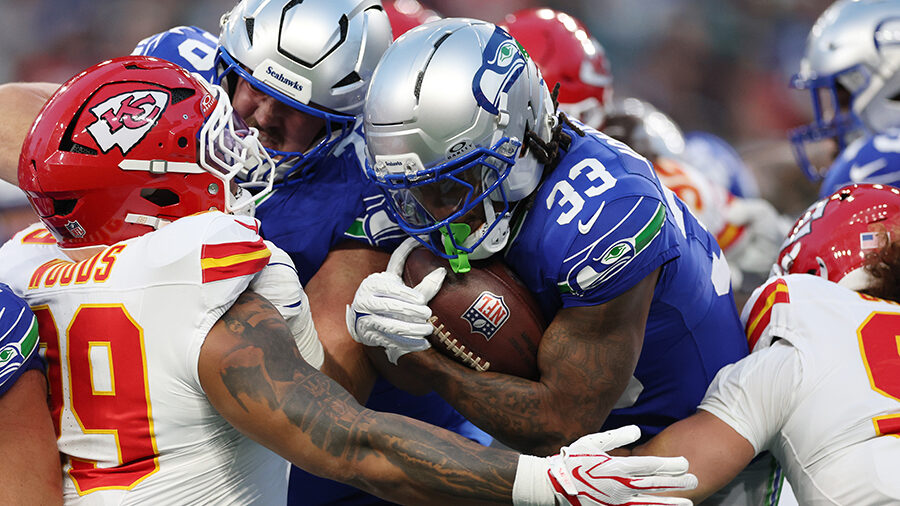
A look at the day’s news: the Seahawks bolster their offensive line with Nelson and weigh whether to make more trades; a truck carrying cleaning products crashes in the University District, prompting crews to protect storm drains; northbound I-5 will close for the weekend as repairs to the Ship Canal Bridge wrap up.
After a blockbuster trade, what’s next for the Seahawks ahead of the deadline?
The Seattle Seahawks jumped into the NFL trade market ahead of everyone else on Tuesday, striking a blockbuster deal with the Indianapolis Colts to acquire All-Pro guard Quenton Nelson. Less than two weeks remain before the November 10 trade deadline, but for Seattle, that is beside the point: the first move is done, and the big question now is whether it will be the only one. The Nelson trade is a major move for the team even if it does nothing else. The offensive line improved last season and returned all five starters, but it has looked unconvincing through the first seven weeks. It has not all been bad—the Sunday win over the Chiefs was the line’s best performance of the season—but the offensive line remains one of the broken gears in a Seattle offense that struggled to get going until Week 7. Still, as Seattle Sports notes, acquiring one of the league’s best guards could be enough, especially with running backs Zach Charbonnet and Jadarian Price expected back soon.
The second-most popular option in a Seahawks fan poll on social media was to keep the remaining draft picks and make no more trades. Still, the most popular response was to bolster another position—not running back or receiver. Many fans point to the need for more depth on the edge of the defensive line. Seattle ranks second in the league in quarterback pressure rate (30%), but has not turned that into sacks: its 17 sacks rank only fifth. With that in mind, keep an eye on Josh Sweat of the Arizona Cardinals and Khalil Mack of the Los Angeles Chargers. The Chargers, who have yet to win a game, could get at least some compensation for their disappointing start to the 2026 season by trading 35-year-old Mack, who has three sacks and 11 quarterback pressures. The Chicago Bears are also among the teams in the mix, but they failed in their attempt to land DeForest Buckner, who went to San Francisco on Tuesday. The Seahawks could join the race, too: free agent Dante Fowler has contributed almost nothing so far—one quarterback pressure in 81 defensive snaps. Sweat is younger at 29, and his team is closer to a top-10 draft pick than to the playoffs.
Another possibility is bolstering the running back group. Jonathan Taylor is probably not in the picture; the Colts may keep him as part of their rebuild unless they receive a generous offer. But Tennessee’s Tony Pollard is a popular name after a standout Week 7, when he rushed for 129 yards and three touchdowns. The Seahawks will eventually get Charbonnet and Price back, but it is unclear whether either will be ready by Monday’s game against the Bears. Both are eligible to return: Charbonnet has been reinstated to the 53-man roster, while Price has missed the minimum four weeks required to be activated from injured reserve. Price showed enough in a limited number of attempts to give fans reason for cautious optimism about a second-half surge, but how confident is the team in a rookie and a veteran returning from ACL surgery? We may see Charbonnet at his best down the stretch, which would fit perfectly with a Super Bowl run—but that would require more consistent production from the running back group. Other candidates include Arizona’s James Conner and Chicago’s Roschon Johnson.
The least popular option among fans—and arguably the most intriguing—is adding a receiver. The Seahawks have injuries in the backfield, have long wanted a star-studded offense, and such a move would make sense. But the offense already has the league’s best receiver. A year after leading the NFL in receiving yards, Jaxon Smith-Njigba is doing it again: 867 yards through seven weeks, or 123.9 per game, putting him on pace for just over 2,000 yards this season. The problem is that JSN has 58 receptions, while the next closest receiver, Kupp, has just 19. JSN led the league in target share last season (36%), so perhaps this is not a problem. The Seahawks have already won a Super Bowl with an offense that relied heavily on a star receiver’s production. But without Kenneth Walker III and Charbonnet in the backfield, that looks like a riskier bet. Rashid Shaheed was supposed to be the No. 2 option, but has yet to flourish in that role and is also dealing with a knee injury. Head coach Mike Macdonald said Monday that the initial outlook was positive, but did not make any promises. The team has options in-house: more opportunities for Shaheed when he returns and more targets for tight end A.J. Barner. But a team that sought outside help last year could do so again. Names to watch include Jacksonville’s Brian Thomas Jr., Minnesota’s Jauan Jennings and the Jets’ Garrett Wilson. Fun fact: Wilson was one of the first-round picks the Hawks sent to the Jets for Jamal Adams.
For readers unfamiliar with the terminology: a guard plays on the interior of the offensive line, protecting the quarterback from pressure up the middle and opening lanes for running backs; Nelson is considered one of the league’s best at the position. “Pressure” refers to a defender forcing the quarterback to speed up a throw or leave the pocket, even if the defender does not record a sack—a tackle of the quarterback with the ball behind the line of scrimmage. “Target share” measures the proportion of a quarterback’s throws directed at a particular receiver; 36% is exceptionally high and shows how heavily an offense relies on one player. Injured reserve is a list of players who cannot play and must miss at least four weeks, after which the team may activate them back onto the roster. Finally, the “trade deadline” is the cutoff after which teams cannot trade players for the rest of the season, making every deal in these two weeks especially valuable.
The key takeaway is clear: Seattle has addressed its most pressing weakness by strengthening the offensive line, but its offense still depends on one outstanding receiver and the hoped-for return of running backs from injury. With the league’s second-highest pressure rate but a modest number of sacks, adding a pass rusher looks like the logical next move. Pursuing a receiver would be a riskier bet, but could prove most valuable if JSN continues to carry the offense. The team’s next moves on the trade market will show whether it is going all-in on a playoff push or taking a more cautious approach to improving the roster.
Seattle truck carrying cleaning products crashes: why an ordinary accident required special precautions
A traffic accident in Seattle’s University District might seem routine at first glance, but it drew the attention of city crews. A truck carrying dishwashing chemicals collided with a passenger car at the intersection of 15th Avenue Northeast and Northeast 40th Street. The Seattle Fire Department responded quickly and asked residents to avoid the area while crews dealt with the spill.
It may have been household cleaning products rather than toxic industrial chemicals, but even a seemingly harmless truckload of these materials requires serious attention. Firefighters did more than clean up the spill: their main task was to keep the cleaning solution out of storm drains. Unlike sanitary sewers, storm drains generally do not carry water to treatment plants. Instead, the water flows directly into streams, rivers, lakes and, in Seattle’s case, Puget Sound. That means any chemical that gets onto the road near a drain could threaten the local ecosystem—fish, aquatic plants and water quality overall.
That is why incidents like this are classified as potentially hazardous-material events, even when a truck is carrying nothing more than dishwashing products. Concentrated detergents contain surfactants, fragrances and other ingredients that can harm aquatic life in large quantities. For fish, for example, concentrated detergent in the water can be deadly because it interferes with breathing through the gills and damages mucous membranes.
The speed and coordination of the city’s response are also notable: the intersection was closed, access was restricted, and cleanup efforts were carried out with the drainage system in mind. This reflects the standard spill-response protocol used in American cities: first isolate the area, then contain the substance, and only then collect and dispose of it. The fact that the fire department issued a public warning shows that even “household” chemicals in industrial quantities are treated as a risk.
The report from KIRO 7 News does not say whether anyone was injured or how large the spill was, nor does it explain what caused the collision—who may have violated traffic rules or whether anyone was hurt. The exact amount of solution being transported is also not specified, making it difficult to assess the seriousness of the environmental threat. Still, the incident is a reminder that transporting chemical cargo through densely populated areas always involves a balance between logistical needs and risks to the city.
The main takeaway is simple: in an urban environment, even everyday substances can become hazardous if they end up where they do not belong. The coordinated response by emergency services and their attention to protecting storm drains show that modern cities treat such accidents as full-fledged chemical incidents—and rightly so. The cost of negligence in cases like this is measured not only in damaged pavement, but also in the condition of the environment.
Ship Canal Bridge repairs in Seattle near completion: northbound I-5 to close for weekend
Seattle residents and anyone planning to travel through the city this coming weekend should plan their routes in advance. Washington state officials have announced a full closure of northbound I-5 between the I-90 interchange and Northeast 45th Street, coinciding with Halloween, one of the busiest nights of the year for traffic. According to FOX 13 Seattle, the closure will run from Friday evening until early Monday morning and is tied to the completion of repair work on the Ship Canal Bridge.
The work is part of the Revive I-5 project, which has involved repairing and reinforcing the bridge’s road surface. During construction, northbound traffic on the bridge was reduced to two lanes. Now that the work zone is being removed, all lanes across the bridge are expected to reopen. The lengthy full closure is necessary so crews can dismantle temporary infrastructure and return the highway to normal operation.
The Washington State Department of Transportation (WSDOT) says all northbound I-5 lanes between I-90 and Northeast 45th Street will be closed from 11:59 p.m. Friday, October 30, until 5 a.m. Monday, November 2. Connector ramps and some lanes will begin closing as early as 9 p.m. Friday. The I-5 express lanes will run northbound only throughout the weekend and return to their usual schedule on Monday. For drivers, this means detours through downtown and along nearby highways will be significantly more congested, especially on Halloween evening, when people head out for celebrations in large numbers.
The biggest uncertainty is the weather. WSDOT says the work zone cannot be removed unless the weather is dry: road surface work and striping cannot be done properly in the rain. If it rains over the weekend, the project may be moved to another dry weekend. The department has not yet announced a backup date, so drivers will have to follow updates and be prepared for the closure to happen at another time. In a region with rainy autumns, that is a significant risk, and the uncertainty itself makes travel planning difficult.
A few details mentioned in the news deserve clarification. Interstate 5 is the main transportation artery on the U.S. West Coast, running from the Canadian border to the Mexican border, and its Seattle section carries tens of thousands of vehicles every day. The Ship Canal Bridge is a key link in the highway just north of downtown Seattle, so its closure affects not only local residents but also through traffic. “Express lanes” are special lanes in the center of the highway whose direction changes depending on the time of day: they usually run southbound in the morning and northbound in the evening, and are often switched to one-way operation on weekends to ease congestion in the main travel direction. Finally, Revive I-5 is WSDOT’s long-term program to repair worn sections of the highway, and completing work on the bridge is one stage of that effort.
The main takeaway for drivers is straightforward: if you plan to travel north through Seattle over the weekend, leave early, consider alternate routes, or skip the car altogether in favor of public transit. The situation is made worse by the closure coinciding with Halloween evening, while the possibility of rain delaying the work makes it impossible for drivers to plan with certainty. The completion of the repairs is good news in the long run, since removing the work zone will restore the bridge’s capacity, but the price of that improvement is one very difficult weekend for traffic.