A gas station clerk was shot in Seattle for no apparent reason, with no robbery involved, and the killer remains at large; the Seahawks activated Irv Charles to bolster special teams; and Calvin Harris will embark on his first solo North American tour, including a concert at Climate Pledge Arena.
Murder for Murder’s Sake: Seattle Gas Station Clerk Shot, but Not Robbed
Early Tuesday morning, a crime took place in Seattle that shocked even residents accustomed to the city’s troubles: a clerk at a 76 gas station mini-mart across from Seattle Center was shot and killed. The most disturbing part of the story is the motive—or, more precisely, the apparent lack of one. A man dressed in black entered the store, bought a drink, then calmly walked behind the counter and shot the employee. There was no robbery, no argument and no apparent reason. Police still do not know whether the attack was random or targeted, and the killer remains at large.
According to a KOMO News report, Seattle Fire Department medics received a call about a “scene of violence” at the intersection of Denny Way and Broad Street at 5:52 a.m. The busy intersection is just steps from the Space Needle, one of the city’s main tourist attractions. The clerk, a man in his 30s, died at the scene before help arrived. Seattle Police Officer Brian Pritchard said the 911 caller reported that someone was inside the store and appeared to be unresponsive. Witnesses or surveillance footage showed the suspect—a heavyset man dressed entirely in black—entering the store, making a purchase, then walking behind the counter and opening fire.
One key detail makes the tragedy especially chilling: a glass partition intended to protect employees stood between the counter and the sales floor. But its door was open. “There was something like a glass barrier there, but the door was open, so he walked around it and was able to shoot the clerk,” Pritchard explained. Police reviewed the surveillance footage and found no fight or attempted robbery. It is not known exactly how many shots were fired or what type of weapon was used. Investigators also have not determined whether the suspect knew the victim. The suspect calmly left after the shooting, and investigators have not ruled out the possibility that a vehicle was waiting for him around the corner.
The death comes against an already tense backdrop. The tragedy occurred just 11½ weeks after a mass shooting at the Bite of Seattle food festival. For local residents, this is no longer a series of isolated incidents but an alarming new normal. Joe, a 68-year-old Capitol Hill resident, told reporters that after 36 years in the same apartment, nighttime gunfire had become a familiar sound. “Hearing about a murder at a gas station—that concerns me. Seattle Center is right across the street; people bring their children there, and that scares me,” he said. He has been going to Seattle Center for 60 years but now does not feel comfortable bringing his grandchildren there. Jack, another resident who noticed the red crime-scene tape on his way to meet a friend visiting from out of town, was brief: “It’s incredible. I don’t feel safe even just parking my car here, let alone something like this.” He added that he had visited the mini-mart and regarded it as an ordinary place to stop and buy something on the way—“certainly not somewhere you expect something like this to happen, especially for no reason.”
The account from the victim’s colleague adds particular pain to the story. The woman, too shaken to appear on camera, told KOMO News that the victim was her manager—“a great boss,” understanding and resourceful. He had started his shift around 5 a.m., roughly 50 minutes before the shooting, taking over from her. “My boss was killed an hour after I left,” she said. “I don’t understand who could have wanted to do this to him.” Asked why the door behind the counter might have been left unlocked, she answered with bitter honesty: “Because I’m probably a little more paranoid than he was.”
Several details mentioned only briefly in the original news report are important for understanding the context. Seattle Center is a large public complex with parks, museums, arenas and the Space Needle, visited daily by thousands of families with children. A murder literally across the street is therefore perceived as a blow to the sense of safety in the heart of the city. A 76 gas station is a chain fuel station with a convenience store—a typical American setup in which the clerk often works alone behind a counter separated from the sales floor. A glass partition with a locking door is a standard employee-safety measure at such locations, and the fact that the door was open rendered the barrier useless. Seattle Police Chief Adrian Sells, serving as acting chief, also visited the scene, while detectives and crime-scene technicians were still working in the parking lot and inside the store by Tuesday evening. The police video unit and homicide detectives reviewed the recordings, but no additional information about the suspect had been released.
The central point of this story is not simply another report of gun violence. Several troubling themes converge here. First, a killing with no apparent motive and no robbery is the kind of crime that is nearly impossible to prevent and leaves the public feeling that the threat is completely unpredictable. Second, the symbolic importance of the location: a center of tourism and family recreation has become a scene of violence, directly affecting residents’ quality of life, as reflected in Joe’s and Jack’s comments. Third is the human dimension. The victim was not an abstract “clerk,” but a specific person who had taken over a colleague’s shift an hour before his death so she could go home, and whom she described as an excellent boss. Police are asking anyone with information or surveillance footage from the area of Denny Way and Broad Street between 5 and 6 a.m. Tuesday to call the Violent Crimes Tip Line at 206-233-5000. For now, residents are left with the same question as the victim’s colleague: who could have done this, and why?
Seahawks Bring Back Key Special-Teams Player, Make Room for Return Specialist
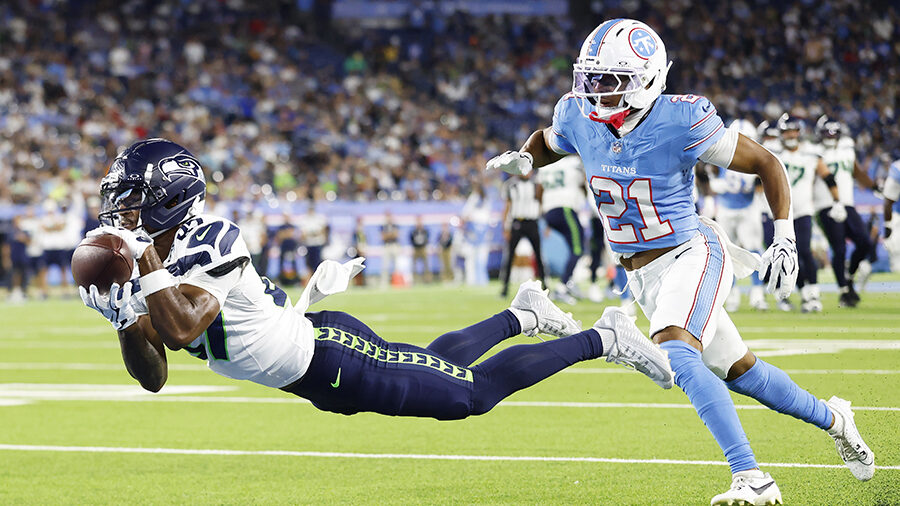
The Seattle Seahawks activated wide receiver Irv Charles from injured reserve Tuesday, opening the possibility of his debut as early as Thursday against the Denver Broncos. The move is an important step for a team struggling in one of the key areas of the game: kickoff returns. At the same time, the Seahawks had to make a difficult roster move. To open a spot on the 53-man roster, the team waived running back and return specialist Velus Jones Jr., though he was later re-signed to the practice squad. The transaction shows how highly Seattle values Charles’s potential on special teams, even though he has yet to play a game for the club.
Charles, 29, was placed on injured reserve before the start of the season because of an undisclosed injury and was cleared to resume practicing last week. The Seahawks acquired him from the New York Jets in May in exchange for a conditional seventh-round pick in the 2028 draft. Charles is expected to become an important part of Seattle’s special teams. In 25 games with the Jets during the 2023 and 2024 seasons, he played 450 special-teams snaps, recorded 14 tackles and blocked one punt. At 6-foot-4, he is particularly valuable in blocking situations and battles for the ball. Charles has seen almost no action on offense, however: just 53 career snaps and no receptions on two targets. He suffered a torn knee ligament in December 2024, causing him to miss the final four games of that season and part of the following one.
Charles’s return is especially important given the Seahawks’ troubling special-teams statistics. This season, Seattle has not allowed an opponent to return a punt for positive yardage—only three of 20 punts have been returned, and none gained ground. The kickoff-return situation is far more concerning. Last year, the Seahawks ranked fourth in the league, allowing an average of 24 yards per return. This season, opponents are averaging 29 yards, the fourth-worst figure in the NFL. That is where Charles is expected to help, given his high-level experience on special teams.
Jones, also 29, played seven games for the Seahawks over the past two seasons, primarily on special teams. In four games this season, he returned two kickoffs for 40 yards and made two special-teams tackles. He also played two offensive snaps without recording a statistic. His release was a temporary measure to create room on the roster, and returning him to the practice squad allows the club to retain depth in case of further injuries or a need for reinforcement.
The move is part of the broader picture of the Seahawks’ season, which began with a 3–2 record. As columnist Stacy Rost notes, this start feels different from those of previous years, potentially reflecting the team’s maturity and ability to solve problems during the season. At the same time, the club is dealing with disciplinary issues around the league: the NFL suspended San Francisco 49ers player Dre Greenlaw for headbutting Seahawks player Jones, underscoring the intensity of the divisional rivalry. In addition, head coach Macdonald continues to express confidence in cornerback Josh Jobe despite criticism of his play.
Activating Charles is not simply about bringing back one player; it is an attempt to correct a specific weakness that can cost the team field position and, ultimately, games. If Charles can quickly regain his form after the injury and adapt to the Seahawks’ system, he could become the missing piece that restores reliability to Seattle’s special teams. Thursday’s game against the Broncos will provide the first opportunity to test that possibility.
Calvin Harris Embarks on First Solo North American Tour, Including Seattle
If you think you have never heard of Calvin Harris, you are kidding yourself. Turn on any popular radio station from the past decade and you can probably sing at least one line from one of his hits. “One Kiss” with Dua Lipa, “We Found Love” and “This Is What You Came For” with Rihanna, “Feels” with Pharrell Williams, Katy Perry and Big Sean, “Slide” with Frank Ocean and Migos, and “Promises” with Sam Smith—the list could go on forever. The man behind billions of streams worldwide is embarking on his first solo North American tour, and Seattle is among the cities on the schedule.
According to information published by Seattle Refined, the DJ and producer will perform at Climate Pledge Arena on May 14, 2027. The show is part of an 18-date tour across cities in the United States and Canada. It is a milestone for Harris: despite being one of the world’s most sought-after producers, he has never previously mounted a full solo tour of North America, instead appearing at festivals and holding residencies in Las Vegas.
The past year has been a busy one for the musician. He played sold-out shows in Scotland and Ireland and set a record for the longest DJ set in São Paulo. His catalog has surpassed 56 billion global streams, and his tracks have long crossed the boundaries of dance floors, radio airplay and festival stages to become an integral part of pop culture.
The logistics are also important for fans. Ticket sales will open in stages. Spotify Premium subscribers will be the first to get access through Reserved by Spotify on Monday, October 19, at 10 a.m. local time. Presale for fans registered with the artist begins Tuesday, October 20, at noon. General sales open Thursday, October 22, also at noon.
Why does this matter? Harris’s tour is a rare instance of an artist whose singles seem to play everywhere finally bringing a solo-show format to North America. For Seattle, it is also a major event in terms of the city’s profile: Climate Pledge Arena, known for its commitment to environmental standards, will host one of the most commercially successful musicians of the modern era. The 2027 concert will test how strong public interest in electronic dance music remains at a time when festival headliners are increasingly giving way to pop stars and rappers. If tickets sell as quickly as they did in Europe, it will confirm Harris’s status as one of the few DJs capable of filling arenas on his own across two continents.