The Mariners exercised Andrés Muñoz’s option, declining those for Bryce Miller and Víctor Robles; MLS announced a 14-match Sprint Season in 2027 ahead of its shift to a summer-to-spring calendar; and South Park opened Cloverleaf, the city’s largest tiny-home village, with 90 units.
Mariners keep Muñoz, let Miller and Robles go: calculation or risk?
The Seattle Mariners have made their first major move in what promises to be an offseason packed with roster decisions—and it’s a mixed one. The club announced that it had exercised the option on closer Andrés Muñoz’s contract for the 2027 season, worth $9 million, while declining the options for starting pitcher Bryce Miller ($6.075 million) and outfielder Víctor Robles ($9 million). The move looks like an attempt to retain the bullpen’s core while saving money on players whose value has come under increasing scrutiny in recent seasons. After these moves, the major-league roster stands at 34 players, leaving room to maneuver in free agency and the trade market.
The main paradox is that Muñoz is staying with the team after a decidedly disappointing season. The two-time All-Star tied for the league lead in blown saves (10) and posted a career-worst 4.24 ERA. His underlying numbers, however, are not disastrous: 89 strikeouts and 24 walks over 57 1/3 innings in 61 appearances, a 5-6 record with 28 saves, and a 1.22 WHIP. In other words, the problem is less about stuff or control than about inconsistency in high-pressure situations—a classic case in which a closer’s numbers can be misleading without context. The club apparently believes the 27-year-old right-hander can return to his previous form, especially since it holds another $9 million club option for 2028. That amounts to a two-year bet on his rebound.
The logic is different with Miller. The 28-year-old right-hander had a roller-coaster season: he began the year on the injured list, returned in spectacular form in mid-May, then went winless in his final 13 starts. He finished 4-10 with a 4.17 ERA, a 1.16 WHIP, 119 strikeouts and 38 walks over 118 2/3 innings in 22 games (21 starts). Declining the option does not mean cutting ties: Miller remains under club control and is entering the second-to-last year of arbitration eligibility. In January, the two sides had already agreed on a one-year contract with a club option for 2027 to avoid an arbitration hearing. The Mariners are therefore preserving flexibility: Miller is not going anywhere, but the club is avoiding locking in a high salary amid his inconsistency.
The most painful decision concerns Robles. The 29-year-old outfielder turned his breakout 2024 season into a two-year contract, but over the past two years he has played just 97 games—injuries and a drop in form took their toll. In 2026, his slash line was a modest .256/.315/.308: three doubles, two triples, no home runs, 10 stolen bases, nine walks and 22 strikeouts in 65 games. That is not enough for an outfielder earning $9 million, and the club chose to move on. Robles is now a free agent, joining an already long list of departing players: Randy Arozarena, Taylor Ward, shortstop J.P. Crawford and reliever Hoby Milner are also headed to the market. Free agents will be able to officially sign with any club starting November 2 at 2 p.m.
A few terms need explaining to complete the picture. A club option is a team’s right to extend a player’s contract on terms agreed in advance. If the team declines, the player either becomes a free agent or remains under club control through arbitration. Arbitration is a process in which the salary of a player without a long-term contract is set through negotiations or a hearing; the club retains the player’s rights until he accrues enough service time. That is why declining Miller’s option is not a loss: it is a way to save money while retaining control. A save is recorded when a reliever finishes a game under certain conditions; a blown save is charged when the reliever fails to preserve the lead. Muñoz’s league-leading number of blown saves helps explain fans’ concern. WHIP—the average number of walks and hits allowed per inning—is a key measure of a pitcher’s effectiveness. Muñoz’s 1.22 and Miller’s 1.16 are both respectable, underscoring the gap between perception and the numbers.
The main takeaway: the Mariners are building their offseason around manageable risk. They kept Muñoz at a reasonable price, did not let Miller walk for nothing, and parted ways with an expensive, injury-prone Robles while opening up roster space. But this strategy comes at a cost: both the bullpen and starting rotation remain areas of uncertainty, and the division’s rivals are not standing still. The club is also searching for a new manager: according to Seattle Sports, candidates are already taking in-person interviews, and analyst Jon Morosi has discussed why Joe Espada might be a good fit for the job. A Seattle Sports report notes that the roster overhaul will affect not only the players but also the coaching staff. Adding to the sense of an era ending is the news that former Mariners catcher Mitch Garver has retired.
If Muñoz returns to All-Star form, the club’s decision will look like a masterstroke for $9 million. If he doesn’t, the Mariners risk repeating last year’s scenario, with an unreliable closer in high-leverage games. In any case, the next few weeks will show how aggressively the club is prepared to address the holes in its outfield and starting rotation.
MLS enters a new era: what the 2027 “Sprint Season” will bring
North America’s top soccer league is preparing for a seismic shift in its calendar, and the first step will be an unusual, abbreviated and tightly packed tournament. Major League Soccer has officially announced the schedule for its so-called 2027 Sprint Season, a transition season that begins February 19 and ends May 8. The league will test a format that differs dramatically from the model familiar to European fans, ahead of a much broader reform: beginning with the 2027–28 season, MLS will move fully to a summer-to-spring calendar.
According to the official announcement on the Seattle Sounders FC website, all 30 clubs will take part in the Sprint Season, with each playing exactly 14 regular-season matches—seven at home and seven away. The schedule is straightforward and symmetrical: each team will face every opponent in its conference once. This approach significantly reduces the overall workload on players and allows the regular season to fit into roughly two and a half months, from mid-February to early May.
For the Seattle Sounders, the tournament begins February 21 with a home match against Real Salt Lake at Lumen Field. Two away games follow: against Minnesota United on February 28 and Austin on March 6. Key dates on the calendar include two Cascadia Cup matches: away to the Vancouver Whitecaps on March 20 and at home against the Portland Timbers on April 3. The regular season ends May 8 on Decision Day, when all conference matches kick off simultaneously and the results determine the final standings. The Sounders will close out the season away to St. Louis CITY. One interesting detail: this is the second time in the past five seasons that the Seattle club has ended its regular season in St. Louis.
The playoffs will also change. The top eight teams in each conference will qualify for the postseason, which will use a single-elimination format—in other words, no two-game series, as the league has used in recent years. The conference champions will meet in the MLS Cup final, scheduled for Memorial Day Weekend. Exact playoff dates and the bracket will be announced later.
The commercial and media aspects are also worth noting. Every Sprint Season match will be available on Apple TV in more than 100 countries and regions, without local blackouts. This continues the league’s global partnership with Apple, which has made the platform a one-stop destination for MLS. What’s more, an Apple TV subscription will be included with clubs’ full-season memberships. For the Sounders, this also means a rethink of ticket sales: the club is offering two membership options. The first, Sprint Season Membership, covers all seven regular-season home matches and includes the full range of benefits, including Return Ticket Credit. The second, Flex Membership, costs $500, credited toward tickets that can be used for any matches during the season, including the playoffs. Fans who sign up by November 5 will also receive tickets to the 2026 Decision Day match against the LA Galaxy on November 7.
A few terms help clarify the details. The “Sprint Season” is an abbreviated transition tournament that bridges the old spring-to-fall calendar and the new summer-to-spring one. Single elimination means a team is out of the tournament after its first loss, unlike a best-of-three series, where teams have room for error. Decision Day is the final day of the regular season, when all conference matches start simultaneously so no team can tailor its result to the known outcomes of games being played elsewhere. Finally, the Cascadia Cup is a traditional rivalry among three clubs from the Pacific Northwest—Seattle, Portland and Vancouver—that compete for a separate trophy based on their head-to-head results.
The main takeaway from the announcement is clear: MLS is deliberately pursuing a bold experiment that challenges the familiar North American sports model. A 14-match season is unprecedentedly short for a league that has historically built its schedule around long regular seasons. The emphasis is on intensity, excitement and high stakes in every game: over such a short stretch, every dropped point matters enormously, and the race for playoff spots becomes almost cutthroat from the opening rounds. For fans, that means fewer games that feel inconsequential; for clubs, it means less time to find form and greater demands on squad depth and rotation. For Seattle, the Sprint Season is also an opportunity to attract new fans with flexible, lower-cost membership options, lowering the barrier for those not ready to buy a full-season membership. It remains to be seen how successful the format will be and whether it will prove more of a necessary compromise on the way to a broader calendar reform. But one thing is certain: MLS intends to put its idea to the test very soon.
Seattle opens its largest tiny-home village: 90 homes and a new approach to homelessness
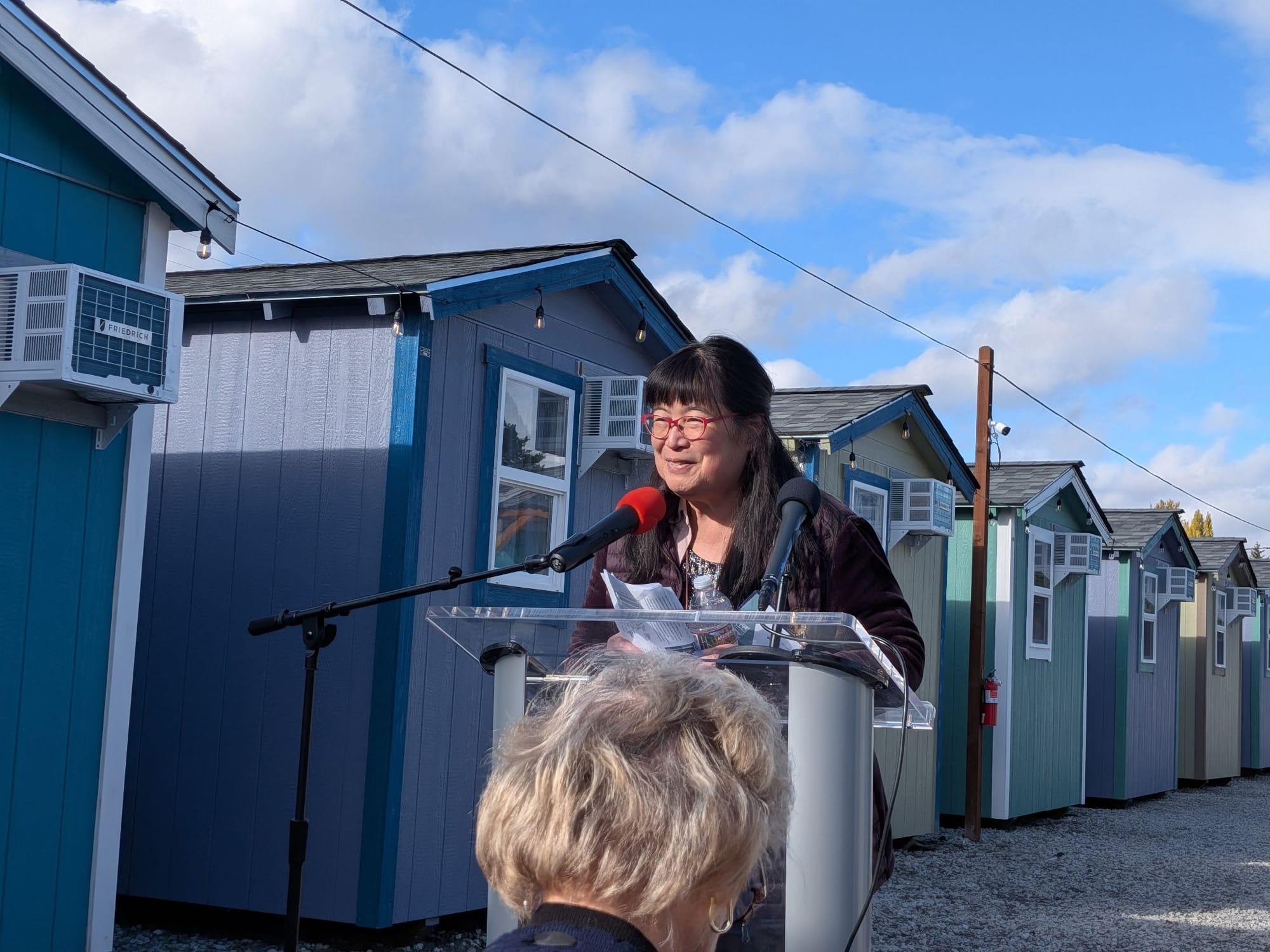
The Cloverleaf tiny-home village has opened in South Park, an industrial neighborhood in south Seattle near Highway 99. It is the largest such initiative in the history of the nonprofit Low Income Housing Institute (LIHI). The 90 compact homes, each measuring eight by twelve feet, can house around 100 people. For a city that has been living under a homelessness emergency for more than a decade, the village is both a symbolic gesture and a test of whether local government can quickly create at least some housing for people living on the streets. The opening is the first notable result of an accelerated shelter-building program launched by new Mayor Katie Wilson, and an occasion to consider how fragile the balance remains between local efforts and federal policies that weaken the social safety net.
At the opening ceremony, Wilson put the significance of the moment simply: “When I look around, I think this is what progress looks like. This is 90 tiny homes, 90 doors that lock, 90 opportunities for someone to come inside, take a breath and find a new beginning.” She said Cloverleaf is part of a broader commitment the city is finally ready to fulfill. Behind that statement lies a long and dispiriting history: Mayor Ed Murray declared a homelessness emergency back in 2015, but the problem has not gone away. The 2026 point-in-time count, conducted by the King County Regional Homelessness Authority, found that homelessness had increased by 9 percent compared with 2024, with a growing share of people living unsheltered. At the same time, service providers are bracing for the effects of changes in federal policy: cuts at the Department of Housing and Urban Development, reductions to health insurance subsidies and to the Apple Health and SNAP food assistance programs. Decisions by the Trump administration are weakening the social safety net, threatening to push more people onto the streets.
The village’s financing reflects the city’s bet on a partnership with business. The project was funded through a public-private partnership with Challenge Seattle, with support from the Seattle Foundation; the business community contributed $3 million. “The mayor told us that addressing chronic homelessness was one of her top priorities,” said Christine Gregoire, former state governor and executive director of Challenge Seattle. “We asked how business could help, and we’re here today because our members stepped up.” The city, in turn, will continue to cover the village’s operating costs, provided the City Council approves the relevant line item in Wilson’s proposed 2027 budget without changes. Pastor Lawrence Willis of New Direction Missionary Baptist Church is Cloverleaf’s faith sponsor. Having a sponsor helps speed up a village’s launch and gives the sponsor a role on its community advisory committee.
According to LIHI Executive Director Sharon Lee, the mayor’s intervention is what allowed the village to open so quickly. “She brought all the department heads into one room, looked at our plans and permits, and said, ‘Does anyone have a problem? Speak now, and we’ll approve the permits. This has never happened before,’” Lee said. “For a tiny-home village, this is probably the shortest permitting timeline in history.” Without that extra push, she added, Cloverleaf would have opened only next year. The acceleration was made possible after Wilson sent three legislative proposals to the City Council early in her term: additional funding for emergency shelters in 2026, authorization for the city to lease large parcels of land at market rates, and an increase in the base and maximum number of people shelters can accommodate. All three ultimately passed, though not without friction between the council and the mayor’s office.
The village’s infrastructure extends well beyond the homes themselves. It has a large kitchen tent, ten restroom units with a toilet, sink and shower, shared indoor and outdoor spaces, and a laundry room with free machines and detergent. Operation Sack Lunch provides residents with three meals a day. On-site staff provide case management and mental health support—services that, Lee said, LIHI villages had previously been unable to afford as part of their comprehensive support. The homes are insulated and have heating and air conditioning, and their doors lock. The village is for adults only, but pets are allowed: there is a dog run in the back and dispensers for waste bags. Some homes have double beds for couples, and 12 units meet ADA requirements. Security cameras are positioned at regular intervals and monitored on-site, while staff are on duty around the clock, seven days a week.
Transportation is the project’s weak point. The nearest bus stop is more than half a mile away, some nearby streets have no sidewalks, and heavy truck traffic serves the businesses in the area. LIHI plans to launch a shuttle, but its frequency and hours of operation have not yet been determined. “We’re still developing Cloverleaf’s transportation plan,” Alexis Diltz, LIHI’s senior communications manager, told The Urbanist. “We expect to purchase a van soon and will develop a schedule and routes as the project gets underway. We want the plan to reflect participants’ needs and priorities, so their feedback will be an important part of the process.” She said the shuttle will take residents to nearby grocery stores.
The emotional heart of the ceremony came from people who have lived in LIHI villages. Tyson, known as Turtle, a former resident of Camp Second Chance, has since moved into his own apartment. “Your support has built more than tiny homes,” he told the crowd. “You have built the scaffolding that will help all of us build our futures. When you have a safe place to land, you’re less afraid to try your wings and fly.” Donna Anderson, LIHI’s regional operations manager, spoke about the role village life played in her own recovery from addiction. “I want to thank the mayor. For the first time in a very long time, I have hope that we can actually do better, and there’s one outstanding reason for that,” she said. “For a long time, administrations weren’t listening to the people doing the work on the ground, to us—the people doing this every day. This administration listens. It listens to nonprofits, to what works and what doesn’t. So we’re not just throwing money at something that won’t work. We’re growing. We’re funding more services. We’re funding the services that are needed.”
The city says it will introduce a new strategy for allocating shelter beds based on neighborhoods, and Cloverleaf’s beds are expected to be an important part of it. Having mental health professionals on-site will make it possible to serve residents with more complex needs. LIHI’s next project will be Glassyards Commons, scheduled to open in November. It will have 72 RV spaces and 20 tiny homes, and Lee says it will accommodate more than 140 people because “almost every RV has more than one person living in it.” That fact calls into question a new RV permitting program proposed by City Councilmember Dan Strauss, which would allow a permit only for someone who can prove they are the registered owner of the RV. Early next year, LIHI also plans to open a seven-story building at 125th Street and Aurora Avenue, with 90 apartments for people aged 62 and older earning up to 50 percent of the area median income. The city’s schedule also includes a shelter run by Purpose Dignity Action and expansions to three existing shelters. With Cloverleaf and Glassyards Commons, South Park will have three homeless shelters, including Camp Second Chance, which KIRO 7 reports is the leading candidate for expansion from its current 69 beds to 250 under Wilson’s new legislation. The mayor’s office did not respond to The Urbanist’s inquiry about the factors it considers when choosing shelter locations.
In closing, Wilson returned to the main argument for projects like this: they should not simply move people off the streets, but put a stop to the endless cycle of moving people from one block to another. “Shelters like Cloverleaf are how we really invite people indoors, how we can stop this pattern of moving people from block to block”