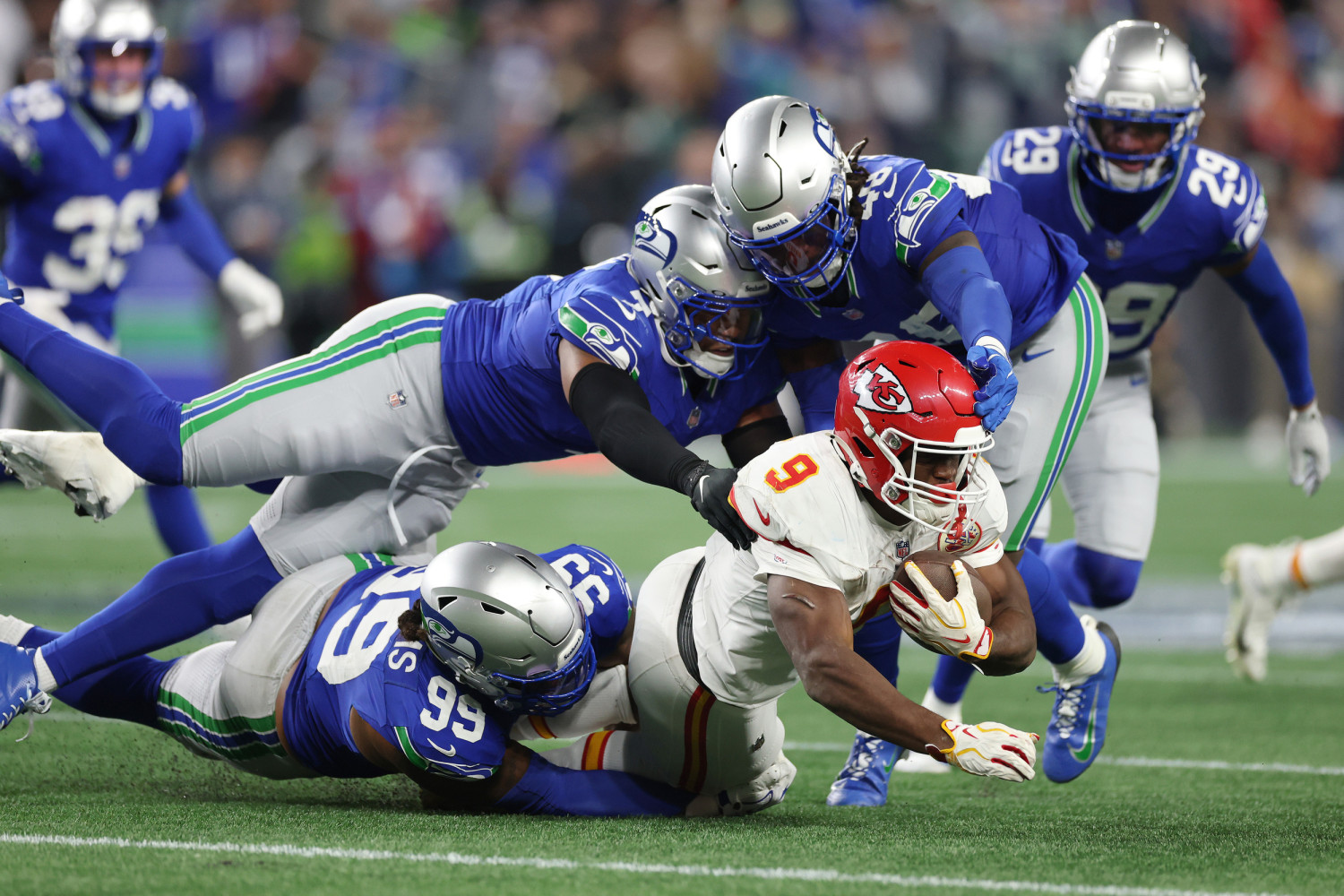
The Seattle Seahawks routed the Kansas City Chiefs 20–3, handing the visitors their first loss of the season. The home team’s defense completely neutralized Patrick Mahomes, who had one of the worst games of his career: 165 yards, no touchdowns and an interception. Kenneth Walker III, who joined the Chiefs from Seattle, managed just 36 yards against his former team, while Jaxon Smith-Njigba was the star of the night with 150 yards and a touchdown.
Seahawks Teach Chiefs a Defensive Lesson: Mahomes Has One of the Worst Games of His Career
Sometimes, in the National Football League (NFL), a big storyline unfolds very differently from what the scriptwriters had in mind. The matchup between the Seattle Seahawks and the Kansas City Chiefs was billed as a “revenge game” for Kenneth Walker III, who won the Super Bowl MVP award in February while playing for Seattle before joining Kansas City. Instead, Sunday night became a showcase for the Seahawks’ defense and one of the worst games of Patrick Mahomes’ career. Seattle routed the previously undefeated Chiefs 20–3, a result that matters far more than any personal drama.
It is worth starting with the context. The Seahawks came into the game on a two-game losing streak with a shaky 3–3 record, defending their Super Bowl title in an uneven season: two wins to start, followed by three losses in four games, each by a combined margin of just eight points. The Chiefs, by contrast, were unbeaten at 5–0, with Mahomes in his familiar role as conductor of one of the league’s most dangerous offenses. On paper, everything favored the visitors. On the field, the opposite was true. After the game, Seattle head coach Mike Macdonald summed up the team’s philosophy: “I’m really proud of our team. Being resilient in the face of adversity is what we do. We find solutions.” NBC News’ report cited those words as the essence of the night.
The hero was not the quarterback but Seattle’s defense. Mahomes threw for just 165 yards, had no touchdowns and threw one interception. His receivers struggled to get open against one of the league’s best pass defenses, and 11 of his 19 completions went to Walker and the tight ends—in other words, on short, low-risk routes. The Chiefs had their lowest totals for total yards, first downs and trips to the red zone in any game with Mahomes as their starting quarterback, while their three points tied their worst total with him under center. According to NFL researcher Tony Holzman-Escareno, the numbers provide a comprehensive picture of the collapse. “Our guys played great,” Macdonald said of the defense. “They’re just warriors. How can you not tip your hat to these guys?” Kansas City coach Andy Reid was brief: “We’ll go back to the drawing board.”
Now for the revenge that never happened. Walker entered the game leading the NFL in rushing yards and yards per carry, but against his former team he had just 14 attempts for 36 yards and no touchdowns. He had gained at least 115 yards in four of the season’s first five games; his previous low was 70. After the final whistle, he left the field without greeting his former teammates. It was a telling detail: the psychological burden of playing against his old team proved heavier than expected. Mahomes, meanwhile, gave a blunt assessment of the overall performance: “You’ve got to feel this. It sucks.”
The irony of the game was that Seattle won by doing what it usually had struggled to do: run the ball. The Seahawks had 41 rushing attempts for 153 yards, their second-best total of the season. Emanuel Wilson rushed for 100 yards—the first Seahawk to reach that mark since Walker did so in the Super Bowl. Quarterback Sam Darnold, who had thrown two interceptions in three of his previous four games, finished with 257 yards, a touchdown and just one interception. He got plenty of help from receiver Jaxon Smith-Njigba, who had nine catches for 150 yards and a touchdown. Not even Chiefs kicker Harrison Butker could help his team: he missed two field goals, one of which would have made it 13–6 in the fourth quarter and brought the game back into reach.
What does this mean going forward? Seattle improved to 4–3 and is just two games behind the San Francisco 49ers in the NFC West, with two consecutive home games ahead. Kansas City fell to 5–1 and scored fewer than 22 points for the first time this season. In Week 8, the Chiefs face another elite defense: the Denver Broncos. On November 2, the Seahawks will host the Chicago Bears (5–2), who average 30.8 points in games started by quarterback Caleb Williams. In short, neither team has an easy road ahead.
For clarity, the “red zone” is the area within 20 yards of an opponent’s end zone, where an offense has its best chance to score; reaching it is considered a measure of offensive efficiency. A “field goal” is a kick through the uprights during play, worth three points. A “first down” is a situation that gives the offense a new set of four attempts, and the number of first downs reflects a team’s ability to move the ball. An “interception” is a pass caught by an opposing defensive player, usually resulting in a change of possession. Finally, a “tight end” is a hybrid position combining blocking and receiving duties, often used on short routes.
The main takeaway is simple: in the NFL, even a great quarterback cannot save an offense if the opposing pass defense dominates and the receivers cannot get open. Patrick Mahomes remains the face of the league, but this game was a reminder that greatness is measured not only by wins, but also by the ability to get through a night you would rather forget. Seattle, meanwhile, proved that its championship title was no fluke and that a midseason slump is not a verdict. Both teams face serious tests ahead, and those games will show whether this night was a turning point or simply a statistical anomaly.
Kansas City Stumbles for the First Time This Season: Seattle Shows How to End a Perfect Start
In the early hours of October 26, 2026, one of the NFL season’s most talked-about streaks ended at the worst possible time for the Kansas City Chiefs. Andy Reid’s team came to Seattle with a perfect 5–0 record but left Lumen Field with its first loss of the year, falling 20–3 to the reigning Super Bowl champions. The score suggests a blowout, but for much of the game the Chiefs remained within one or two scoring plays of their opponents. They simply could not overcome their own struggles in key moments.
The problems began before kickoff. Kansas City took the field without wide receiver Rashee Rice and offensive lineman Jaylon Moore, while Seattle was missing running back Zach Charbonnet. The night’s main storyline was Kenneth Walker III’s return to Seattle. The league’s leading running back had left the Seahawks as a free agent over the summer. Walker never managed to punish his former team: he had just 28 yards on nine carries, and for most of the game was contained by Nohl Williams and Chris Roland-Wallace, who both played well against the run.
The biggest disaster for the visitors was third down, on both sides of the ball. The Chiefs’ offense could not sustain drives, while Seattle converted seven of nine attempts in the first half and continued to torment Kansas City’s defense throughout the game. By halftime, the Seahawks had run 47 plays to the Chiefs’ 24 and gained 251 yards to 96. Patrick Mahomes finished the first half 8 of 15 for 68 yards with an interception—one of the least convincing stretches of his career. Ty Okada intercepted one of his passes before the break, and late in the half Nohl Williams picked off Darnold in the end zone and returned the ball deep into Seattle territory, giving the Chiefs one last chance to get on the scoreboard. But they squandered that opportunity too: Harrison Butker missed a 58-yard field goal, and the teams went into halftime with Seattle leading 10–0.
The star of the night was Jaxon Smith-Njigba. In the first half, he had six catches for 129 yards and a touchdown, repeatedly beating Mansoor Delane on fade routes. His 33-yard catch on third down and a 21-yard reception late in the half became symbols of Kansas City’s secondary’s helplessness. Sam Darnold, with Seattle clearly emphasizing quick decisions and mobility, twice escaped the pocket on third down, evading George Karlaftis, Felix Anudike-Uzomah and Chris Jones, and found Cooper Kupp and Emanuel Wilson in the defense’s most vulnerable spots.
The second half gave the Chiefs a faint glimmer of hope. Their defense stopped Seattle in the red zone three times, forcing the Seahawks to settle for field goals, and Butker finally got Kansas City on the board—though only after Mahomes was sacked and fumbled. By the middle of the fourth quarter, the score was just 13–3. The KMBC broadcast rightly noted that the Chiefs were still one scoring pass away from making it a contest, even though their play could have left them trailing 24–3. But Butker missed for a second time, and on third down Darnold found Wilson for 21 yards and a touchdown that sealed the game. Kansas City failed to convert on fourth down, and Seattle’s winning streak against the Chiefs continued.
It is telling that even with the offense completely failing, some Kansas City players performed well. Matt Araiza pinned Seattle deep in its own territory twice with his punts, while Karlaftis and Jones on the defensive line managed to reach Darnold at times. But when an offense runs only 24 plays in a half and the defense cannot get off the field on third down, those individual successes are not enough. Other troubling signs included Creed Humphrey’s occasional low snaps, a Travis Kelce penalty that wiped out a first down he had already earned, and the clear lack of depth at receiver after Rice’s absence.
The loss does not ruin the Chiefs’ season—a 5–1 record is still an excellent start—but it exposes vulnerabilities that opponents will exploit ruthlessly in the playoffs. For Seattle, this was a statement: on their home field, the reigning champions did more than win; they methodically dismantled one of the league’s best offenses, disrupting Mahomes’ rhythm and forcing him to throw under pressure. Kansas City now faces a genuinely difficult stretch of its schedule, and Andy Reid has a full week to answer the question of whether this game was a fluke or a warning.
Seahawks End the Chiefs’ Perfect Season: How Seattle’s Defense Buried Patrick Mahomes
A game that looked like a routine win for Kansas City at the start of the season turned into a cold shower for one of the league’s highest-scoring offenses. The Seattle Seahawks beat the Chiefs 20–3 at home, handing the visitors their first loss of the season and showing that even the NFL’s best offenses can be neutralized by disciplined, aggressive play. For a team that was itself coming off two consecutive losses just a week ago, this was more than a win—it was a declaration that Seattle’s defense can handle any opponent.
The star of the night was Seahawks receiver Jaxon Smith-Njigba, who caught nine passes for 150 yards and a touchdown. His connection with quarterback Sam Darnold, who threw for 257 yards and a touchdown, was Seattle’s main weapon. The Darnold–Smith-Njigba connection drove Seattle into the red zone twice in the first half: first with a 33-yard pass that set up a Jason Myers field goal, then with a 28-yard touchdown that put the home team up 10–0 just over a minute before halftime. That sequence effectively decided the game, as Kansas City’s defense never found an answer to Smith-Njigba’s crossing routes and quick releases from coverage.
But the real story of the game was the collapse of the Chiefs’ offense. Patrick Mahomes, who usually dictates the pace of play, finished the night with a modest 165 yards and an interception. His main weapon this season, running back Kenneth Walker III, who joined Kansas City from Seattle after winning Super Bowl MVP last season, was completely shut down: 36 yards on 14 attempts. Walker entered the game leading the league with an average of 133 yards per game, but the Seahawks’ defense did more than contain him: it choked off the visitors’ entire rushing attack, limiting them to just 50 yards on the ground and 213 total. Notably, Seattle has not allowed a running back to gain 100 or more yards in 36 consecutive games, the longest active streak in the NFL. That streak held firm on this night.
The only bright spot for Kansas City was a historic milestone for Travis Kelce. The tight end caught four passes, bringing his career total to 1,104 receptions and moving him past Marvin Harrison and Cris Carter into fifth place in NFL history. But even that moment failed to turn the game around: after Kelce’s 19-yard catch early in the fourth quarter, the Chiefs scored no more points, and kicker Harrison Butker missed from 45 yards wide right. It was Butker’s tenth miss since the start of last season, and in a game where every point mattered, it felt symbolic.
Another moment worth noting came late in the first half, when Darnold was intercepted in the end zone by Nohl Williams. Williams returned the ball 64 yards, but Butker failed to convert a 58-yard field goal, and Kansas City went into halftime with nothing on the board. That play captured the game as a whole: the visitors had chances but could not take advantage of them, while Seattle punished every mistake.
It is also worth noting that the Seahawks won without several key players. Running back Zach Charbonnet, who had recovered from a torn ACL and been activated to the roster, did not take the field, while receiver Rashid Shaheed left the game in the second half with a knee injury. Tackle Charles Cross also injured his ankle in the fourth quarter. The Chiefs were without receiver Rashee Rice, who missed his third straight game with a hamstring injury, and starting tackle Jaylon Moore, who was in the concussion protocol. These absences undoubtedly made things more difficult for both teams, but Seattle’s roster depth proved stronger on the night.
For those unfamiliar with the terminology, the “red zone” is the area within 20 yards of an opponent’s end zone, where the offense has its best chance to score. A “field goal” is a kick through the uprights worth three points. An “interception” occurs when a defensive player catches a pass thrown by the opposing quarterback, allowing that player’s team to take possession at the point of the catch. A “sack” is a tackle of the quarterback while he has the ball, behind the line of scrimmage, pushing the offense backward. All these elements came together to form a clear picture: Seattle won through ball control, disciplined defense and timely big plays on offense.
The main takeaway from the game is simple: Kansas City remains a season favorite, but its offense is not invincible, especially when the running game is not working. Seattle, meanwhile, proved it can compete with the elite, even if that means relying on its defense and Darnold’s sound decisions. The coming games will show whether this was a fluke or whether the Seahawks are becoming a team to reckon with in the playoffs. For fans, the story will continue to unfold; more details about this game and other coverage can be found in KCTV’s report.