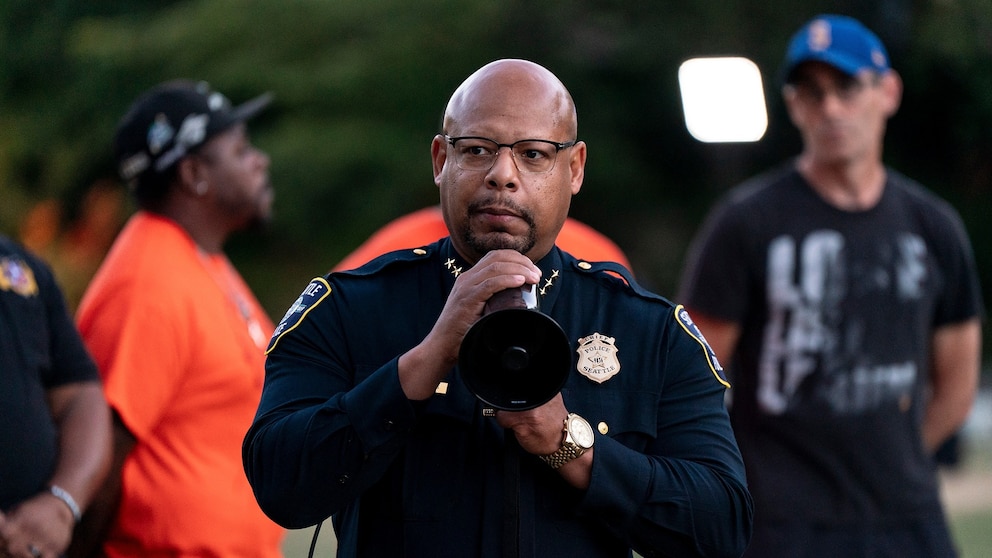
Mass “No Kings” marches with early-voting fairs were held in Seattle to oppose Trump’s policies. Meanwhile, amid the tragedy at the Bite of Seattle festival, the mayor forced the police chief to resign, prompting criticism from the City Council over the instability of the department’s leadership.
“No Kings”: How Seattle’s Protest Marches Turned Into a Push for Early Voting
Last Saturday, Seattle authorities warned drivers of possible traffic jams in the city center: a “No Kings” demonstration was scheduled to pass through the streets. The city’s Transportation Department announced road closures in advance that could affect Fourth Avenue, Pine Street, and access roads to Westlake Park and Seattle Center. At first glance, this may look like an ordinary traffic advisory, but behind it lies a far more interesting political story: the protest movement that grew out of opposition to Donald Trump’s policies is increasingly shifting from street symbolism to a specific electoral task—getting voters to cast their ballots early.
The Seattle rally was organized by Seattle Indivisible together with its partners. The event ran from 2 to 5 p.m. at Westlake Park and was conceived not simply as a march, but as a “march, rally and voting fair” under the slogan “Vote Early.” And this was not merely a local initiative: similar events were held in dozens of cities across the country that weekend, including Washington, New York, Atlanta and other communities. The organizers formally describe the actions as nonpartisan, but a MyNorthwest report explicitly states that they are connected to the “No Kings” marches held over the past two years, whose participants opposed President Trump’s agenda. The main goal is to encourage people to fill out their ballots in advance, before Election Day on November 3, and thereby support opponents of the current administration.
The scene in the capital shows what this looks like in practice. An orchestra played at the Lincoln Memorial, while several hundred people in hats and jackets danced along to the music despite the cold. Signs reading “VOTE EARLY” and “KEEP YOUR HANDS OFF MY VOTE!” rose above the crowd. In Atlanta, City Councilmember Michael Julian Bond urged those gathered to persuade their acquaintances to vote before Election Day. This format—a rally combined with an information fair about voting—is a typical political-mobilization tactic: it lowers the barrier for people who support the cause but, for various reasons, keep putting off going to the polls.
The scale of previous actions explains why organizers are counting on an effect. On March 28, during another “No Kings” march in Seattle, city police estimated that at least 75,000 people had taken part—a figure comparable to the population of a large district. Similar protests were held nationwide, as well as across the Pacific Northwest in June and October last year. In other words, the movement has an established network and an experienced audience that organizers are now trying to convert into actual ballots.
Several points are worth clarifying to understand the context. Midterm elections are elections for the U.S. Congress held halfway through a president’s term. They are traditionally viewed as a referendum on confidence in the incumbent president, and turnout is usually lower than in presidential elections, making the fight for every early vote especially important. Early voting is the practice of voting before the official Election Day, either by mail or at designated polling locations; this is precisely what the organizers are emphasizing. The name “No Kings” refers to the idea that presidential power should not take on monarchical characteristics. Finally, Indivisible is a nationwide network of grassroots groups that emerged as a resistance movement against Trump’s policies and operates through local chapters.
The key conclusion of the report is this: the protest movement in the United States is moving from expressing discontent to electoral mobilization, and street demonstrations are increasingly serving as campaign events. The scale is also telling: 75,000 participants at a March rally in Seattle is a serious figure for a single city, while synchronized events in dozens of cities point to a coordinated campaign. The formal nonpartisan character of the events coexists with a clearly defined political position—opposition to the Trump administration—which the organizers state openly. The question remains how effectively high-profile marches translate into turnout: early voting requires discipline, not just enthusiasm in a public square, and that will determine whether the “voting fair” becomes a real political tool or remains a striking but symbolic gesture.
“No Kings”: Thousands March Through Downtown Seattle
On Saturday afternoon, downtown Seattle once again became a stage for a nationwide protest movement. Organizers planned a “No Kings” march and voting fair, with participants traveling from Westlake Park to Seattle Center. According to a KOMO report, the event was scheduled for 2 p.m., but the march itself began at approximately 2:15 p.m. in the Westlake area of downtown. Unlike previous demonstrations, no rally was held at Westlake Park this time; participants immediately headed north along Fourth Avenue toward Seattle Center.
The procession was genuinely large: according to the outlet, thousands of people took part. The march ended at the International Fountain at Seattle Center, where the main program took place, including the voting fair—a venue where participants could receive help registering to vote and obtain information about the voting process. The event was part of the nationwide “No Kings” movement, which organizers describe as a series of peaceful demonstrations against authoritarianism and in defense of the idea that power belongs to the people, not to a “king.” The movement’s name is a direct reference to rhetoric about strong, centralized personal rule and attempts to portray President Trump as a monarch; hence the formula “No Kings.”
This was not Seattle’s first such event. The previous well-known “No Kings” march took place in the spring, when several hundred people proceeded along Fifth Avenue, and the central streets were reopened to traffic fairly quickly. The current march was considerably larger, which is significant in itself: organizers were clearly aiming for broader mobilization, and Saturday’s format—with a voting fair—suggests an effort to connect street activism with the electoral agenda. Streets have been closed for such marches and rallies in the past, so drivers in the Seattle Center area should expect serious traffic disruptions on Saturday afternoon. The practical conclusion for residents is simple: it would be best to avoid the area around Seattle Center and Fourth Avenue later in the day, while anyone planning to vote should check the locations of registration sites in advance.
Several concepts merit separate explanation. A voting fair is not a rally but an informational and organizational venue where people can check their registration, obtain a ballot or receive advice; in the United States, such events are often held alongside protests to turn civic activism into actual votes. In this context, the organizers use the term “authoritarianism” as a general description of a system in which, in their view, power is concentrated in one person’s hands and institutional checks are weakened. Finally, “No Kings” is not the name of a specific organization, but an umbrella brand for a nationwide wave of demonstrations, so individual city events may differ in format, route and size.
The main conclusions from the report are as follows: the Seattle event drew thousands of participants and took place without reports of disorder, consistent with the peaceful character claimed by organizers; the march ended not with a rally but with a practical voting fair, indicating a shift in focus from symbolic protest to electoral mobilization; and the size of the procession grew compared with the spring march, when hundreds of people participated. For the city, this means predictable traffic problems on Saturday afternoon; for the national picture, it represents a continuation of a series of coordinated actions under a single slogan. The organizers’ formulation that power belongs to the people, not to a “king,” is also telling: it frames the events not as a one-off outburst but as part of a long-term campaign tied to the election cycle.
Resignation Amid Tragedy: Why Seattle Lost Its Police Chief After the Food Festival Shooting
The resignation of Seattle Police Chief Sean Barnes is not simply a personnel decision following a tragic incident. It is a telling example of how political pressure, public anger and questions about management can become intertwined just days after a mass shooting. Formally, Barnes resigned himself, but, as he acknowledged, Mayor Katie Wilson asked him to do so at a meeting on Wednesday. That detail changes the way the entire situation is perceived: this was not a voluntary gesture of accountability, but a compelled step taken under pressure from the city administration.
Events unfolded rapidly. Last weekend, a shootout broke out at the Bite of Seattle festival, held near the Space Needle. According to Barnes, it was a “targeted gang shooting,” and bullets flew into the crowd. Two people were killed and four others were injured. All six victims, the police chief emphasized at the time, “had nothing to do with the suspects.” A 15-year-old teenager was arrested, while a second alleged participant, a 19-year-old man, was killed. Investigators have not yet ruled out the possibility that more than one suspect may still be sought.
It was against this backdrop that Mayor Wilson asked Barnes to step down. In a statement released through his attorney, he said he was “surprised” by the request but “believes this is the best path forward for a city still recovering from the shock and pain caused by the tragic events at Seattle Center.” In a separate statement, Barnes added: “The city’s attention should rightly be focused on the investigation into the tragic events at Seattle Center, justice for the victims, and healing the city after this senseless act of gun violence.” He called leading the department “one of the greatest honors” of his life.
Significantly, the mayor did not place all the blame on Barnes in her statement and instead emphasized the police department’s accomplishments. “The courage and professionalism demonstrated by Seattle Police Department officers deserve recognition,” Wilson said, adding that she shared Barnes’s hope of refocusing attention on “youth gun violence” and ensuring that every family feels safe. She appointed Barnes’s deputy, Andre Sayles, as acting chief. Her vision for public safety, she said, is based on “transparency, trust and genuine collaboration with the community,” while trust requires the department to “show up in neighborhoods every day, build relationships with residents, community organizations and small businesses, and be accountable to the people it serves.”
However, not everyone in the city viewed the resignation as the right move. Four City Council members—President Joy Hollingsworth, Dan Strauss, Deborah Juarez and Bob Kettle—issued a joint statement expressing “disappointment” and directly warning of the consequences. “Following the shooting at Seattle Center, our attention must be focused on the victims and on how we can address gun violence in our city. Resolving these crises and creating a safer Seattle require strong and stable leadership,” the statement said. “When communities are grieving, major decisions must be made with great care; a significant personnel change at this moment puts our city in a precarious position. Having cycled through four police chiefs in just two and a half years, we must think about stability, not further upheaval.” That reference to four chiefs in two and a half years is crucial. It turns the story from a local episode into a symptom of systemic instability in the city’s law-enforcement leadership.
Several points in the text may require explanation. “A targeted gang shooting” is police terminology indicating that the conflict arose between specific groups rather than being a random attack on the festival, although bystanders became victims. Bite of Seattle is a major annual food festival held at the foot of the Space Needle, one of the city’s main landmarks; the shooting at such a crowded venue caused a particularly strong reaction. Another issue concerns questions directed at Barnes about his travel. At a press conference on Tuesday, he was asked how often he traveled to Chicago, where his wife and children live. He responded sharply: “Of course I don’t travel as often as I would like. I think any reports that I’m gone every weekend are greatly exaggerated. I don’t have that kind of money.” He added: “I’m here in Seattle. I love the neighborhood where I live. I love my community.” This detail matters because it shows that, by the time of his resignation, Barnes was under pressure from two directions: criticism over the transparency of information following the shooting and personal attacks.
Another nuance is the confusion over information that emerged after the tragedy. City authorities faced criticism over how they released information, including details about the status of the second suspect. Barnes acknowledged that early information is sometimes incorrect and called that “regrettable,” promising that the police conduct reviews in such cases. His remarks about anger sounded almost like an appeal to the city: “We understand that people are angry. You should be angry. Everyone should be angry. But along with that anger, you have to ask yourself: ‘What can I do to prevent this?’ We need to start working in partnership.” In the context of his resignation, the statement takes on a bitter tone, because partnership and stability are precisely what critics say the city currently lacks.
The key conclusion is straightforward: Seattle is facing a classic dilemma—residents are demanding immediate accountability and change after a tragedy, while the City Council warns that frequent turnover among police leaders itself undermines public safety. Barnes served less than two years, and his departure marks the fourth change of police chief in two and a half years. For residents, this raises not only the question of who will now investigate the festival shooting, but also a more fundamental one: can the city build lasting trust in the police if its leadership changes faster than its most prominent cases can be resolved? The official resignation announcement and the City Council’s reactions are described in detail in an ABC News report, and it is this gap between the political decision and public expectations that will shape developments in the coming weeks.