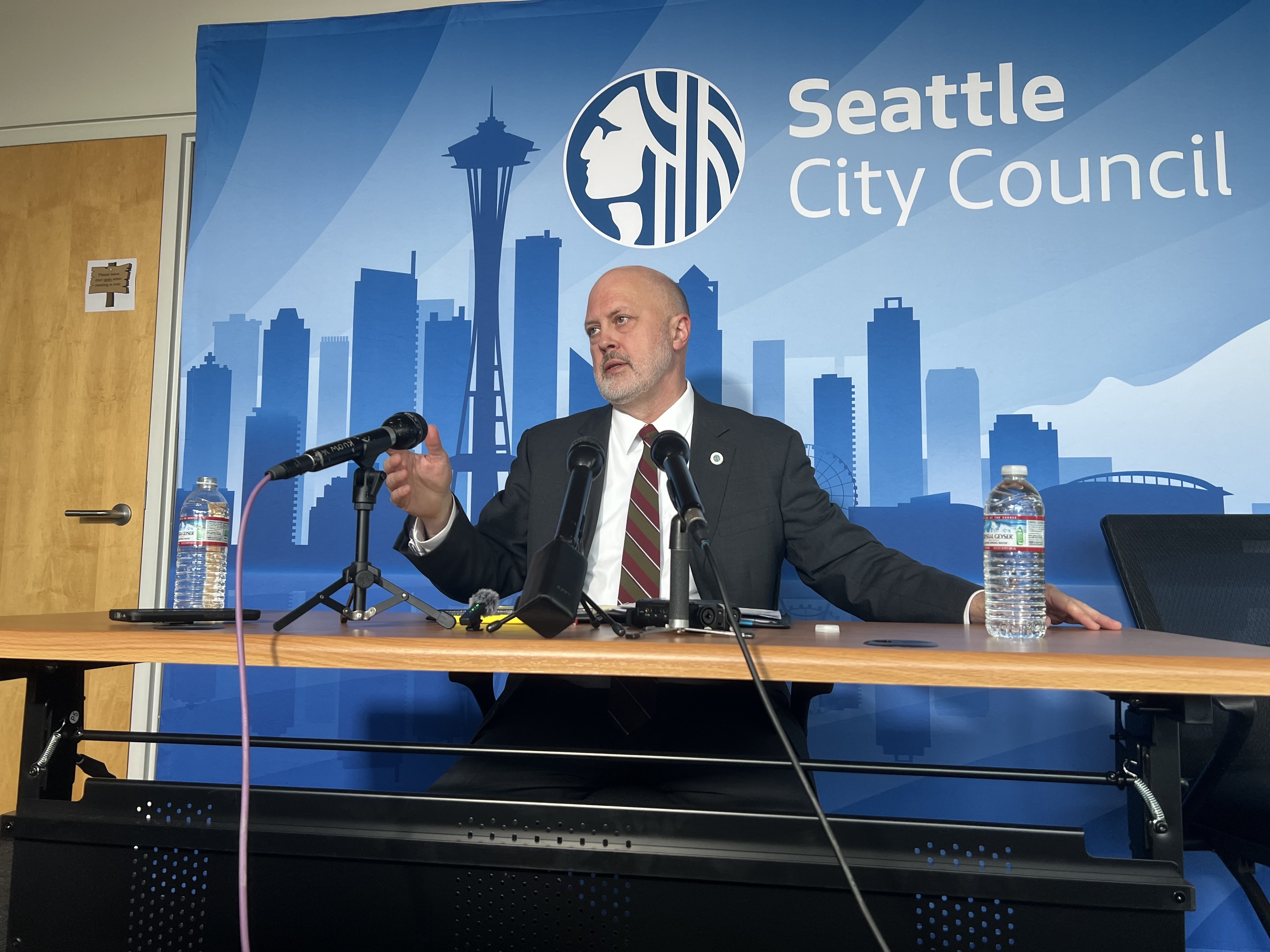
Macdonald shared positive news about Shaheed, the Seattle City Council is restoring firefighters’ overtime, and the school district is discussing mergers amid declining enrollment.
“Positive News on Rashid Shaheed”: Macdonald Gives Update on Injured Seahawks
The day after the Seattle Seahawks’ convincing 20–3 win over the Kansas City Chiefs, head coach Mike Macdonald appeared on Seattle Sports 710 AM to discuss the game and, just as importantly for fans, the health of several key players. Injuries are always a storyline in an NFL season, and the Seahawks are no exception: two starters — receiver Rashid Shaheed and left tackle Charles Cross — left Sunday’s game early and did not return. Shaheed injured his knee; Cross hurt his ankle. Those incidents became the main topic of the coach’s conversation with the hosts of the Brock and Salk show. Macdonald said the situation looked encouraging, although it was too early to draw firm conclusions.
Macdonald chose his words carefully, which is understandable for a coach who does not want to give opponents unnecessary information or raise false hopes among his team and its fans. There is no clarity on Cross yet: medical examinations are ongoing, imaging results are not in, and the coach admitted that he had no update. The news on Shaheed, however, was positive, and Macdonald did not hide his relief. “Rashid, the initial results are positive,” he said on air. “Any time you’re talking about a knee, you hold your breath, so for now, let’s just say it’s positive.” His cautious phrase “let’s just say” shows that even with good preliminary results, the final verdict is being deferred until doctors have completed their assessment — a common practice in a league known for its tough approach to injuries.
Running back Zach Charbonnet, who has yet to make his season debut, also drew attention. The article refers to his “2026 debut,” which, judging by the context, reflects the publication date and his recovery timeline after surgery. Macdonald made clear that no decision has been made on whether Charbonnet will play in the Week 8 game against the Chicago Bears. He stressed that the team is sticking to its previously laid-out plan: Charbonnet will continue practicing fully, and his progress will be assessed over the course of the week. “He had a great week, he’s in a great place mentally, but let’s remember: this will be nine months after ACL surgery, and you can count on one hand the number of people who have even done that — Adrian Peterson, and that’s it?” Seattle Seahawks quoted him as saying. This is more than a coach’s expression of caution; it is a nod to sports science. An ACL tear is considered one of the most serious injuries in American football, and returning to competition in nine months is rare even among professional athletes. Legendary running back Adrian Peterson is known for his extraordinarily fast recovery from similar surgery, and Macdonald’s reference to him underscores just how exceptional the situation would be.
Another important development is rookie running back Jadarian Price’s return to practice. He is eligible to come off injured reserve, giving the Seahawks additional depth at a position that takes a heavy toll in today’s NFL. Taken together, the three issues — Shaheed’s knee, Cross’s ankle and Charbonnet’s return timeline — offer a broader picture of roster management. Seattle is in good shape after beating the Chiefs, but roster depth and careful injury management could determine whether the team maintains its momentum in the coming weeks. The main takeaway from Macdonald’s appearance is simple: Shaheed appears to have avoided the worst, uncertainty remains over Cross, and the team is deliberately taking its time with Charbonnet, favoring long-term health over a short-term gain.
Seattle Firefighters Get Their Overtime Back: How the City Council Is Revising the Mayor’s Budget
The Seattle City Council is at the center of a tense budget battle that could directly affect how quickly emergency services respond. After Mayor Katie Wilson proposed cutting funding for Fire Department overtime, council members responded with a flood of amendments — 170 in all — to the budget proposal. Most are unlikely to survive negotiations amid tight spending constraints, but one measure appears to have a real chance: restoring about $7 million for firefighters’ overtime. This is more than a technical budget adjustment; it is a clash between two views of the city’s priorities: fiscal discipline and public safety.
The conflict began when Mayor Wilson, facing a $175 million budget shortfall, called on most departments to cut spending by between 1% and 8%. The Fire Department was asked to reduce overtime, which the mayor said accounts for about 2% of its operating budget. Wilson maintains that the department can absorb the cut while maintaining excellent response times and service levels. Firefighters and their union, however, saw it as a direct threat to residents’ lives. At a budget hearing, firefighter Sam Woestdin of Station 25 on Capitol Hill warned council members: “Everyone in this room will wait longer when you call 911.” That means waiting longer while a neighbor’s house burns or someone on the street suffers a heart attack, he said.
That argument appears to have swayed the council. Councilmember Bob Kettle, chair of the Public Safety Committee, told reporters Monday that restoring overtime had “consensus across the room” and would be “first in line.” Budget Committee Chair Dan Strauss, through an aide, confirmed that he was coordinating with Kettle and Councilmember Maritza Rivera to restore the funding. Strauss is no casual ally of firefighters: in 2004, a car hit him in Ballard, puncturing one lung and collapsing both. Firefighters arrived in five minutes and got him to Harborview Medical Center in 15, which he says saved him from permanent brain damage. “If we’re staffed down, that’s extra time and a higher risk that someone doesn’t get that second chance. We’re stifling people’s ability to live full lives, give back to the community, and be good residents of our city. That’s what this overtime is about,” Strauss said in September.
To understand why the council can even consider this spending in a “very tight year,” it helps to understand how the budget works. Usually, council members have to find items to cut to offset most major additions and keep the budget balanced. But this month’s revenue forecast was unexpectedly favorable, giving the council about $13 million in “breathing room” — some of which could go toward firefighters’ overtime. The mayor’s proposal, incidentally, includes no new taxes and calls for adding 66 police officers; business groups, nonprofits and union leaders have generally welcomed it. The council itself, however, is skeptical. Kettle compared the budget to the story of Goldilocks: “My disappointment is that this budget was presented as a Goldilocks budget: everything is just right, no new taxes, all positive feedback. But I’ll tell you: on the public safety side, it’s a bowl of cold oatmeal.” He wants to add three times as many police officers as the mayor proposed, but acknowledges that the council probably does not have enough votes for that.
The key date is November 3, when Strauss will release a balanced package specifying what can be added and what will have to be cut. For now, one thing is clear: firefighters’ overtime has become a symbolic dividing line. Behind the figures — $7 million and $13 million in available funds — lies the question of what matters more to the city: a balanced ledger or the assurance that a fire crew will arrive in time. In this debate, firefighters seem to have the most compelling argument: human lives, measured in minutes. As KUOW reports, the final decision rests with the council, but the political will to restore the funding is already there.
Seattle Rethinks the Future of Its Schools: Falling Enrollment Prompts Merger Plans
Seattle Public Schools is beginning a months-long process that could lead to school consolidations and closures. Formally, this is a response to demographic and financial pressures. In practice, it is an attempt to say out loud what parents and teachers have been saying for years: children in the same city learn in vastly different conditions, and the divide between “rich” and “poor” schools has become too stark to ignore. That is what district Superintendent Ben Shuldiner wrote in a letter to families, published amid news that student enrollment had fallen below 50,000 for the first time.
The numbers are striking. In 1964, more than 94,000 children attended Seattle schools; today, the figure is under 50,000. Shuldiner does not attribute the decline to a single cause. He points to the “Boeing Bust” of the late 1960s and early 1970s, when cuts to aerospace jobs hit the city; “incredible wealth creation” that changed its demographics; and “a massive rise in private school enrollment.” But he describes part of the decline as “self-inflicted” — and here the superintendent’s wording sounds almost like a public admission: “a lack of clarity of vision and purpose,” “a revolving door of disparate and troubled leaders,” and programs and policies that changed so often they stopped “putting students and families first.”
Shuldiner says he made clear when he was hired that “everything was on the table,” including mergers, but that he did not want to make decisions before getting to know the district from the inside. “What I saw shocked me,” he writes. Behind that phrase is a description of two parallel school systems. Some schools have “beautiful buildings with bright, airy classrooms.” Others have rooms “without interior walls,” “poorly lit hallways” and the sounds of “smaller creatures in the rafters.” The differences are not only in the buildings: some schools have “strong learning communities,” while others have “just one second-grade teacher who was expected to survive on their own.” Some have music; others do not. Shuldiner also mentions “forced split classes” — second- and third-graders learning together, as well as classes combining sixth, seventh and eighth grades. Some schools are very small: K–8 schools with fewer than 50 students and K–5 schools with fewer than 120. Even strong teachers, he says, face an additional burden in these circumstances.
That is why the discussion of mergers is not being framed as “cost-cutting optimization,” but as an effort to keep children from spending “one more year” in an unacceptable learning environment “if we can avoid it.” KOMO’s report also lays out the timeline. After the Seattle Education Association contract was settled in the first week of September, senior leadership met during the first two weeks of September, followed by meetings with principals in September and October. Staff meetings are planned for October and November, and meetings with families at receiving schools will run from November through mid-December. The district will then present a preliminary list to the school board and the public, followed by community meetings and public hearings in January and February. The board could make a decision “in late February or early March.”
There is one important detail for parents: the process overlaps with the open choice window. Shuldiner promises to extend the transfer period until the week after a possible board decision and reminds families that open enrollment is “a lottery, not first come, first served.” Families transferring from a closing school will receive priority. He also offers a caveat likely intended to ease concerns: if a school was not invited to take part in the current round of discussions, “we are not considering closure right now and will not be in the near future.” He addresses the Bridges and Interagency programs separately: the discussion may involve locations, but “not closing Bridges or Interagency as programs.” The district is also considering ways to strengthen Seattle World School by partnering with one or more comprehensive high schools.
The strongest line in the letter is not about buildings or budgets, but trust: “When we get through this round, I never want to do it again.” Shuldiner adds: “I give you my word that after this year I will try very hard to work with what we have.” This is both a promise and an admission of how fragile the situation is: mergers may free up resources and make conditions more equitable, but they also disrupt communities and families’ sense of stability — including families who chose a school based on their neighborhood, not a lottery. For now, this is just the beginning of a conversation with principals, staff and families, and the final list could change. But the direction is set: the district no longer wants to pretend that 50,000 students can be educated the same way as 94,000, or that the difference between “bright classrooms” and “hallways without walls” is just a detail.
For clarity, here are a few terms from the article. “Boeing Bust” refers to Seattle’s economic downturn linked to Boeing layoffs in the late 1960s and early 1970s, which led to an outflow of residents. “K–8” and “K–5” schools serve students from kindergarten through eighth or fifth grade, respectively. “Split classes” are classes in which children from different grade levels learn together because of a shortage of students or teachers. “Open choice” and “open enrollment” are systems that let families apply to schools outside their neighborhood, with placement determined by lottery. “Bridges” and “Interagency” are special district programs that, according to Shuldiner, will continue even if their locations change.