Alaska Airlines is launching nonstop flights from Seattle to Osaka and Papeete, Tineco is supporting Seattle shelter pets through its Clean Start initiative, and two post-pandemic productions in Washington are turning conventional ideas about theater upside down—from a “box without actors” to a play without rehearsals.
Alaska Airlines Expands Its Network with Nonstop Flights from Seattle to Osaka and Papeete
U.S. airline Alaska Airlines, together with its partner Hawaiian Airlines, has announced two new long-haul routes that significantly expand the carrier’s international presence. As early as next spring, passengers will be able to fly nonstop from Seattle to Osaka, Japan, and to Papeete—the capital of French Polynesia on the island of Tahiti. According to a press release on the Alaska Airlines website, both routes will operate year-round, making the airline the only carrier to offer nonstop service between these destinations.
For passengers from the continental United States, this means exotic and distant destinations will become more accessible: from Seattle, travelers will be able to reach Tahiti and the Kansai region without tiring connections. Thanks to the combined Alaska Airlines and Hawaiian Airlines network, convenient onward connections will also become available to residents of other cities. Both flights will operate from Seattle-Tacoma International Airport, identified by the code SEA, with destinations at Kansai International Airport in Osaka (KIX) and Papeete Airport (PPT). It is important to note that the route launches still require regulatory approval, so the final dates and schedules may change.
To generate interest in the new routes, the carrier has introduced special introductory fares. From October 22 through 26, the promotional period, round-trip Main Cabin tickets will start at $999 to Papeete and $1,199 to Osaka, subject to availability. Tickets are already on sale at alaskaair.com and hawaiianairlines.com, with standard fare terms and restrictions applying.
Several terms are worth explaining. Main Cabin is the basic service class offered by U.S. airlines—something between economy class and standard service: passengers receive a seat in the cabin, a carry-on bag and basic food service, but none of the privileges of premium classes. Airport codes (SEA, KIX and PPT) are standard three-letter designations used throughout the aviation industry and appear on tickets and schedules. French Polynesia is an overseas collectivity of France in the southern Pacific Ocean that includes the islands of Tahiti, Moorea, Bora Bora and others; Papeete is its administrative center. Kansai International Airport is a major international hub in western Japan serving the Osaka, Kyoto and Kobe metropolitan areas. Finally, the phrase “subject to government approval” reflects a routine procedure for international air service: routes between countries must be approved by aviation authorities, and the airline cannot begin flights until permission is granted.
Strategically, the move is significant. Alaska Airlines, historically strong in the U.S. domestic market and along the West Coast, gained access to long-haul resources after merging with Hawaiian Airlines and is now trying to compete for trans-Pacific traffic. Nonstop flights to Osaka and Papeete are not simply new points on the map but an attempt to occupy a niche where competitors either offer no direct service or provide less convenient options. The uniqueness of the offering—the lack of alternative nonstop flights—gives the airline a pricing advantage and attracts both tourists and business travelers. Introductory fares starting at $999 are a classic marketing tactic designed to fill the first flights quickly and test demand. If the routes prove popular, Hawaiian Airlines’ network may expand further across Oceania and Asia—markets that until now have largely been dominated by competitors such as United and Delta.
A Clean Start: How Tineco Is Helping Seattle Shelters and New Owners Adjust
When a shelter pet arrives at home, life changes faster than anyone can prepare for. Dirty paw prints appear where there were none before, water somehow spreads across the floor, fur turns up in places you never knew existed and, of course, accidents happen. A new pet usually changes the household routine before everyone has even learned the rules. But that is not necessarily a bad thing: the first weeks are a time for getting to know one another, establishing routines, building trust and making room for a new personality in the family.
That idea is at the heart of Clean Start, a new initiative from Tineco launched together with Homeward Pet Adoption Center, PAWS (Progressive Animal Welfare Society) and Seattle Animal Shelter. The campaign is designed to support pets and their new owners not only when they leave the shelter but afterward as well. Through Clean Start, Tineco is providing practical kits, adoption support and other resources to help new owners get through the first weeks at home and establish a workable routine with an animal. At Homeward Pet Adoption Center, “Tineco Tuesdays” help fund adoptions throughout the fall and support behavioral consultations for individual adopters. At PAWS, the Worth The Wait initiative draws attention to animals that need a little more time to find the right person and creates new opportunities for them. At Seattle Animal Shelter, Clean Start is supporting adoption weekend on October 24–25 by providing new families with essentials for settling in.
The support also extends to the everyday realities of living with a pet—including the battle against mess. The Tineco GO H2O HammerHead MessDetect wet-dry floor washer combines dry and wet cleaning to handle muddy paw prints and dirt brought in from outside. The cordless Tineco Pet GO vacuum features an anti-tangle brush and a multistage filtration system that captures dust and dirt. The campaign’s message is simple: mess is part of the journey. For many families, adoption means adjusting to a new routine and, often, accepting a little more unpredictability. By combining adoption support with practical household resources, Clean Start helps more Seattle pets and their people begin that journey with greater confidence. A clean start is not about a perfectly clean home, but about a home that adapts to muddy paws, new routines and one very new personality. The mess may be harder to keep up with, but eventually it all starts to feel like home.
A few points are worth keeping in mind when reading the material. “Routine” here means more than a schedule for feeding and walks: it is a set of repeated actions that reduces an animal’s anxiety and helps it understand the rules of the home. For a shelter dog or cat, that may be almost as important as food itself. Worth The Wait is a PAWS program that “repackages” animals who have been waiting a long time. Rather than hiding them in distant kennels, the organization deliberately tells their stories, because large dogs, older animals and pets with behavioral or health issues generally wait the longest. Tineco’s initiative is a classic example of marketing through good works: the home-appliance brand is not simply advertising vacuums but placing its products in the real-life context of a home with a pet, where dirt is inevitable and cleaning becomes part of care rather than a punishment.
The material’s key insight is that the greatest risk for shelter animals is not the shelter itself but the first weeks afterward, when an inexperienced owner encounters fur, puddles and damaged belongings and concludes that they “couldn’t handle it.” Support during this period, rather than only on adoption day, reduces the likelihood that an animal will be returned to the shelter. The campaign’s practical value is that it gives new owners tools—and, more importantly, permission not to be perfect. Mess is presented as normal, not as evidence of failure. For Seattle’s shelters, the initiative means additional adoptions and resources for behavioral work; for Tineco, it builds loyalty among pet owners; and for readers, it is a reminder that a fresh start begins not with a perfectly clean apartment but with a willingness to adapt to a new resident, as described in detail in this Seattle magazine article.
Theater Invented in Isolation: How the Pandemic Taught the Stage to Work Without Actors or Rehearsals
Sometimes, to understand why people need live theater at all, it is useful to temporarily take away everything familiar: the stage, the curtain, the actors and the rehearsed lines. That is what happened in Washington, where two productions conceived during the COVID years opened almost simultaneously. Strangely enough, neither was a grim meditation on loss; both were celebrations of collective invention. A critic for DC Theater Arts who attended both shares his impressions of two productions that overturn the very idea of who—and what—does the work onstage.
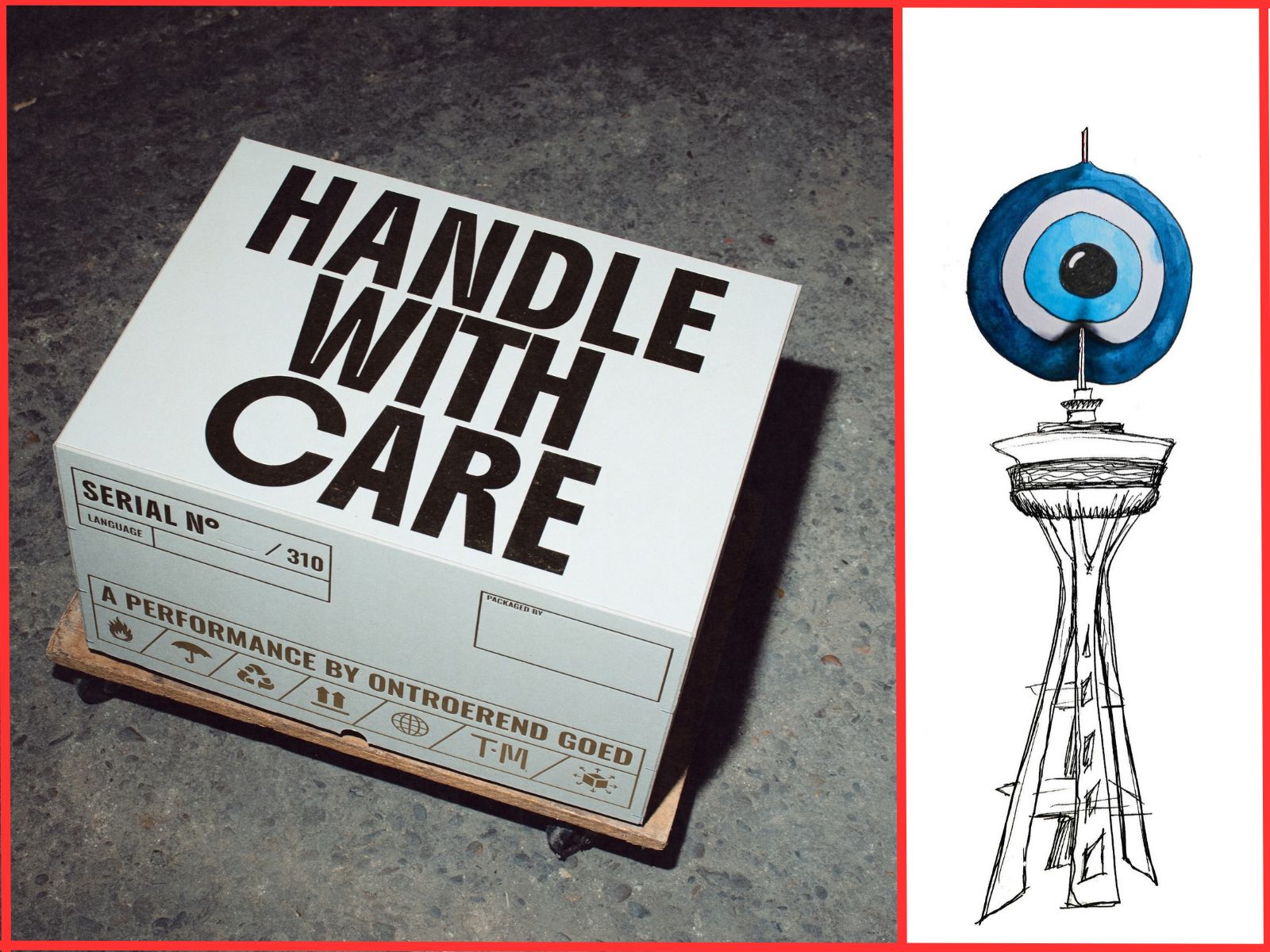
The first is Handle With Care by the Belgian collective Ontroerend Goed, playing in Studio Theatre’s Fourth Theater through October 25. The company’s slogan sounds like a riddle: “No actors. No technicians. Just a box. And you.” A plain cardboard box filled with props and printed instructions really does sit onstage, and no more than 45 audience members are admitted at a time. What follows is what the reviewer calls an “absolutely astonishing participatory experience.” Someone in the audience takes the first step, opens the box and reads a letter about themselves. More instructions follow, and gradually almost everyone present enters the playing space, carrying out what is written on an unfurled banner: “Everything you do is theater. You are the performance.” The reviewer deliberately reveals few details so as not to spoil the surprise, but describes how strangers turn into a group over the course of an hour, absorbed in a shared activity no less enthusiastically than participants at an adult game party.
The most interesting aspect is the production’s origin. “Theater in a box” emerged directly from pandemic isolation and the awkwardness of returning to other people. “We all felt that the digital connections we made at that time did not bring us closer,” the author quotes one of the creators, Alexander Devriendt, as saying. In response, the company removed everything from theater except a box of props and paper prompts, allowing the audience to build a sense of community on the spot. According to the company, the production has already had hundreds of performances in 16 countries and 10 languages.
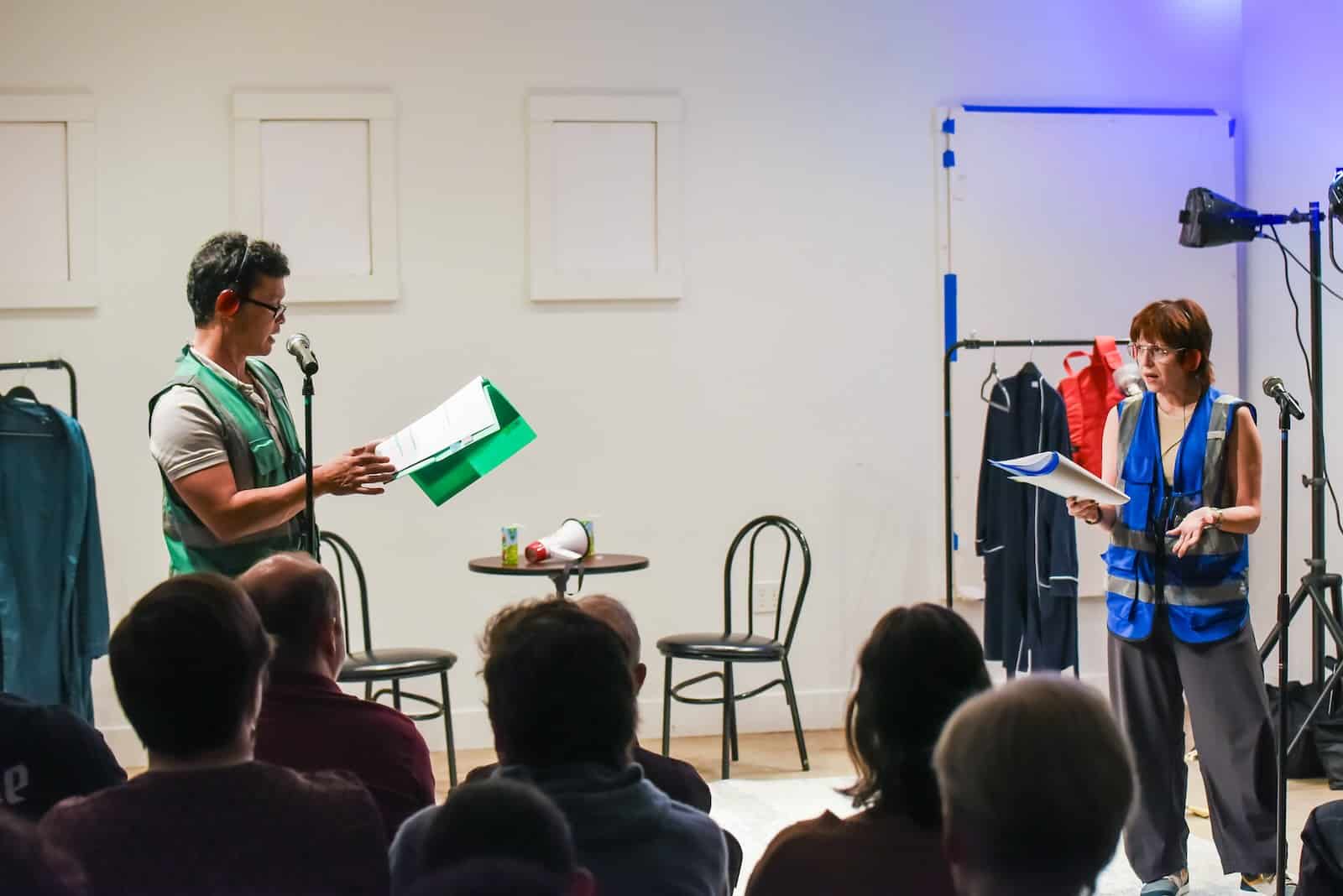
The second production, Oedipus in Seattle by playwright Savannah Reich, is structured as a mirror image: here, the instructions go to the actors rather than the audience. The production was independently produced by Chad Dexter Kinsman and ran just three times, from October 10 through 12, at Studio 1469, a gallery at the end of an unmarked alley in the Columbia Heights neighborhood. There are no rehearsals at all. Each pair of performers takes the stage for the first time, hears prerecorded prompts through headphones, reads them from microphone stands, answers questions and works with prepared props and costumes. The audience hears some of the lines from the “deus ex machina,” while others are heard only by the actors. Douglas Vento’s sound design, together with the lighting and a projection of a rocky shoreline, transforms the bare white walls into a surreal world. That evening, the performers were well-known Washington actors Kimberly Gilbert and Jacob Yeh, and the audience, according to the reviewer, laughed wholeheartedly.
The plot was an elaborate blend of Sophocles’ tragedy and the 1993 film comedy starring Tom Hanks and Meg Ryan. The author openly admits that he did not fully grasp the connection between the two sources—apart from their shared themes of fate and destiny. But, he stresses, this was not an evening for high-minded literary analysis. It was an exercise in improvisation unfolding before everyone’s eyes. The only material the actors prepared in advance was a series of brief autobiographical monologues.
In an afterword, Reich explained where the form came from: “Like many of us, I spent most of 2020 in my apartment, thinking that theater probably no longer existed. A play is a blueprint for a future event, and I simply stopped being able to imagine the future… This is a play I wrote when I couldn’t imagine writing a play.” That admission is the key to both productions. They did not grow out of a desire to create a monument to the pandemic, but out of the need to reinvent how people could gather when familiar methods no longer worked.
The reviewer asks whether there is a shared lesson here—about the resilience of imagination in difficult times, the value of live theater, or the benefits of less passivity and greater engagement—and invites readers to finish the sentence themselves and say it to someone. Both productions run for about an hour without an intermission. Handle With Care sells tickets for $37, with discounts available, and was nearly sold out according to the reviewer; Oedipus in Seattle has already completed its three performances.
To understand why these productions are called “theater in a box” and “a play without rehearsals,” a few points should be explained. Ontroerend Goed is a Flemish experimental collective known for erasing the boundary between performers and audience. In Handle With Care, the audience does not watch the action but performs it, receiving roles and lines from the box—hence the phrase “you are the performance.” Oedipus in Seattle uses a form of headphone theater: actors hear a guiding voice and repeat what they hear, so the production is created anew each time and never repeats itself. “Deus ex machina” is an ancient dramatic device in which a suddenly appearing deity resolves a tangled plot; here, the phrase is played with literally, as a prerecorded female voice directs the action. Finally, the COVID context—2020 lockdowns, closed theaters and the shift to digital communication—explains why both works revolve around the same task: restoring the sense of togetherness that was so lacking during isolation.
The main conclusion suggested by the article is simple and unexpected: theater survived not through large stages and familiar formats, but through a willingness to abandon them. Some creators entrusted the script to the audience, while others surrendered it to chance and the actors’ courage. In both cases, the result proved more alive than many meticulously rehearsed productions.