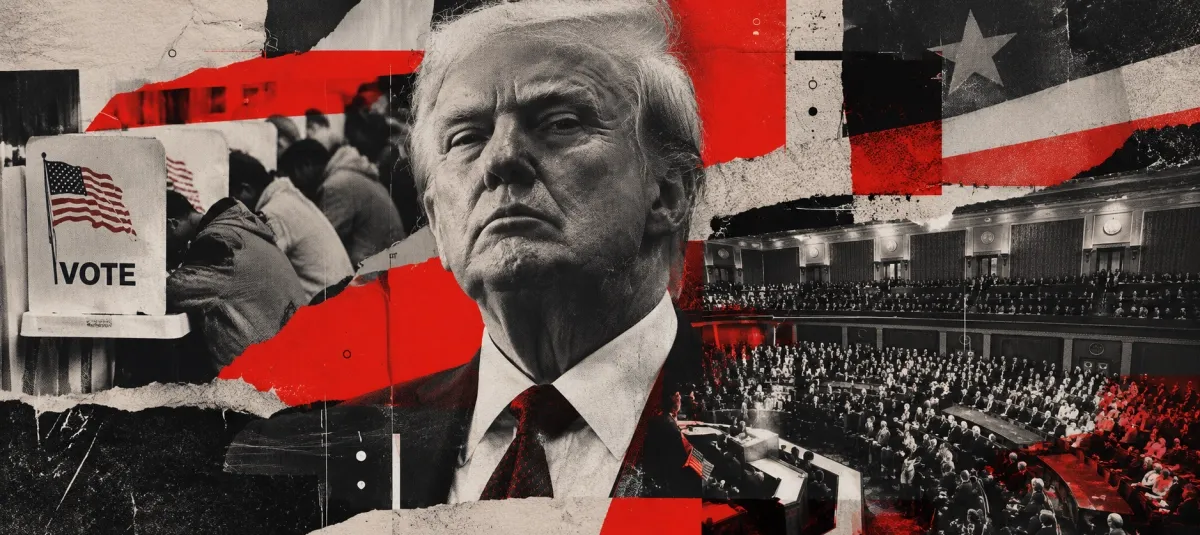
The possibility that Republicans could lose control of Congress in the U.S. midterm elections may significantly narrow Donald Trump’s room for maneuver at home, but it does not guarantee a softer U.S. stance toward Venezuela or Latin America more broadly. That is the conclusion of an EL TIEMPO analysis examining the elections through the lens of their international consequences.
The midterm vote is described as a major test for Trump’s second term. His administration faces discontent over the rising cost of living, the war with Iran, trade tariffs and a hard-line immigration policy. According to a Reuters/Ipsos poll cited in the article, just 32% of Americans approve of the president’s performance, while 73% say the cost-of-living situation is heading in the wrong direction.
Against this backdrop, the authors believe Democrats have a good chance of regaining control of the House of Representatives and, in some scenarios, the Senate as well. But for Caracas, a new balance of power on Capitol Hill does not in itself mean that sanctions, oil restrictions or diplomatic pressure will automatically be reconsidered.
As analyst Ryan Hass notes, even with a Congress hostile to the White House, the U.S. president will retain broad powers in foreign policy. Trump, the article says, will be able to “continue using tariffs and pursuing an aggressive policy in the region,” justifying such actions as efforts to combat drug trafficking and curb migration. In Venezuela’s case, that means the risk of new trade, sanctions and diplomatic measures from Washington remains.
This uncertainty is especially significant for Venezuela. The country’s economy and international ties have been shaped for years by U.S. sanctions and restrictions on its oil sector. In the United States, the issue of Venezuela is also regularly linked to immigration and security, making domestic U.S. debates a direct factor in the lives of millions of people on both sides of the border.
The situation of the Venezuelan diaspora is also significant. Mass raids by U.S. Immigration and Customs Enforcement, migrant detentions and pressure on families with mixed immigration statuses affect not just abstract statistics but a substantial part of Latin American communities, including Venezuelans. The consequences may also be felt inside Venezuela, through family ties, remittances and humanitarian contacts.
A Democratic Congress, if elected, would still have tools to influence the administration. The House of Representatives could hold hearings, demand documents, launch investigations, oversee budget spending and obstruct some White House initiatives. However, the president would retain the power to veto legislation, and overriding a veto requires a two-thirds vote in both chambers.
Brookings expert Scott R. Anderson notes that Congress can increase pressure on the executive branch through investigations and targeted funding restrictions, but that may not be enough to force the White House to change its foreign policy. For Venezuela, this scenario means that decisions by the Trump administration may receive greater public scrutiny and face tougher oversight, but a rapid end to the pressure campaign is unlikely.
Thus, the EL TIEMPO article presents the U.S. elections as more than a domestic political contest between parties. The war with Iran, tariffs, immigration raids and Trump’s falling approval ratings are treated as elements of broader uncertainty for Latin America. The main message for Venezuela is that even a weakened U.S. president may retain the tools most sensitive for Caracas: executive action on foreign policy, sanctions pressure, the immigration agenda and trade restrictions.
Trump Ties Conflict Around Iran to U.S. Oil Revenues
The conflict around Iran and tensions in the Middle East are becoming not only a security issue but also a factor directly affecting global energy markets, fuel prices and oil company revenues. A Turkish-language article on Vietnam.vn focuses on Donald Trump’s remarks that the situation is bringing significant economic benefits to the United States through increased oil production and exports.
At a rally in Lubbock, Texas, Trump said that amid events in the Middle East, the United States had produced more oil over the past seven months and earned “more money than ever.” At the same time, he promised to work to lower fuel prices for American motorists.
But he made those remarks as consumer costs were rising sharply. According to the American Automobile Association, cited by the publication, the average price of a gallon of gasoline in the United States had reached $4.27, while diesel had reached $6.35. This highlights an obvious contradiction: the oil sector and the national economy may benefit from high prices and increased production, while ordinary people are forced to pay more at the pump.
The Turkish article looks at the situation as more than a domestic American debate over gasoline prices. It reflects a widespread critical view in Turkey of the consequences of foreign powers’ policies in the Middle East: regional crises can give strategic and energy advantages to countries outside the conflict, above all the United States, while the main social and economic burden falls on the countries of the region and neighboring economies.
For Turkey, instability around Iran has particularly practical implications. The country depends on energy imports, so potential risks to supplies through the Persian Gulf and the Strait of Hormuz quickly affect the prices of oil, gas, shipping and imported goods. This, in turn, adds to inflationary pressure, complicates the trade balance and increases costs for Turkish households.
For Turkish audiences, Iran is not a remote, abstract issue but a neighboring state, an important regional player and a security factor along the country’s eastern borders. Any threat of escalation is therefore seen both as a military and political risk and as a potential blow to the economy.
The article focuses less on the military dimension of the confrontation than on the asymmetry of its consequences. While some parts of the U.S. oil sector may benefit from higher demand and expensive oil, consumers—in America and elsewhere—pay for geopolitical instability through rising energy and everyday goods costs.