As the midterm elections approach, attention is focused on Donald Trump’s political prospects and on whether his opponents can restore a system of checks and balances. At the same time, the administration’s influence on business and foreign policy is fueling controversy, including Audi’s dealings with Trump and the prospects for investment in the United States. Washington’s statements and pressure in its dealings with Brazil, Greenland and Iran are also seen as displays of strength that inspire more skepticism than confidence. This article is based on reporting by Asahi (Japan) and NDR (Germany).
Can the US elections restore Congress’s oversight of Trump?
The US midterm elections are testing not only the balance of power between Democrats and Republicans, but also the ability of the American political system to restrain presidential power. In an analysis by Asahi Shimbun, the question is viewed primarily through Japan’s interests. As a key US ally, Japan has a direct stake in the predictability of Washington’s policies on security, trade and international affairs.
According to the Japanese newspaper, during Donald Trump’s second term, the Republican-controlled Congress has largely supported the White House while performing its oversight role far less vigorously. The pace and scale of the changes were illustrated on the first day of the new presidential term: Trump rescinded 78 executive orders and memorandums issued by his predecessor, Joe Biden, including measures on climate policy and public health. For US allies, this means that a change of power in Washington can quickly reshape not only domestic rules but also the country’s international commitments.
One of the article’s central interviewees is Democrat Sherrod Brown, a longtime former senator from Ohio who is seeking to return to the upper chamber of Congress. He recalls a fundamental principle of the US Constitution: “Congress and the president are co-equal branches. Congress has to stand up.” In Brown’s view, lawmakers have failed to establish effective limits on executive power over the roughly decade-long rise of Trump. “Members of Congress haven’t had the courage,” he says.
A potential Democratic victory that puts the House of Representatives—and perhaps the Senate—under their control is therefore seen as more than an electoral win for one party. It could strengthen congressional oversight, make it harder for the White House to pursue unilateral policies, and restore the importance of procedures, hearings, budgetary oversight and legislative constraints.
For Tokyo, this has clear practical significance. Japan relies on the United States for regional security, including deterring China and North Korea and maintaining a US military presence in the Asia-Pacific. At the same time, Japan’s economy is vulnerable to changes in US tariff policy, trade demands, currency decisions, energy policy and Washington’s stance on climate agreements. A stronger, more independent Congress could make US policy less dependent on the president’s personal decisions and thus more predictable for allies.
However, a change in the party holding a majority does not in itself guarantee the restoration of a full system of checks and balances. As Asahi Shimbun notes, there are signs of resistance to Trump within the Republican Party. This is summed up by the phrase “人生は一度きり”—“you only live once.” It reflects some politicians’ willingness to risk their careers and publicly break with the president. But such opposition remains limited: loyalty to Trump is still an important political asset within the party.
The Japanese perspective differs from the familiar American focus on approval ratings, districts and party prospects. The main concern is not so much the electoral arithmetic as the state of the institutions. For a country that places a high value on political stability and bureaucratic continuity, the abrupt reversal of a previous administration’s decisions and the weakening of congressional oversight are sources of serious foreign-policy uncertainty.
Thus, Japan sees the US midterm elections as a test of a broader question: will the United States remain a reliable, governable and predictable partner, or will its policies depend to a decisive extent on the will of one president? The ability of Congress to reclaim its role as an equal branch of government will affect not only the resilience of American democracy at home, but also allies’ confidence in the durability of Washington’s commitments.
Audi chief’s appearance with Trump draws criticism in Germany
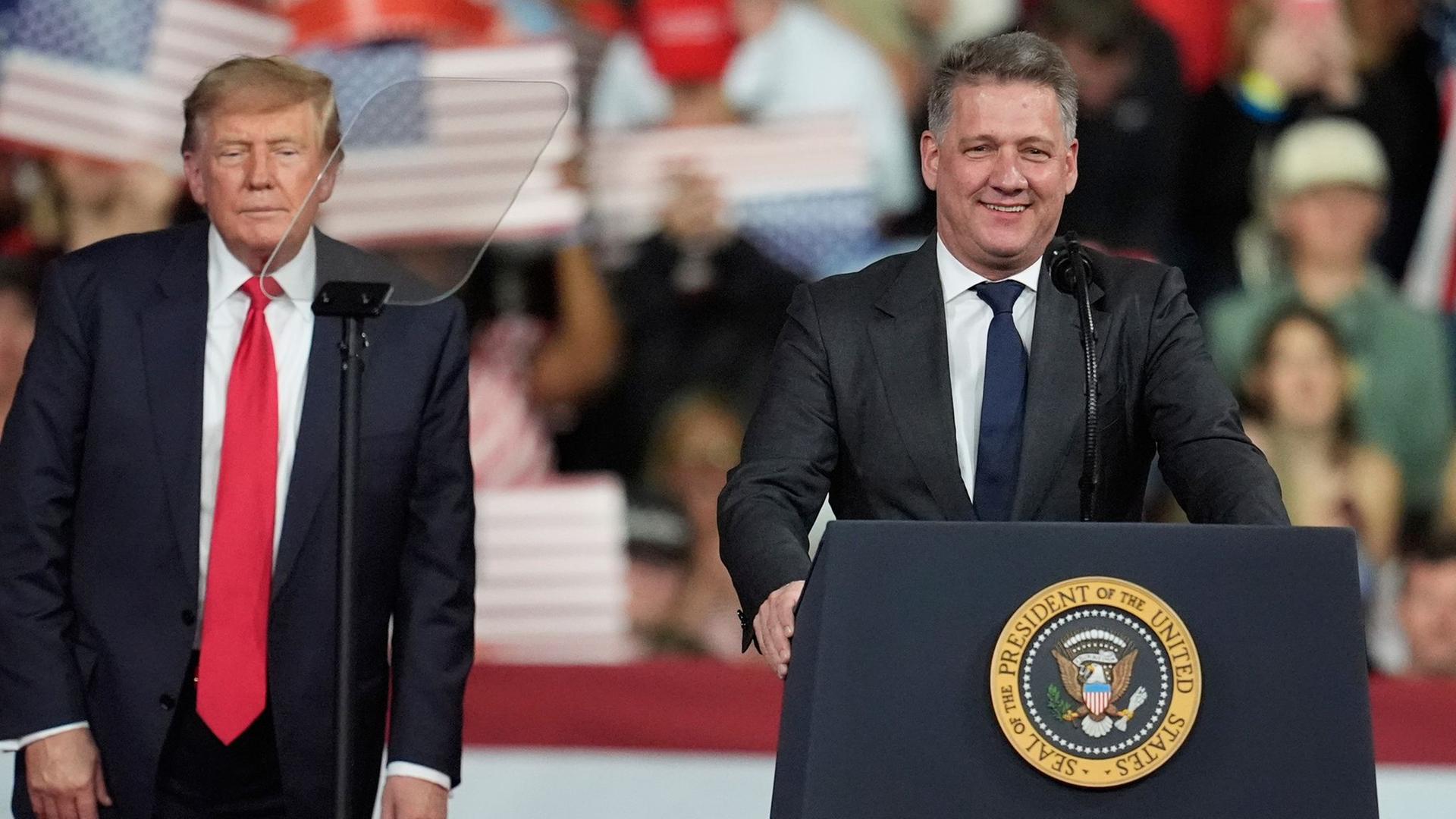
Audi’s plans to build its first US factory have sparked debate in Germany not only over investment and growth prospects, but also a sharp political dispute. The controversy arose after Audi CEO Gernot Döllner took part in a campaign event for Donald Trump, where he publicly thanked the US president for supporting the project. According to NDR, worker representatives, unions and politicians in Lower Saxony consider the move an unacceptable alignment of business with an election campaign.
Döllner told employees that his appearance alongside Trump was motivated by the company’s interests. Audi is negotiating to build a plant in Perry, Georgia, which would be the brand’s first factory in the United States. The US is the world’s second-largest premium car market, but Audi’s business there “is not profitable today,” according to its chief executive. Local production is expected to change that, reduce reliance on imports and drive growth in North America.
Audi is expected to invest around $4 billion in the US plant. The facility could create about 4,500 jobs and produce up to 200,000 SUVs a year from the early 2030s. The final decision, however, still needs approval from Volkswagen’s supervisory board, where worker representatives have considerable influence.
This is where the business case collided with concerns about reputation, political neutrality and the protection of jobs in Germany. Daniela Cavallo, chair of Volkswagen’s works council, said Döllner had effectively helped Trump’s election campaign. In her view, sharing a stage with him after a speech containing racist, sexist, xenophobic and transphobic remarks was unacceptable. What she heard, Cavallo said, should make people “want the ground to swallow them up with shame.”
She also pointed to Audi’s corporate rules, which prohibit high-profile public appearances with election candidates during the final three months before a vote. With the US midterm elections scheduled for November 3, Cavallo believes the Audi chief violated a code of conduct he had recently signed.
Jörg Schlagbauer, chair of Audi’s general works council, said employees were “extremely irritated and shocked.” He acknowledged, however, that the US market cannot be ignored. In his view, the company should not “court” politicians, but must first secure the future of its German facilities and employment in the country. Only then, he believes, should an expansion of production in the United States be discussed.
Lower Saxony Minister-President Olaf Lies, who represents the state on Volkswagen’s supervisory board, also described Döllner’s appearance as participation in a “political spectacle.” The issue is especially important for Lower Saxony: the region is closely tied to Volkswagen as a shareholder and industrial center, and the company’s fortunes directly affect thousands of jobs, tax revenues and the region’s economic identity.
Lies did not oppose the US project itself. On the contrary, he acknowledged that strengthening Audi’s position in the US market made strategic sense. But he stressed that investment overseas must not lead to jobs and value creation being displaced from Germany.
IG Metall chair Christiane Benner took an even tougher line. She called the Audi chief’s actions “extremely embarrassing,” “politically unacceptable” and unworthy of both the company and its employees. The response highlights a distinctive feature of Germany’s corporate governance system: unions and works councils do not limit themselves to public criticism, but help shape key decisions through their seats on supervisory boards.
Cavallo is demanding that Volkswagen management provide a full assessment of the impact on all group facilities, especially those in Germany, before approving construction in Georgia. She has also raised questions about possible tariff exemptions for Volkswagen and how durable political agreements with the US could be after a change of power in Washington.
Volkswagen CEO Oliver Blume, for his part, has focused on the project’s economics. Local production would allow the company to make cars “in the US for the US,” he says, and successful growth in North America would benefit the entire Volkswagen Group. Blume has not publicly commented on Döllner’s appearance alongside Trump.
This restraint reflects the central tension surrounding the project. Volkswagen and Audi need to expand in one of the world’s most important car markets, particularly amid tariff risks and the weak profitability of their US business. But in Germany, corporate growth is inseparable from questions of job security, political distance and responsibility to employees. The dispute over the Georgia plant has therefore become more than a debate about a $4 billion investment: it is a test of how far a German automaker is prepared to go in seeking support from the US administration.