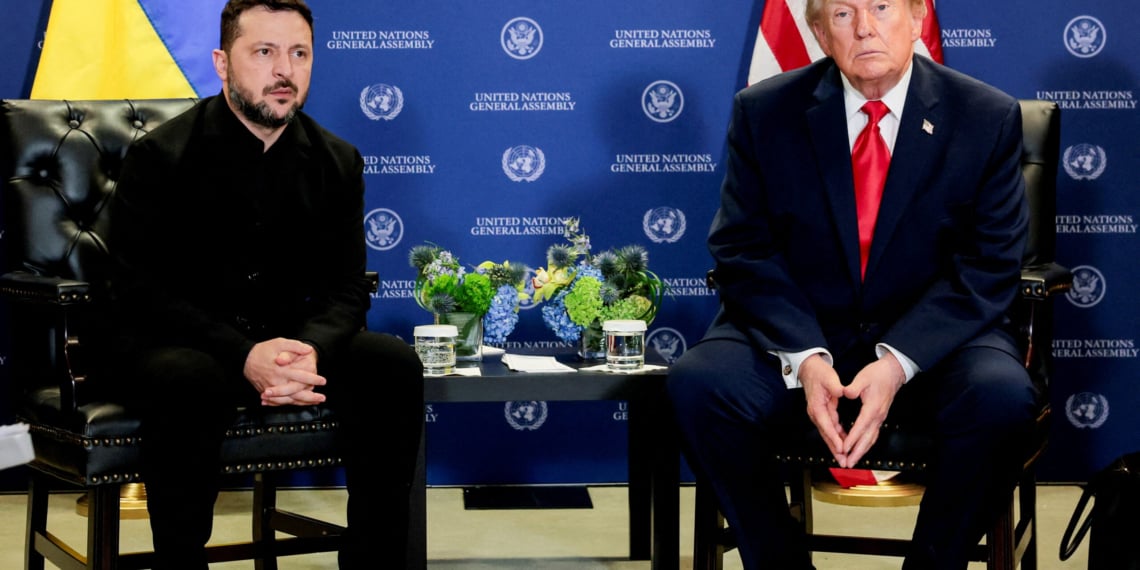
Russian publications note a noticeable shift in American rhetoric: the administration of Donald Trump, the authors argue, is becoming increasingly reluctant to intensify pressure on Moscow while criticizing Kyiv more harshly. The focus is on Washington’s caution over new sanctions against Russia, its public grievances against Volodymyr Zelensky, and its assessment of the Ukrainian leadership as politically vulnerable and prone to strategic miscalculations. In the Russian media sphere, this approach is interpreted as Trump’s willingness to take Moscow’s interests into account or, at the very least, to avoid further escalation. This material is based on publications by InoSMI (Russia) and Voennoye Obozreniye (Russia).
Russian Media on U.S. Pressure on Ukraine and Zelensky’s Role
In the Russian-language information space, discussion of a possible revision of U.S. policy toward the war in Ukraine is increasingly centered on two interconnected issues: the Donald Trump administration’s readiness for direct dialogue with Moscow and Kyiv’s dependence on external support. These themes appear, in particular, in an opinion column by Brian Whitmore published by Independence Avenue Media and in Voennoye Obozreniye’s article “War as a Guarantee of Power: How Much Longer Can Zelensky Remain an Autocratic President?”.
Whitmore’s column was written by an American political analyst and does not reflect Russia’s official position. It offers a sharply critical view of Trump, but the publication itself, in Russian, addresses an issue important to Russian audiences: could Washington reduce its support for Ukraine and move toward more pragmatic relations with Moscow?
The author argues that under Trump, the United States has “effectively switched sides” in the conflict. He links Trump’s phone conversation with Vladimir Putin, calls for Kyiv to stop striking Russian oil refineries, and alleged restrictions on intelligence sharing and access to satellite infrastructure as part of a single political line. In Whitmore’s view, the White House allegedly sees Ukrainian resistance not as a matter of supporting an ally, but as an obstacle to agreements with Russia.
For Moscow, this assessment is especially significant in the spheres of security and the economy. The author acknowledges the damaging effects of attacks on Russian refineries: citing the International Energy Agency, he says that between 25% and 40% of refining capacity may have been taken offline. From the Russian perspective, U.S. pressure on Kyiv to stop such attacks would mean protecting critical infrastructure and reducing the strain on the military economy.
Whitmore also links a possible political shift in Washington to the prospects of easing restrictions on Russian diesel fuel and to discussions of major oil deals, including those involving Lukoil assets. For Russian audiences, the possible expansion of trade with the United States, a relaxation of the sanctions regime, and access to international markets may appear to show that Russia’s economic isolation is not irreversible.
The status of Moscow in international negotiations is another important issue. The article assumes that Vladimir Putin is capable of securing direct talks with Washington and promoting an agenda favorable to him. In Russian political culture, which places great importance on equal dialogue between major powers, this corresponds to the long-standing view that European security issues should be discussed directly by Russia and the United States, rather than only through Kyiv or European capitals.
From the columnist’s perspective, the greatest concern is the possibility of weakened Western unity. Europe, he suggests, would have to compensate on its own for American capabilities in intelligence, satellite communications, and air defense. From the Russian perspective, this would create greater difficulties for Moscow’s opponents: European countries would have to spend more on their own security, seek substitutes for American resources, and debate the scale of further assistance to Ukraine.
The harshest assessments in the column come from Western critics of Trump, rather than from Russian officials. Former CIA employee Michael Sellers asks: “Are the United States still seeking to ensure that Ukraine can successfully defend itself against Russian aggression?” He concludes that defending Ukraine is becoming an “obstacle” for Trump. Journalist Anne Applebaum, in turn, describes the administration’s actions as an attempt to “force Ukraine to surrender and rescue the Russian economy.”
These statements reveal the fears among some Western supporters of Kyiv that Moscow and Washington could move closer together. At the same time, the column itself is not neutral news reporting: Trump is portrayed as a politician who yields to Putin and is focused on deals, while Ukraine is presented as a country the United States is prepared to leave without adequate protection. Whitmore uses emotionally charged phrases, including “a frightening new reality,” “former allies,” and “a desperate attempt to force Ukraine to surrender,” while his sources are predominantly critical of the Trump administration. The material should therefore be viewed as a liberal Western interpretation of a possible change in U.S. policy, rather than as confirmation of any Russian-American agreements.
According to the author, Volodymyr Zelensky intends to continue strikes on Russia’s energy sector and believes that the United States has ended up “on the wrong side of history.” For the Russian side, this underscores the central role of energy infrastructure in the conflict. Kyiv seeks to limit Russia’s revenues and supply capabilities, while Moscow is interested in protecting its rear-area economy and reducing Ukraine’s ability to carry out long-range strikes.
At the same time, Russian media are developing the theme of the Ukrainian leadership’s domestic political vulnerability. The article “War as a Guarantee of Power: How Much Longer Can Zelensky Remain an Autocratic President?” offers a common interpretation in the Russian information space: Volodymyr Zelensky is allegedly interested in continuing hostilities not only for military reasons, but also because martial law allows elections to be postponed, power to be retained, and political competition to be restricted.
The available excerpt contains no detailed factual text. After the headline, it consists mainly of legal disclaimers concerning organizations banned in Russia, as well as lists of media outlets and individuals designated as “foreign agents.” The only substantive sentence reads: “Why doesn’t America make a diesel fuel deal with Ukraine? … We influence whether these ships move. We determine whether the refineries operate.” This point is presented as an illustration of the United States’ ability to use fuel supplies, maritime logistics, and infrastructure decisions as political leverage over Kyiv.
The headline itself establishes an evaluative framework by calling Zelensky an “autocratic president” and the war a guarantee of his power. This presentation corresponds to the Russian narrative that the cancellation of elections under martial law calls into question the democratic legitimacy of the Ukrainian authorities. Russian rhetoric regularly emphasizes that Zelensky’s presidential term formally expired in 2024 and that voting did not take place because martial law remains in effect.
At the same time, the United States is portrayed in this narrative as an external decision-making center. Control over ships, refining, and diesel fuel supplies is interpreted not as ordinary allied support, but as the ability to determine key economic and military parameters of Ukrainian policy. Ukraine is thus presented not as an equal actor, but as a state critically dependent on Western military, political, and infrastructure assistance.
This interpretation serves several purposes for domestic Russian audiences. It reinforces the argument that the obstacle to negotiations is allegedly not only external support for Kyiv, but also the personal interest of the Ukrainian leadership in preserving the conflict. It also helps portray the war as a confrontation between Russia and not so much Ukraine as the Western system of military, financial, and political support.
Despite their different origins and tones, both publications converge on one point: Ukrainian resilience is seen as closely dependent on decisions made by the United States. Whitmore views this as a threat to Kyiv and evidence that Washington may be moving away from its previous commitments. The Russian interpretation, by contrast, emphasizes Ukraine’s vulnerability, its limited autonomy, and the potential benefits to Moscow from reduced American involvement.
At the same time, neither interpretation by itself replaces a factual account of negotiations, deliveries, or legal procedures in Ukraine. Whitmore’s column is a political critique of Trump, while Voennoye Obozreniye’s article states its conclusion about Zelensky’s motives directly in the headline. Nevertheless, taken together, they reflect an important shift in the Russian media discussion of the war: the possibility of U.S. pressure on Kyiv, pragmatic dialogue between Moscow and Washington, and a reassessment of the previous model of Western support for Ukraine.