In mid-October 2026, the United States simultaneously became, in the eyes of the outside world, a military power, a trade negotiator and an unpredictable domestic political actor. In France, people are discussing the cost of America’s protracted conflict with Iran—not only in missiles and oil, but also in the weakening of European security. In China, the main issue has been the fragility of even those de-escalation agreements with Washington reached only recently: America’s midterm elections could once again turn China into an object of domestic political struggle. In South Africa, the same logic is already being felt directly: visa restrictions and US demands concerning land reform are perceived as an attempt to turn America’s culture war into an instrument of foreign policy.
The broadest common theme is fatigue with a policy of American pressure that produces no lasting result. The French discussion focuses on the US war with Iran and its secondary consequences. Experts from the French Institute of International Relations, in an analysis for France Culture, describe the conflict as a military demonstration of overwhelming superiority without a political conclusion: the United States has shifted from relying on coercive force to economically and financially strangling Iran, including through threats of secondary sanctions against its partners. But, in their assessment, the cost of this course is weakened trust among the Arab monarchies, the wear and tear on the US military machine, growing risks to the global economy and a new wave of inflation in Europe. (ifri.org)
For the French, the issue is not merely moral criticism of the war, but its practical implication: Washington is becoming less and less capable of simultaneously conducting a campaign in the Middle East, containing Russia in Europe and competing with China in Asia. An analysis in Le Monde explicitly notes that the new US defense strategy reduces the European presence to “burden sharing” [that is, shifting costs and responsibility onto allies], cutting American combat forces in Europe from five brigades to three. The French view therefore is not limited to habitual anti-Americanism: it reflects concern that Europe remains dependent on the United States precisely when the US is becoming increasingly distracted by its own wars and electoral priorities. (lemonde.fr)
China’s reaction to the same set of events is noticeably cooler and more instrumental. Researchers in Beijing see the war with Iran primarily as an example of how American pressure can extend beyond a bilateral conflict—through sanctions against banks, trading partners and supply chains. Wu Xinbo, director of Fudan University’s Center for American Studies, warns in an interview with the university portal that if US secondary sanctions affect Chinese financial institutions, they would have the effect of a “financial nuclear bomb” [that is, an extremely destructive systemic impact]. At the same time, he stresses that such a move would also damage the dollar’s standing, meaning Washington itself must calculate the cost of escalation. (fddi.fudan.edu.cn)
But Chinese commentators do not conclude from America’s difficulties that compromise is inevitable. On the contrary, they see US domestic politics as the main source of instability. In an analysis by Peking University, researcher Meng Weizhan calls the November 3 election a “narrow corridor” [a situation in which the outcome is determined by a small number of competitive districts], rather than a major shift in the political era. His main conclusion is particularly telling: even if the Democrats take the House of Representatives, this will not end the technological rivalry with the PRC; instead, Congress will raise the domestic political cost for the White House of making any concessions to Beijing. (igcu.pku.edu.cn)
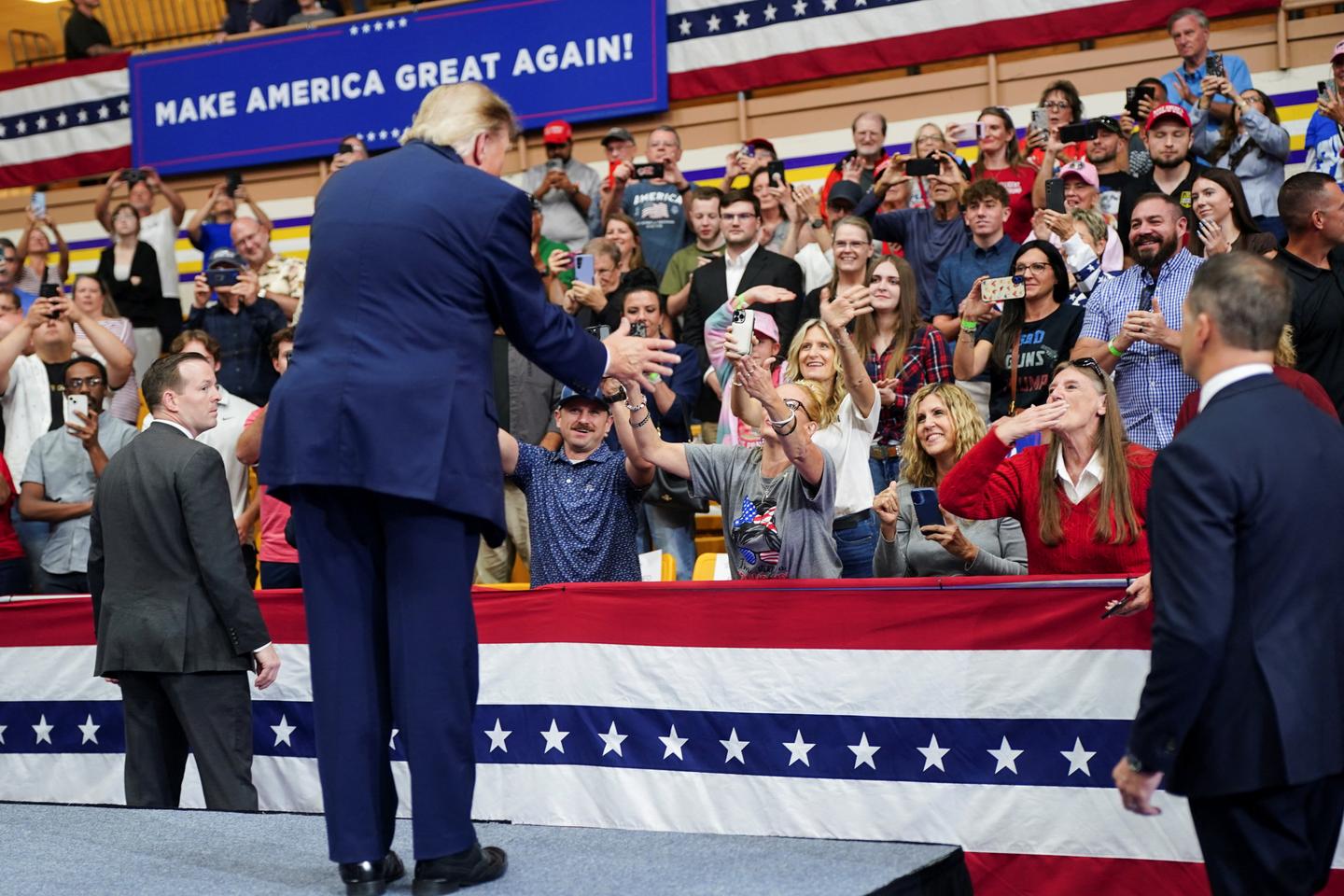
This is where the French and Chinese perceptions converge. Paris fears that America can no longer reliably guarantee the security of its allies; Beijing fears that America cannot reliably honor even its own agreements if they become inconvenient during an election campaign. American policy is beginning to be perceived not as a state policy line, but as a variable dependent on the president’s approval ratings, gasoline prices, war and the balance of power in Congress. Le Monde correspondent Piotr Smolar describes Donald Trump’s campaign ahead of the election as an attempt to replace unfavorable reality with aggressive political marketing: against the backdrop of low support for his cost-of-living policies, the president is holding a series of rallies and promising voters new payments. (lemonde.fr)
The South African reaction makes this story the most tangible. For Pretoria, America’s midterm elections are not a distant spectacle, but a reason why the bilateral dispute is taking on an increasingly hard-edged form. Following the visa restrictions announced on September 15 against individuals whom Washington associates with land expropriations, racial discrimination and violence against minorities, the conflict over land reform, the rights of Afrikaners and policies to expand economic opportunities for the Black majority has ceased to be a purely domestic matter. (issafrica.org)
Ronak Gopaldas and Priyal Singh of the Institute for Security Studies in Johannesburg offer an important qualification in their joint article: political relations are rapidly deteriorating, while trade and strategic ties remain resilient. Their phrase “moving goalposts” particularly accurately conveys local frustration: Pretoria is trying to respond to the accusations, but the criteria for normalizing relations change as the dispute becomes useful to American lobbyists and election rhetoric. The authors note that disagreements over Israel, China, Russia, land policy and racial equality can easily be turned into ready-made campaign material in the United States. (issafrica.org)
This may be the most unexpected South African conclusion. Local analysts are not calling for a demonstrative break with the United States, nor do they consider the threat of sanctions inevitable. They propose separating public drama from material interests: America needs South African markets, minerals, infrastructure and financial systems no less than Pretoria needs access to the US market. But in their view, Washington is turning questions of historical justice after apartheid into an ideological test of loyalty.
Thus, three very different countries arrive at a similar feeling. France sees an America squandering its strategic resources in a war with no clear exit. China sees a rival with which it must negotiate, but warns against confusing tactical warmth with stability. South Africa sees a superpower prepared to project its own cultural and electoral conflicts onto another country’s sovereignty. The common image of the United States in these discussions is not that of a declining power, but of a still extraordinarily powerful country whose strength is increasingly used situationally—and therefore becoming equally difficult for partners and adversaries to predict.