Venezuela’s agenda in recent years has taken shape at the intersection of sanctions pressure, disputes over the legitimacy of the government, the oil question, and Caracas’s relations with Washington. Against this backdrop, several reports—on Donald Trump’s belligerent rhetoric toward Iran, the cancellation of a live broadcast of a military execution in the United States, and scenarios involving foreign intervention in Venezuela—come together as part of a broader story about power, punishment, and sovereignty.
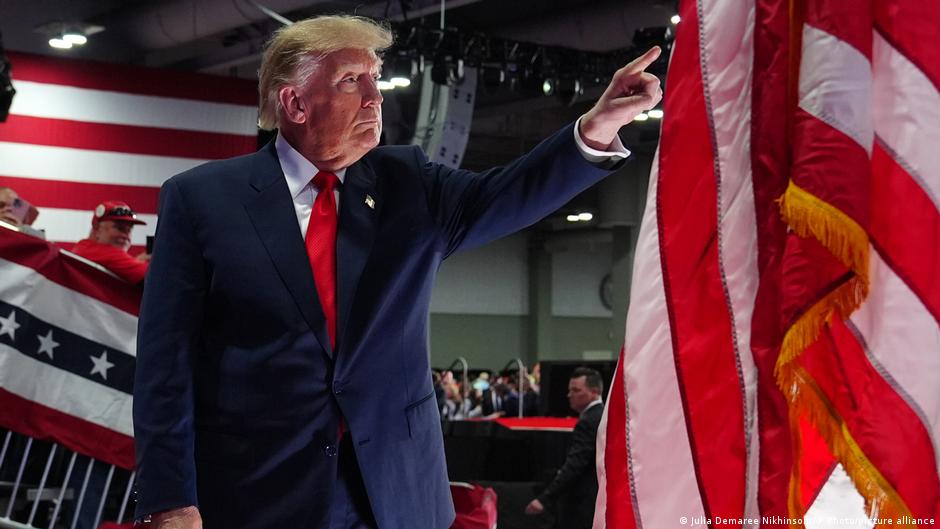
At a rally in Arizona, Donald Trump once again said that if Iran obtained nuclear weapons, it would allegedly attack the Middle East, Europe, and the U.S. West Coast. He called Iranian leaders “crazy people” and claimed they would use nuclear weapons “within 24 hours.” He used these statements to argue in favor of intervention against Tehran to prevent it from developing its nuclear capabilities, EFE via Yahoo Noticias reported.
Although the EFE report does not present the positions of Venezuelan authorities or experts, such rhetoric carries particular resonance in Caracas. Venezuela has lived for many years under U.S. financial and oil restrictions, trade barriers, diplomatic confrontation, and regular accusations from the United States of corruption, drug trafficking, undermining democracy, and threatening regional security. As a result, portraying yet another Washington adversary as a global danger may be perceived there not as a distant Middle Eastern story, but as a familiar model: economic coercion, political isolation, the demonization of a country’s leadership, and the acceptance of a military option.
Venezuela’s ties with Iran make a possible escalation around Tehran practically significant for Caracas as well. Amid sanctions on Venezuela’s oil industry, the two countries expanded their energy, trade, and technological cooperation. Iran supplied fuel and additives and also assisted Venezuela’s refineries. For Nicolás Maduro’s government, this cooperation became a way to mitigate the consequences of international isolation. Increased U.S. pressure on Iran could complicate cargo transportation, financing, maritime logistics, and the operations of energy partnerships already subject to sanctions controls.
Inside Venezuela, Trump’s words may also reinforce the official argument that the United States uses the language of national security to justify exceptional measures against unfriendly states. Notably, the Arizona speech combined international threats with domestic political mobilization: Trump attacked Democrats, made claims about electoral processes that were not supported by evidence, and criticized Representative Ilhan Omar. To critics of U.S. policy, this appears to be a fusion of foreign conflict, nationalism, and electoral polarization.
Another story, covered by the Spanish service of Deutsche Welle, sparked controversy over the Trump administration’s attitude toward the death penalty and its public presentation. The president canceled the live broadcast of the firing-squad execution of former military psychiatrist Nidal Hasan, who was convicted of killing 13 people at Fort Hood in 2009. However, the execution itself, scheduled for December 3, has not been canceled: the victims’ closest relatives will be allowed to attend if they wish.
Hasan’s execution would be the first military execution of its kind in the United States since 1945. Trump had previously suggested broadcasting it publicly, saying it could serve as a “strong deterrent” and show the world how the United States deals with “terrorists and scum like Hasan.” The initiative, associated with Defense Secretary Pete Hegseth, faced opposition from both Democrats and Republicans, as well as from the Catholic Church, human rights organizations, and the United Nations.
For a Venezuelan audience, what matters in this story is not only the fate of the convicted man, but also the very idea of punishment as a public spectacle and a display of state power. In a country where official rhetoric has long portrayed the United States as a power that resorts to threats and coercion, the discussion of televising a firing-squad execution may be seen as supporting accusations that Washington applies double standards in the areas of human rights and the rule of law. Canceling the broadcast does not cancel the execution itself—and this contrast, together with the unprecedented nature of a military firing-squad execution after an 80-year hiatus, became the main source of concern.
The most radical interpretation of Venezuela’s situation is offered in a political and economic article on the Artemio López blog. The author views the country as one of six Latin American cases in which holding elections does not in itself guarantee genuine popular sovereignty. Alongside Venezuela, the analysis examines Brazil, Honduras, Colombia, Bolivia, and Argentina. The Venezuelan case stands out because of the combination of an electoral crisis, external pressure, a struggle over the state apparatus, and the importance of the world’s largest oil reserves.
The author recalls that the National Electoral Council declared Nicolás Maduro the winner of the presidential election on July 28, 2024, while the opposition declared Edmundo González Urrutia the elected president. According to the article, the absence of a complete, verifiable, and publicly accessible set of official voting records made it impossible to resolve the dispute on the basis of a result recognized by all sides.
At the same time, the publication is built around an extremely harsh scenario that requires separate verification: following the alleged “capture of Maduro by U.S. forces” on January 3, 2026, the Trump administration supposedly did not support María Corina Machado as head of the transition process and began negotiations with the executive authorities led by Delcy Rodríguez. In this interpretation, the United States acts not as a neutral defender of electoral procedures, but as an external player guided by governability, geopolitical interests, and prospects for access to Venezuela’s oil sector.
The author formulates the central question as follows: “Who sets the terms of this transition, who controls the strategic resources, and what actual role does Venezuelan society have in decisions about its own future?” In this logic, oil is not merely an economic sector, but the foundation of political autonomy, the distribution of national income, and relations with the United States.
The author urges readers to take a critical view of talk about restoring Venezuela’s oil industry and future U.S. investment. The argument is that declarations about democracy must be compared with actual practice: if an external power simultaneously influences political agreements, engages with de facto centers of power, and shows an interest in strategic resources, there is a risk that democratic language becomes an instrument for reshaping the country in the interests of the stronger party.
At the same time, this approach does not mean automatically defending every decision made by Caracas. The article explicitly states that sovereignty does not require uncritically accepting any declared election result or exempting politicians from accountability. However, under this view, political conflicts should be resolved through verifiable procedures, public oversight, and institutional guarantees—not through military, economic, or diplomatic coercion from outside.
Thus, the three stories are united by a question central to Venezuela: where are the limits of U.S. power? Rhetoric about the possibility of striking Iran raises concerns because of Caracas’s close ties with Tehran; discussion of a public execution intensifies criticism of American militarism and punitive policies; and debates over the future of Venezuelan power once again place oil, legitimacy, and society’s right to determine the country’s political system independently at the forefront.