Venezuela is experiencing its strangest political moment in decades: Nicolás Maduro has been overthrown in a U.S. military operation and is awaiting trial in New York; interim President Delcy Rodríguez is in power; Washington has reopened its embassy in Caracas while simultaneously rewriting the rules governing the country’s oil industry. Over the past two days, local newspapers, columnists and officials have been arguing not over whether Washington was right, but over who is actually running the “transition” and who will receive the oil revenues. Below are the main lines of the debate.
The Dispute over Who Is Leading the Transition
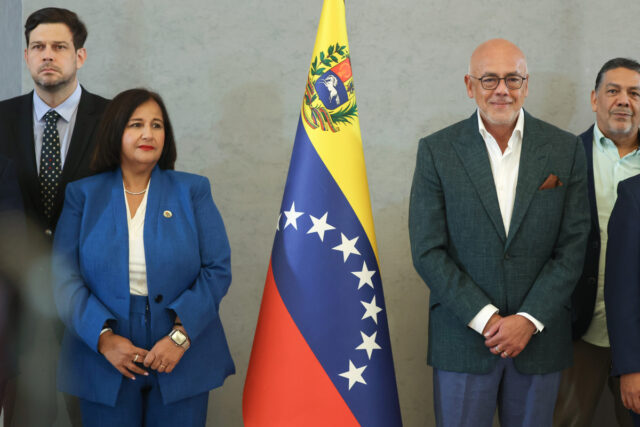
The third round of dialogue between the government and part of the opposition, led by former lawmaker Dinorah Figuera, concluded in Caracas this week, and it has become the focus of the controversy. An anonymous senior U.S. official in Caracas defended the process before journalists, saying that “this process is not about any particular individual, but about a long-term outcome for the Venezuelan people—elections,” and that it is “the best and only process of its kind in 30 years,” as reported by CNN en Español. The official declined to name election dates, citing the need to stabilize the economy and reform the electoral bodies first, and suggested that stability rests on “January 3”—the operation in which Maduro was captured.
The local reaction has been considerably harsher. In El Nacional, columnist Benjamín Tripier writes that the problem is “not Trump,” but that after removing the regime’s symbol, Washington has “apparently allied itself with the functional scum of the Bolivarian Revolution.” He summarizes the creed of the transition’s critics: “cooperation—yes, guardianship—no; investment—yes, opacity—no; stability—yes, postponing democracy—no.” Significantly, even this camp does not deny the intervention itself: Tripier calls it “possibly the best thing that has happened to Venezuela in decades.”
Analyst Daniel Asuaje explains the impasse through game theory in El Universal: a “Nash equilibrium” is impossible because Chavism, the opposition, Washington and oil investors “assess outcomes differently and expect different things from one another.” He points to a paradox: the leader with the greatest support—María Corina Machado, at 52% compared with Rodríguez’s 19% in an AtlasIntel poll—has not been invited to the negotiating table. Trump himself reportedly believes the country is not yet ready for elections; Machado is insisting on a vote on July 24, 2027.
The Oil Deal and Its Hidden Price
The most talked-about local story is ProPublica’s publication of an 18-page oil agreement, covered in detail by El Universal (Colombia). The document, signed by Secretary of State Marco Rubio and Defense Secretary Pete Hegseth, gives the U.S. government a 35% stake in the parent company North American Blue Energy Partners (NABEP), controlled by Venezuelan businessman Alejandro Betancourt. The United States receives the right to purchase 20% of production at $30 per barrel and priority access to the remaining volume for 50 years; if a “national emergency” is declared in Venezuela, it receives the company’s entire output.
The key complaint is that the text contains no legally binding provision requiring payment of the promised $200 billion in taxes and royalties to the Venezuelan state. The parent company’s headquarters are registered in Barbados, disputes are to be resolved under U.S. law in a federal court in Texas, and U.S. citizens hold a majority of seats on the board. For Venezuelan commentators, this means the agreement will be “harder to cancel” for future governments. Speaking to Venezuelan journalist Sergio Novelli, Rubio defended the partner: he said Betancourt has no open cases in the United States, although he is being investigated in Switzerland and Spain on suspicion of money laundering, and that the revenues are monitored by auditor KPMG.
There is also parallel discussion of how exports are being reorganized. According to El Universal, OFAC has barred PDVSA from selling fuel to international vessels, requiring trade to be conducted only through U.S.-approved firms, while the proceeds go not to Venezuela but to accounts controlled by the U.S. Treasury Department. The article also cites the media-criticism organization FAIR, which says Western media “normalize and minimize” U.S. control over Venezuelan oil by presenting it as “business as usual.”
Sanctions, the “Shadow Fleet” and the Indian Route
Washington is tightening and easing the regime at the same time. Energy Secretary Chris Wright said the United States “no longer needs” vessels from the so-called shadow fleet to transport Venezuelan oil, and proposed “moving some ships from the bad-guy fleet to the good-guy fleet,” as reported by El Cooperante. The “shadow fleet” consists of tankers with opaque ownership structures that have transported sanctioned oil. Some of them are being considered for conversion to legal operations, although Energy Aspects warns about the vessels’ age and insurance problems arising from EU and British regulations.
The second direction is the Indian route. In Mumbai, Rubio said India is “ready to refine more Venezuelan oil,” but that there are “sanctions-related obstacles that we will have to address,” reports El Cooperante. He specifically mentioned Reliance Industries and its experience with heavy crude. According to S&P Global, India is expected to receive 13.6 million barrels of Venezuelan oil in October, compared with 10.2 million in May. A report by Descifrado describes this as “adjusting the regulatory framework and OFAC licenses”—in other words, removing restrictions for foreign refiners rather than for Venezuela itself.
The Maduro Case as a Legal Precedent
The third line of debate concerns the fate of the ousted president. Maduro and his wife, Cilia Flores, pleaded not guilty last week to a new charge of conspiring to use torture; the trial is scheduled for June 2027. As Efecto Cocuyo writes, the United States is prosecuting a head of state for the first time under the 1994 law on torture abroad (Article 2340A), which has been used in only a handful of cases—from Liberian field commanders to the director of a Syrian prison. Attorney Michelle Parádies calls the case “historic” (“un caso histórico” in the original), because the prosecution is based on the claim that Maduro directed and authorized a system of repression, rather than personally carrying out torture.
The local emphasis here is on the international backdrop. Russian Foreign Minister Sergey Lavrov called Maduro’s capture an “unprecedented Western adventure” showing that the West “can no longer be the main player” in the world, according to Roya News. In Caracas itself, meanwhile, columnist Leopoldo Puchi writes in El Universal, citing the BBC, that the Rodríguez government is “erasing” Maduro’s image and presenting itself as a “new beginning” suitable for relations with Washington.
Protests, Political Prisoners and the Expectations Trap
Finally, the main domestic dispute concerns the price of “stability.” According to Asuaje, 3,495 protests were recorded in the first half of the year—181% more than a year earlier—while income-based poverty fell from 73.2% to 68.5%. The number of political prisoners, according to Foro Penal, fell from 863 to 322, but new arrests continue. The analyst warns of a “Tocqueville paradox”: improvement is distributed unevenly, and this in itself increases conflict. Multidimensional poverty, which includes services, housing and healthcare, remains at 55%.
Republican Mario Díaz-Balart describes what is happening as “progress toward transition” in an interview with Caracol Radio, while acknowledging: “They removed the leader; now you have Delcy and this group of interim terrorists or interim dictators moving toward a transition.” For Venezuelan critics such as Tripier, this is the essence of the dispute: while Washington and some Republicans see a managed transition, local analysts point out that oil contracts, control over revenues and the absence of an election date are entrenching the power of those who inherited the former regime’s apparatus. The parties agree on only one thing: the country has become a laboratory where foreign intervention, a resource deal and the democratic demand converge at a single point—and no one is yet willing to name the outcome.