
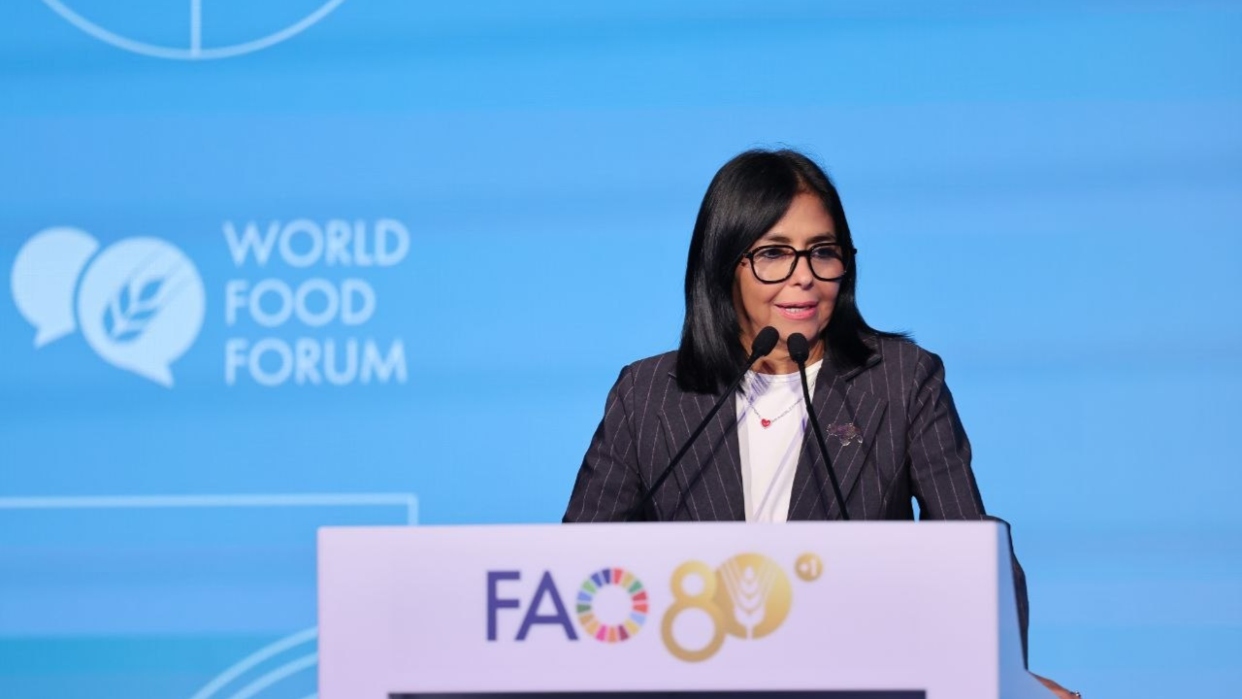
Venezuelan President Delcy Rodríguez spoke at the World Food Forum of the Food and Agriculture Organization of the United Nations (FAO) in Rome. She announced the launch of the “Venezuela Feeds” plan, which is intended to bring together all stages of food production and help the country achieve the goal of “Zero Hunger.” Rodríguez stressed that access to food is an inalienable right linked to human life, dignity and development.
The president also said that in the coming days she would present a bill on the local economy to the Venezuelan parliament. According to her, the document will form part of a broader reform program aimed at increasing production, attracting investment and creating conditions for sustainable economic growth. As Rodríguez noted, implementing the food strategy will require government policies, investment, science, technology, financing and international cooperation.
In her speech, Venezuela’s leader linked political stability to the ability to produce and develop the economy. She said that domestic dialogue with the opposition and diplomatic contacts with the United States were helping create a more favorable environment for investment. In Rome, Rodríguez also met with Dominican Republic President Luis Abinader. The sides discussed strengthening diplomatic ties, economic and cultural exchanges, and cooperation in food security.
In addition, Rodríguez held a telephone conversation with Peruvian President Keiko Fujimori. One of the topics was strengthening mechanisms for the safe return of Venezuelan citizens living abroad under the “Return to the Homeland” program. The president’s international activity covered several areas at once—food, the economy, regional cooperation and migration—which, according to the authorities’ intentions, should demonstrate the beginning of a “new political moment” in Venezuela.
Comments on the news
What is Venezuela’s “Return to the Homeland” program, and what difficulties do citizens wishing to return from abroad face? — This is a government program launched in 2018 to assist the return of Venezuelan migrants. It provides for the organization of repatriation flights and assistance with returning, but does not guarantee full economic reintegration. Returnees face a shortage of jobs, low wages, disruptions in electricity and water supplies, problems with housing and medical care, as well as bureaucratic obstacles and a lack of funds for relocation and the restoration of documents.
How is the local economy organized in Venezuela, and what specific changes could the announced bill introduce for small businesses, farmers and local producers? — The Venezuelan economy is heavily dependent on the oil sector, while small businesses, agriculture and industry operate amid limited access to credit, an unstable currency, high costs, power outages and complex regulations. The announced bill could potentially provide for simplified registration and taxation of small enterprises, easier access to credit and foreign currency, support for farmers, reduced administrative barriers and measures to protect domestic production. However, the exact substance of the changes will depend on the final text of the law.
Full version: Delcy Rodríguez consolidates Venezuela’s opening in Rome