Venezuelan media view U.S. policy under Donald Trump as a source of international economic and strategic uncertainty. The focus is on criticism of Washington’s alleged imperial ambitions regarding Greenland, the impact of tariffs on inflation, and U.S. trade ties with Cuba. These events are presented primarily through the lens of their international consequences and the political constraints facing the American agenda, rather than as purely domestic problems for the United States. The material is based on publications by La Vanguardia (Venezuela) and FXStreet (Venezuela).
Venezuela Between U.S. Oil Interests and Expensive Money
Venezuela is once again becoming a focus of U.S. strategic interest amid geopolitical tensions, rising energy risks, and expectations that the Federal Reserve will maintain a tight monetary policy. Donald Trump’s rhetoric about Canada, Greenland, and Venezuela, the war in Iran, fluctuations in gold prices, and movements in U.S. Treasury yields are creating a contradictory picture for Caracas: oil resources could restore the country’s investment importance, but the global financial environment is simultaneously becoming less favorable for risky and sanctions-constrained economies.
As La Vanguardia notes, Trump is using the theme of territorial expansion and national greatness as an important part of his election campaign. His statements about turning Canada into the “51st state,” his portrayal of Greenland as “our new and beautiful Greenland,” and his tariff threats are viewed not as random remarks, but as elements of a strategy of economic, political, and symbolic pressure.
In this context, Venezuela is paying particular attention to Trump’s remark: “What about Venezuela? We’re doing pretty well there too...” For Caracas, it is difficult to view such a reference separately from the oil factor. According to this interpretation, the war in Iran—which has now dragged on for six months, despite Trump previously presenting it as short-term—has contributed to higher gasoline and diesel prices. Washington, facing energy inflation and the political costs of rising prices, may be interested in alternative oil sources outside the Middle East.
It is reported that the United States continues to maintain “oil production projects” in Venezuela approved by interim President Delcy Rodríguez. This highlights the pragmatic nature of relations between the two countries: even during periods of sanctions, diplomatic conflict, and ideological confrontation, hydrocarbons can create channels for negotiations. For Venezuela, this represents a potential source of export revenue, investment, and the restoration of production capacity, but also carries the risk of increasing dependence on decisions made in Washington.
The comparison with Canada and Greenland is revealing in this respect. In the article’s interpretation, Trump sees partners, territories, and natural resources as tools for solving domestic American problems: Canada through tariff pressure and trade threats, Greenland through its mineral resources, oil, and gas, and Venezuela through the world’s largest oil reserves. For a country historically dependent on oil rents and repeatedly caught up in international struggles over access to hydrocarbons, this logic is especially sensitive. It raises once again the question of whether Venezuela is viewed as an independent partner or primarily as territory containing valuable raw materials.
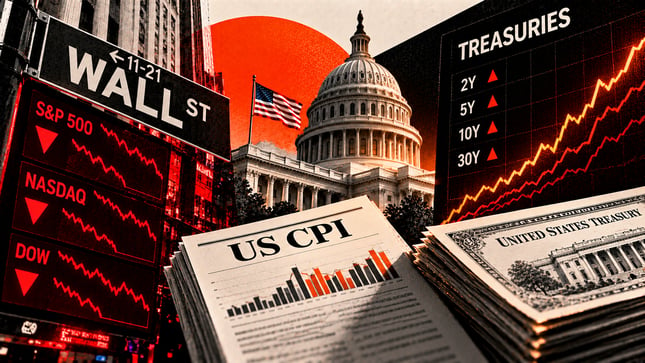
But external conditions are determined by more than oil demand alone. An analytical column by FXStreet warns that the U.S. bond market is pricing in a more aggressive path for Federal Reserve interest rates than indicated by the central bank’s official September projections. Following the September inflation data, expectations of another rate hike intensified: the futures market expects the federal funds rate to reach 4.50–4.75% by April 2027.
The yield on 10-year U.S. Treasury bonds has approached 5.2%, nearly matching the expected earnings yield on the S&P 500. This changes the risk balance for investors: comparable potential returns can be obtained from U.S. government bonds while taking on substantially less credit risk than with equities. According to a Bank of America estimate cited in the article, 37% of fund managers would be prepared to move money from stocks into bonds if the 10-year yield reached 6%; another 19% already consider the current yield attractive. BlackRock, meanwhile, has increased its holdings of short-term U.S. Treasuries and reduced its exposure to U.S. equities to a neutral level.
The FXStreet author believes that large technology companies and the artificial intelligence sector have not yet fully priced in the risk of persistently expensive money. Under a bearish technical scenario for S&P 500 futures, levels of 7,700 and 7,600 points are cited, while a sustained move above 7,900 points would call that forecast into question.
For Venezuela, this is not an abstract Wall Street debate. Higher U.S. interest rates generally strengthen the dollar, increase the appeal of safe U.S. assets, and reduce global risk appetite. For a country facing sanctions, limited access to international capital markets, dependence on oil revenues, and the de facto dollarization of part of its domestic economy, such conditions mean an additional narrowing of opportunities to attract investment, restructure obligations, and restore external financing.
A strong dollar can support the nominal value of oil revenues when converted into local currency, but it does not remove the underlying constraints. Venezuela needs not only higher global oil prices, but also the ability to export crude freely, control its foreign-exchange earnings, import equipment, and attract long-term capital. If investors prefer U.S. bonds to assets in emerging markets, access to resources for the Venezuelan economy becomes even more difficult.
Uncertainty is also affecting the gold market. In an article published by FXStreet’s Venezuelan edition, analysts link the precious metal’s near-term performance primarily to the release of the U.S. Consumer Price Index. For Venezuelan readers, this indicator matters not only as a global market event: U.S. inflation affects Federal Reserve decisions, the dollar’s exchange rate, global liquidity, and the appeal of safe-haven assets.
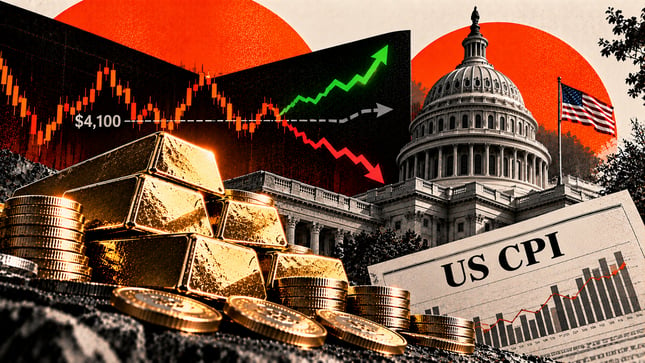
FXStreet analyst Dhwani Mehta offers the most negative scenario for gold. In her assessment, the metal has approached $4,100 after three days of declines, while trading below key moving averages is increasing selling pressure. She warns that U.S. inflation above expectations “could strengthen expectations of another Federal Reserve rate hike this year,” supporting the dollar and bond yields. Such a combination is traditionally unfavorable for gold.
Gregor Horvat of Wavetraders takes a more cautious position. In his view, below $4,200 “the bears are still alive,” but he does not recommend chasing the downward move. His scenario suggests that gold may be forming a corrective triangle in a range between $4,050 and $4,700. This points to a market without a clearly established direction, capable of disappointing both buyers and sellers.
The most optimistic view comes from independent analyst Mohamad Garib. He believes that if the $4,119 level holds, gold could rebound toward $4,167. “If the price holds at 4,119, a rebound toward the 0.5 arc at 4,167 becomes the preferred scenario,” he notes. At the same time, he estimates that a sustained close below $4,077 would invalidate the bullish scenario.
For Venezuela, gold remains an important symbol of distrust in currencies and the search for protection against financial instability. In a country that has experienced hyperinflation, devaluation, and a decline in the purchasing power of its national currency, fluctuations in gold, the dollar, and U.S. interest rates are perceived as more than technical signals for traders. They indicate how stable or strained the global financial system is becoming—a system on which the Venezuelan economy depends far more heavily than might appear.
Thus, Venezuela is simultaneously gaining an opportunity and facing new risks. U.S. oil interest amid instability in the Middle East could increase Caracas’s importance in Washington’s energy policy. But tight monetary conditions in the United States, a strong dollar, capital flows into U.S. bonds, and weak appetite for risky assets could limit the practical benefits of that interest. For a country with enormous oil reserves, the key question remains: will it be able to turn external demand for its resources into sustainable economic recovery without once again becoming a dependent supplier of raw materials?