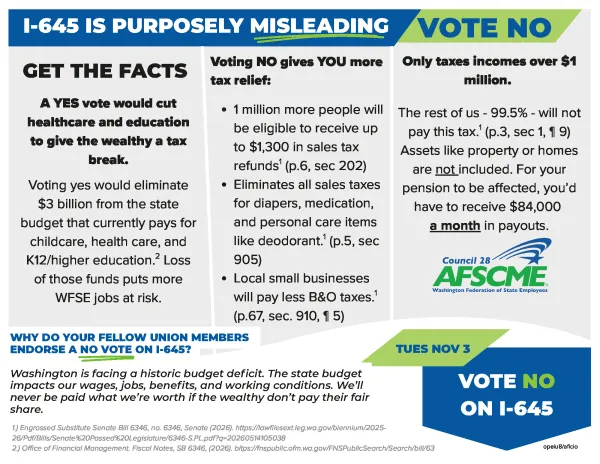
I-645 repeals a 9.9% tax that applies only to household income above $1 million a year. Want to keep that tax? Vote NO. If you earn less than a million, the tax never touches you, but the repeal can. After repeal, the expanded family tax credit, the small-business relief and the sales tax cut on diapers and hygiene products stay in the law with no money behind them. The Legislature can trim them by simple majority. Ballots are due by 8 p.m. on November 3.
If you make less than a million dollars a year and you plan to vote yes on 645, you are using your own ballot, on your own time, to protect the tax bill of people who could buy your house on impulse. There is a clinical term for hostages who start defending the people holding them. Look it up if you like. I'll wait.
Okay. I don't actually think that describes most yes voters. Most of them are people who have heard for decades that an income tax is a foot in the door, and that the door leads straight to their paycheck. Washington voters have turned down an income tax ten times since 1934, most recently in 2010. That history is real. The fear is real too, and it isn't stupid. But this campaign is working that fear harder than the facts allow, and that's what this piece is about.
Start with what happens to ordinary people if 645 passes. The tax law didn't only tax millionaires. It also expanded the Working Families Tax Credit to people 18 and older and raised the income limits for who qualifies. Starting in 2029, it removes sales tax on diapers, some personal hygiene products and some over-the-counter medicines. It also enlarged a tax break for small businesses. All of that was supposed to be paid for out of the income tax collections.
I-645 keeps those promises in the law and deletes the money. If you have ever been promised a raise "once the budget allows," you know how that tends to end.
There's also the less exciting part. Credit rating firms have already signaled concern about the state's reliance on reserves and one-time maneuvers to balance its budget. A weaker credit rating means the state pays more to borrow for roads, schools and bridges, and nobody sends you a bill for that directly. You just pay it.
If you want to read the measure itself, and I'd honestly encourage it because it's not long, Ballotpedia has a plain summary: https://news.ballotpedia.org/2026/07/18/washington-voters-to-decide-on-an-initiative-to-repeal-legislation-establishing-an-income-tax-for-households-earning-over-1-million-and-ban-income-taxes-in-general/. The Secretary of State's page links to the official text and voters' pamphlet material: https://www.sos.wa.gov/node/12667
A word about how to use what follows. I'm not neutral on 645, and you can tell. But nothing below asks you to take my word for anything. Each claim comes with the fact that answers it and a link where you can check. Some of those links go to sources on the yes side, deliberately, because when the people pushing a measure admit something in their own words, that settles it better than I can. If you have a question or a worry about this initiative, the goal is simply to turn it into something you can look up and decide for yourself. If you check and still disagree with me, fine. That is how voting is supposed to work.
"Vote yes and you keep the tax cuts. I-645 requires Olympia to fund the Working Families Tax Credit."
This one is false, and it's the most harmful one, because it's aimed at exactly the people who would lose something. When Let's Go Washington launched the campaign, Skagit County Republicans circulated a list of what the initiative supposedly does. It said the initiative requires Olympia to fund the expanded credit and provides small-business tax relief. It does neither. It repeals the tax and leaves the relief sitting there unfunded.
You don't have to take the opponents' word for this. The Washington Policy Center, a conservative think tank that supports 645, wrote that the Legislature could amend, delay or repeal the remaining tax relief by simple majority in 2027 or 2028, before it takes effect. In fairness, they made that point to argue something else. But that's the point. Nothing "requires" anything. A promise with no money behind it, which any future majority can quietly cancel, is a wish.
Read it yourself: the Policy Center piece, https://www.washingtonpolicy.org/publications/detail/the-seattle-times-case-against-income-tax-repeal-needs-correcting; the Skagit GOP announcement, https://skagitrepublicans.com/node/2878; and the Washington State Standard's explainer on what repeal keeps and what it cuts, https://www.tacomadailyindex.com/2026/06/18/initiative-to-repeal-wa-income-tax-would-ax-revenue-keep-added-costs/
"The income tax is coming for YOU."
As a description of the law on the books, this is false. The tax applies to household income over $1 million and nothing below it. The yes campaign likes to say that once voters realize Olympia's income tax is coming for them, they stop supporting it. That's a campaign line, not a description of the law.
Now the grey part, because pretending it doesn't exist would be insulting. Rep. Cindy Ryu, a Democrat running for the state Senate, told KUOW she'd be open to lowering the threshold and floated $250,000. Sen. Jesse Salomon has said he'd support $750,000. Lawmakers also declined, more than once, to write the $1 million threshold permanently into law. Those are real things real people said and did, and if they bother you, they should bother you.
On the other side of that ledger, Gov. Ferguson has vowed to veto any bill that lowers the threshold, and Democratic legislative leaders say they have no plans to do it.
And here is the part almost nobody mentions. I-645 isn't a permanent shield either. It's an ordinary statute, and after two years a simple majority in the Legislature could change it. So the "they'll come for you later" argument cuts both ways. Whatever protects you from a future Legislature, this initiative doesn't.
Read it yourself: KATU on Ryu's comments, https://katu.com/news/politics/poll-vote-washington-state-politics-how-worried-are-you-that-the-income-threshold-will-be-lowered-for-the-millionaires-tax; Seattle's Child on the veto pledge, https://www.seattleschild.com/?p=122024; MyNorthwest's debate coverage, https://mynorthwest.com/mynorthwest-politics/millionaires-tax-9/4284486; and a tax lawyer's explainer on what happens after the two-year lock, https://thestartuplawblog.com/washington-income-tax-repeal-initiative-ip26-645/
"Nothing gets cut. The No side is lying about the money."
This is a half-truth, which in some ways is worse than a lie, because it sounds like a fact. The true half: the state doesn't collect a dime of this tax until 2029, so nothing that exists today loses funding tomorrow.
The missing half: budgets aren't written from the money already in the bank. They're written from forecasts, and the 2027–29 budget will be adopted next year. The Washington Research Council estimates that repeal shaves about $3.1 billion off forecasted revenue in 2027–29 and about $8.3 billion in 2029–31. I'm quoting that figure from a column arguing for 645. Their own source puts the hole at more than $11 billion over four years.
The money goes into the general fund, and they make a point of saying so. But the general fund is the account that pays for schools and health care in this state. "It doesn't go to schools, it goes to the account that pays for schools" is not the gotcha it's dressed up as.
The attorney general's office wrote a ballot disclosure saying repeal decreases funding for schools, higher education and human services. Supporters went to court to keep it off the ballot. The state Supreme Court split 4-4, so the request failed and the disclosure stayed.
Read it yourself: Chris Cargill's column, which carries the Research Council numbers, https://seattlered.com/seattle-red/opinion/chris-cargill-fact-check-washingtons-income-tax-initiative-doesnt-cut-government-programs/4120530
"It won't touch the capital gains tax."
Nobody knows yet, and the campaign itself can't keep its story straight. A Let's Go Washington spokesperson said the initiative was carefully worded to avoid sweeping in the capital gains tax. Brian Heywood, the hedge fund manager who has bankrolled the effort, said in a text message that I-645 does take aim at the capital gains tax.
Lawyers disagree too. A memo by Pacifica Law Group, written for the opponents, says it would likely repeal it. University of Washington emeritus law professor Hugh Spitzer calls that a legitimate concern. Another tax attorney thinks a court challenge on that point would face an uphill fight.
So here's the honest answer: a yes vote might also hand the capital gains tax to the courts, and that one is already being collected.
Read it yourself: https://www.cpapracticeadvisor.com/2026/06/30/could-initiative-to-kill-washingtons-millionaires-tax-also-kill-the-states-capital-gains-tax/185859/ and the other view at https://www.thestartuplawblog.com/ip26-645-capital-gains-tax/
"The tax is unconstitutional anyway."
That's an opinion being sold as a verdict. Critics point to a 1933 state Supreme Court ruling that struck down an earlier income tax. A constitutional challenge is pending in Klickitat County Superior Court, with no ruling issued and no injunction in place. If you believe the tax is unconstitutional, that's exactly what the court case will decide. You don't need to vote yes to win that argument.
Read it yourself: https://www.thestartuplawblog.com/initiative-645-tracker/
And yes, my side has gotten things wrong too.
The No campaign's rebuttal in the voters' pamphlet tells voters that any future change to the income tax would go to the ballot and that voters always have the final say. That isn't true. The Secretary of State's office said there is no requirement to put an expanded income tax on the ballot. It also said, remarkably, that it doesn't verify pamphlet arguments for truth.
The "$13 billion cut" line on No signs is loose too. It's a cut to future forecasts, not to anything funded today, and the honest version of the argument is strong enough without the shortcut.
Read it yourself: https://seattlered.com/taxes/i-645-voters-pamphlet-false-claim-gildon-secretary-of-state/4119931
Why would anyone push the false versions? Some people believe them, plainly, because they heard them from someone they trust. Some are deliberate. A handful of very wealthy people have a lot of money riding on this, and it's no secret who is funding the repeal. Labor unions have raised millions to keep the tax, so nobody is fighting with pocket change. I'd rather you spend your time on the facts than on guessing motives.
There is an honest case for yes, too. Supporters like former Rep. Jaime Herrera Beutler argue the state should rein in spending, pointing to recent pay raises and hiring in state government. State GOP chair Jim Walsh has said he opposes any income tax at any level, down to one dollar. You can agree with that. It's a real argument about the size of government. It's just not the argument most of the yes ads are making.
One practical thing, since the ballot itself confuses people: YES repeals the tax, and NO keeps it. I've already watched people say "no to the income tax" out loud while meaning yes on 645. Read the line twice before you fill in the oval.
Ballots go in a drop box by 8 p.m. on November 3, or in the mail with that day's postmark.